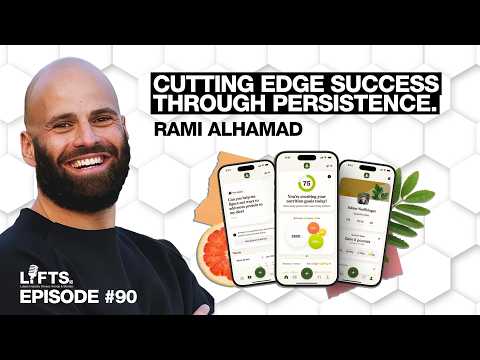
Rami Alhamad, who co-founded the wearable device PUSH and successfully sold it to WHOOP, shares the story behind starting his new AI nutrition management app 'Alma' and the insights he gained along the way. From his philosophy on 'persistence' and 'timing' as keys to startup success, to Alma's strategy of naming ChatGPT as a competitor and using AI to eliminate the friction of nutrition tracking, this episode goes deep. Through critical perspectives on Oura Ring's recent patent lawsuits and Nike's branding strategy, the discussion emphasizes that 'product essence' and 'offline community' -- rather than technology alone -- will be at the core of the future fitness industry.
1. Persistence and Decision-Making: A Founder's Fundamentals
This episode features Rami Alhamad, who has led the hardware and data space in the fitness tech industry for over a decade. He co-founded the strength-measuring wearable 'PUSH,' sold it to WHOOP in 2021, and is currently CEO of the AI-based nutrition management app 'Alma.'
Early in the interview, Rami discussed the Benjamin Franklin quote on his LinkedIn profile -- "Energy and persistence conquer all things" -- emphasizing the entrepreneurial spirit. He said founders can't always make the right decisions and will make countless mistakes, but what ultimately matters is the 'persistence' to endure tough times.
He also applies Amazon's Jeff Bezos framework of distinguishing between 'reversible decisions' and 'irreversible decisions' in his decision-making process. If a decision is easily reversible, don't waste time -- just execute quickly.
"People sometimes think that as an entrepreneur or founder, you always have to be right. But the reality is you're probably making countless mistakes every day. The key is persistence. Enduring the tough times and continuing to push forward."
2. The Birth of PUSH and Startup Timing
In his twenties, Rami was a total "gym rat" who felt a strong desire to quantitatively measure his performance during strength training. At the time, elite Olympic athletes were doing velocity-based training with expensive equipment, but there was no solution for regular people. Watching weightlifting movements, he had a realization: "This is just a massive physics problem (weight x distance)" -- and developed PUSH using smartphone sensors to measure it.
He particularly emphasized the importance of 'timing' in startups. PUSH arrived slightly early to the market, but fortunately not too early to survive.
"I still remember what my mentor told me. There are three phases of startup timing: too early, just early enough, or too late. I didn't know it at the time, but I was internally praying 'please don't let it be too early.'"
3. The Art of the Exit: From PUSH to WHOOP
In 2021, Rami sold the PUSH he had built to wearable giant WHOOP. On the much-debated question of 'when to sell,' he advised that if you're running purely toward an exit from the start, results often suffer. He considered multiple options including B2C expansion and technology licensing before determining that the WHOOP acquisition was the best fit.
More than anything, his personal reason for deciding to sell was a 'thirst for learning.' After spending eight years in the strength measurement space, he felt he had reached the limits of what he could learn and needed a new challenge.
"After running PUSH for eight years, I felt I had reached the ceiling of learning in this space and industry. So I wanted a fresh, new challenge where I could go back to being a beginner, learning and exploring while solving completely different problems in the same domain."
4. From Hardware to AI Nutrition Management (Alma)
After leaving WHOOP, Rami intended to take a break but couldn't resist the massive wave of AI. Initially, he considered starting a MedTech company around cortisol (stress hormone) measurement sensors, but realized regulatory barriers like FDA approval were too high. Instead, he turned his attention to problems in 'Nutrition Tracking,' a field he had personally used for years.
Existing apps like MyFitnessPal have millions of downloads, but 70-80% of users quit within two weeks. The biggest reason? "Logging is just too tedious." Rami was convinced that large language models (LLMs) could dramatically improve this process.
"I realized this AI wave was too massive to just let pass. (...) Existing players will try to slap AI onto their existing products like putting on lipstick, but I knew that if you design from scratch with AI as the top priority, you can build a product 10x better."
5. The Competitor Isn't Nutrition Apps -- It's ChatGPT
Rami declared that Alma's competitor isn't existing nutrition management apps but ChatGPT. While Sam Altman (OpenAI CEO) dreams of one all-encompassing 'super app,' Rami believes that deeply specialized 'expert-type AI' will win.
ChatGPT is strong for general questions, but it's hard for it to proactively make contextual suggestions that account for an individual's eating habits, taste preferences, and micronutrient status. Alma's goal goes beyond simple logging -- it aims to intervene at the moment users decide what to eat, helping them make optimal choices.
"I don't see MyFitnessPal as our number one competitor. I actually think ChatGPT is our number one competitor. (...) We want to be the interface where food decisions are made."
6. Oura's Patent Wars and Nike's Branding Crisis
The latter part of the interview turned to industry issues. Regarding Oura Ring's recent patent lawsuits against competitors, Rami took a critical view, saying "if you're spending time on lawsuits rather than innovation, that's not a sustainable long-term strategy." Hardware form factors can be copied by anyone, so ultimately software-side innovation like algorithms and data interpretation capabilities should be the real moat.
They also discussed Nike's new slogan "Why do it?" All three speakers, as longtime Nike fans, expressed disappointment at Nike losing its innovative edge and ceding market share to brands like Hoka and On.
"If you're spending time suing and chasing companies for patent infringement, you're in a position where you should be thinking much more about 'how to innovate' rather than chasing lawsuits."
7. The Future Is in 'Offline Community'
Rami predicted that brands should focus more on offline community (IRL: In Real Life) rather than online presence going forward. As information floods the internet and it becomes impossible to distinguish what's real, people will grow fatigued and return to real-world meetups and activities. This is why Alma partnered with the fitness race Hyrox.
"For brand building, I think the more conviction-building direction for the next few years is 'do less online, do more In Real Life.' (...) People will start distrusting everything online and eventually return to offline."
Closing
This episode provided deep insights not just on technology, but on the essential direction brands and products should take in a changing era. Host Mo summarized the interview with the phrase "Slogans don't save companies. Products do." -- emphasizing that even in the AI age, only 'overwhelming product excellence' is the key to survival.