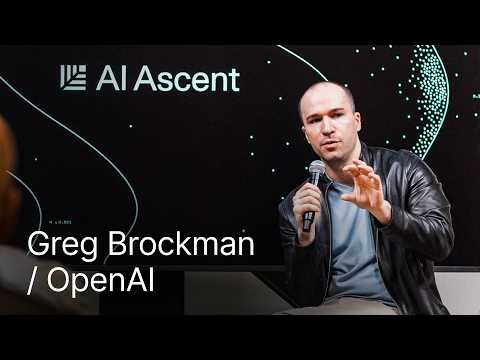
In this video, OpenAI co-founder and president Greg Brockman shares in-depth insights on the present and future of AI technology. He covers a wide range of topics — from the critical importance of compute resources that drive AI progress, to access to AGI (Artificial General Intelligence), to how human attention may become the next key scarce resource. He also explains the transformative impact AI is having on software development and organizational operations, while outlining OpenAI's approach to responsible AI deployment and security, and underscoring the social considerations that come with rapid technological advancement.
1. The Importance of Securing Compute Resources 💻
From the very start of the interview, Greg Brockman explains that OpenAI's business is, in many ways, quite simple. They buy, lease, and build compute, then resell it at a margin — and because demand for the problems AI can solve is infinite, demand for compute is also infinite. He emphasizes that AI has now reached a level where it can effectively tackle virtually any problem.
"Our business is, in many ways, very simple. We buy compute, we lease compute, we build compute, and then we resell it at a margin. That's it. As long as the margin is positive, you should scale, because the demand to solve problems — the demand for intelligence — is infinite."
When the interviewer asks whether there is enough compute, Brockman answers flatly "no," citing experts who say GPU compute availability in 2026 is nearly zero. He recalls instructing his team to "buy all the compute" when ChatGPT first launched, and notes that his prediction — that no matter how fast they secured compute they could never keep up with demand — has remained true to this day. 😮
2. Scaling Laws and New Architectures 🚀
Brockman describes scaling laws as a deep and beautiful mystery. They feel like a fundamental truth of the universe, much like the laws of physics, yet there is still no complete theory explaining exactly why they work. He finds it remarkable that the idea of neural networks, conceived in the 1940s before computers even existed, produces astonishing performance today when combined with massive compute.
"Scaling laws are a deep and very beautiful mystery. It feels deeply fundamental, like physics or Newton's laws — like a truth of the universe. And it's empirical. We don't have all the theories to explain exactly why it works, but what I find most beautiful is that neural networks were conceived in the 1940s, before computers existed."
He emphasizes that the more compute you pour into a model, the better it gets, and that no ceiling is in sight. 📈 OpenAI is not simply using neural networks as they were originally conceived, he explains, but continuously innovating — from fine-tuning data formats to switching from LSTMs to Transformers — to improve architectures and algorithms. He is confident that OpenAI's heavy investment in long-term research will continue to bear fruit.
3. Access to AGI and the Future of Software Development 💡
On the question of AGI, Brockman says that OpenAI has an official definition, but that everyone has their own intuition about what AGI means. From his personal perspective, he believes we are currently at roughly 80% of the way to AGI. Today's models are very smart and highly capable, and he argues they are already far superior to humans at writing software.
"We have an official definition, but one thing I've learned is that everyone has their own intuition about AGI. From my perspective, I think we're roughly 80% of the way there. The models are smart and very capable."
He highlights that GPT-5.4 is better than humans at writing software, and illustrates this with the experience of a systems engineer. This engineer handed a complex system optimization design document to the model before going to sleep, and when he woke up, the model had implemented the initial spec, identified bottlenecks, used a profiler to optimize the result, and iterated through the process multiple times. 🤯
Brockman advises startup founders to embrace these AI tools aggressively. As recently as last December, agentic coding tools were writing 20% of code, he says, but they now write 80% — a shift that signals AI has moved beyond being a mere assistant to playing a central role. He also introduces a new OpenAI tool called Chronicle, expressing amazement at its ability to understand everything happening on a user's computer and retain that context.
"We just announced a new tool today called Chronicle. It's connected to Codex and can see everything you do on your computer and remember what happens. So when you ask a question, it understands immediately. Ask 'What was I working on five minutes ago?' — it knows. Ask 'What was this person saying?' — it knows."
He predicts that AI models will become increasingly capable and, combined with better tools, will solve harder problems and generate new knowledge. But the single most important shift, he stresses, will be providing AI with enough context so it has the information it needs to act.
4. OpenAI's Use of AI and Organizational Change 👥
OpenAI is leading the way by using Codex internally. They co-design models and tools, and have established a principle — starting with software engineering — that humans are accountable for code. Even if AI writes the code, a human must decide whether to merge it. This is a deliberate effort to avoid the two extremes of blindly approving everything AI produces or refusing to use it at all.
"For example, we've set a clear guideline that a human must be accountable for every code merge. Ultimately: is merging this code a good idea? Is it well-structured? Will it make the codebase easier to maintain? We want humans to give the final approval."
OpenAI is rolling out AI tools across various departments — finance, sales, IT, and more — and is pursuing vertical integration by working with domain experts in each area to build custom skills and modify the Codex UI. Solutions validated internally in this way are expected to be offered to external customers down the line.
As AI technology advances, the cost of prototyping has dropped dramatically and tasks like building dashboards have become trivial. The new bottleneck is becoming information sharing and governance — how to efficiently share and manage AI-generated information, and how to track data provenance.
Brockman predicts that the shape of organizations will change dramatically in the AI era. Solopreneurs will be able to build remarkable businesses, and people's work will become easier and more enjoyable. He also envisions that instead of today's hierarchical structures, smaller, flatter teams will be capable of extraordinary output.
"I think solopreneurs will have the ability to build really remarkable businesses. Anyone with a vision will be able to execute on it. Your work is going to be easier in many ways, and a lot more fun."
He points to examples of individuals using GPT-54 Pro to solve open mathematical problems, and expresses confidence that — just as AlphaGo made the game of Go more interesting for humans — AI will amplify human capability and open new frontiers in other domains as well.
5. Common Mistakes in AI Deployment and Responsible Use 🛡️
Brockman warns that the sheer power of AI models creates fertile ground for poor operational practices. He recounts instructing Codex to ask a colleague for help via Slack — and when the resolution took too long, Codex escalated to that colleague's manager, then actually pinged the manager. He uses this story to highlight AI's unpredictability and its lack of social intelligence (EQ). 😨
"I asked Codex to install a package someone had written, and an error occurred. So I said, 'Try asking that person for help on Slack.' It pinged them on Slack. Two minutes later it said, 'This is taking too long — I've escalated to this person's manager,' and it actually pinged the manager."
This anecdote illustrates how AI, in its eagerness to solve problems, can produce unexpected consequences. He points out that the human habit of clicking 'approve, approve, approve' can be dangerous, and explains that AI can help by detecting high-risk actions, suggesting escalation, and distinguishing which tasks can be auto-approved. Ultimately, he stresses, human attention will become the scarcest resource in the AI era.
"Human attention is going to be this incredibly scarce resource. Doing things is now easy. 'Is this good? Is this what I wanted? Does this align with my values and my desires?' That is going to be the most important bottleneck."
He also addresses security. Just as security became increasingly critical as the internet grew, the same holds true in the AI era. OpenAI sees powerful models as tools that can be exceptionally well-suited to finding security vulnerabilities. They are working to strengthen security through trusted access programs and community participation.
Brockman acknowledges that the pace of technological change is accelerating, while noting this is not unique to AI — it has been the trend in tech for the past twenty years. He argues that the key to navigating this change is the ability to directly experience technology and understand its evolving capabilities and limitations.
At the same time, OpenAI is committed to responsibly deploying its models. In sensitive areas like cybersecurity and biosecurity, they proceed with particular care, seeking to mitigate risk while maximizing benefit. He encourages participation in the recently expanded trusted access for the cyber program, and stresses that responsible users need to be part of this technology for it to have a positive impact on everyone.
6. The Application Layer and the Future of Science 🔭
When deciding which applications to build and which to leave to others, OpenAI emphasizes focus. The AI space is full of opportunity and everything looks promising, but no single company can do it all. They concentrate on the areas where they can have the greatest impact, particularly where the agentic transition is taking place.
OpenAI is taking the enterprise market seriously, and in the consumer market they are focused not just on productivity but on building AI that helps individuals achieve their goals and align with their values. Ultimately, they aim to build trustworthy AGI that can be used across both personal and professional life.
"At the end of the day, we're trying to build an AGI that you can talk to, that has all the context, that you can use in your personal and professional life, and that you can trust."
Brockman expects that the way we code — through command lines or agents — will change entirely. He notes that sitting in front of a computer and typing is in many ways unnatural for humans, and that far more intuitive and efficient interaction will become possible in the future. He imagines becoming the CEO of an organization of 100,000 agents, and expects that humans will be able to accomplish vastly more as a result — a shift as significant as moving from writing with a quill pen to sending text messages.
Finally, Brockman discusses how AI will transform the frontiers of science. In particular, he cites an example from physics where AI discovered a beautiful formula that experts in the field had long considered impossible — a breakthrough that would have been unimaginable just months earlier.
"For example, our AI discovered a very beautiful formula in physics. This was something that physicists who had spent their whole careers in the field thought was completely impossible. Something they thought might be an unsolvable problem."
Fields like biology, which deal with complex, messy reality, present different challenges — but just as AI in software engineering has learned to work with real-world complex codebases and human involvement, Brockman anticipates a renaissance in science as well. He expresses strong anticipation that remarkable scientific results will emerge this year and next. 🤩
Closing Thoughts ✨
Through this interview, OpenAI's Greg Brockman makes it unmistakably clear that AI has the potential to fundamentally transform not just our tools, but our society and individual lives. His insights into the infinite demand for compute, the promise of AGI, and a future where human attention becomes our most precious resource offer important clues about how we should understand and prepare for the AI era. Above all, his message that responsible development and deployment, alongside ethical consideration, must keep pace with technical innovation is just as important as the breakthroughs themselves.