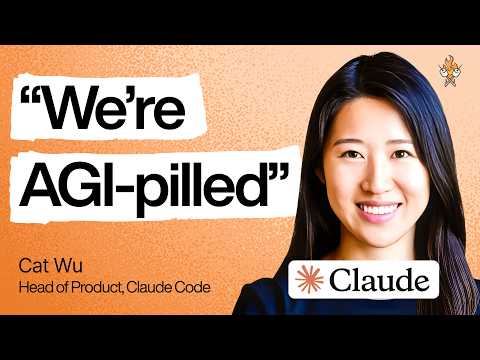
This video features a deep conversation with Cat Wu, Head of Product for Claude Code and Cowork at Anthropic, covering how Anthropic's product team ships faster than anyone else, and what new capabilities product managers need in the AI era. Cat Wu explains Anthropic's unique approach to calibrating the pace and direction of product development to match the rapid advancement of AI technology, and how combining human judgment with AI's potential drives innovation. This summary covers Anthropic's secrets to rapid growth, the evolving PM role, and real-world examples of using Claude Code and Cowork.
1. Anthropic's Secrets to Fast Growth and the Changing PM Role
Anthropic's Cat Wu appeared on Lenny's Podcast to explain how Anthropic's product team ships so much faster than other companies. She emphasizes that Anthropic's product team has compressed product development timelines from six months to one month, sometimes one week or even one day, keeping pace with the rapid advancement of AI technology. This speed, she says, is driving a major shift in what it means to be a product manager.
Having interviewed hundreds of PMs, Cat Wu noted that many misunderstand the PM role in the AI era. Previously, technology changed slowly — planning happened in six-to-twelve-month increments, and because coding was expensive, PMs spent a lot of time coordinating with other teams before launching features. Now, AI has dramatically accelerated engineering velocity and model capabilities are improving rapidly, so PMs need to focus on how to ship the fastest and get user feedback, rather than managing multi-quarter roadmaps.
"The PM role is changing a lot. It's changing really fast. The most important thing about building AI-native products is fast iteration. You need to find a way to ship features every week."
Anthropic enables rapid shipping through the following:
- Clear goal-setting: Because LLMs are too general-purpose, it's critical to clearly define who the product is for, what problem it solves, and what the core use cases are. For example, a goal like "help professional developers safely achieve zero permission prompts in enterprise environments" eliminates many potential approaches and sets a clear direction.
- A repeatable launch process: Claude Code ships nearly every feature as a Research Preview, allowing users to give feedback on early ideas. This reduces the burden on the product team and enables shipping features within one to two weeks.
- A tight collaboration framework: A tight process between engineering, marketing, and documentation ensures that once a feature is ready it can launch quickly. Engineers post features to the Evergreen Launch Room, and marketing and docs finish launch prep the next day.
Cat Wu also explained how PRDs and roadmaps have evolved at Anthropic:
- Rigorous metrics reviews: Every week the entire team reviews metrics to deeply understand every aspect of the business — goals, progress, and the factors affecting whether targets are being hit.
- Team principles: A list of team principles — including who the core users are and why — lets every team member understand the business and priorities and make their own decisions without needing to involve a PM or other stakeholders.
- The role of PRDs: Not every feature gets a PRD, but for especially ambiguous features, a one-page PRD capturing goals, compelling use cases, and the problems to solve is helpful. Longer infrastructure projects spanning several months still get PRDs as well.
2. The Mythos Model, Anthropic's Launch Velocity, and PM Team Structure
Anthropic released an extremely powerful model called Mythos, which contributed to their rapid shipping pace — but Cat Wu says it's not the whole story. They were already moving fast several quarters earlier, and that comes down to using the models internally as well as "process and team expectations." Anthropic wants everyone to feel empowered to have an idea and put it into the world within a week, sometimes within a day.
"We've streamlined our processes a lot. We want to remove all the barriers to shipping things. We want every person on the team to feel empowered to have an idea and put it out into the world within a week, sometimes within a day."
On the recent leak of Claude Code's source code, she said it was the result of "human error" — it happened despite two human review steps, and Anthropic has since strengthened its processes to prevent a recurrence.
On questions about the policy change around OpenClaw integrations, she explained that demand for Claude is high and Anthropic is working hard on infrastructure scaling and token efficiency improvements. Third-party products like OpenClaw have different usage patterns from Anthropic's first-party products, which meant Anthropic had to prioritize the first-party products and API. Cat Wu added that it was a difficult decision, but they tried to ease the transition by providing some credits with subscriptions for all users.
Anthropic's PM team is roughly thirty to forty people, organized as follows:
- Research PM team: Channels customer feedback to the model research team and manages model launches.
- Claude Developer Platform team: Maintains the API on which Claude Code is built and ships features like managed agents.
- Claude Code team: Owns the Claude Code and Cowork products.
- Enterprise team: Handles cost management, role-based access control (RBAC), and security controls to make Claude Code and Cowork easier for enterprise customers to adopt.
- Growth team: Owns growth across the product portfolio.
3. The Convergence of Engineer and PM Roles, and the Importance of Product Taste
Cat Wu explained that in the AI era, the boundaries between all roles are blurring. PMs are doing engineering work, engineers are doing PM work, and designers are playing PM roles and writing code. She said Anthropic responds to this by "focusing on hiring engineers with exceptional product instincts." This reduces overhead in the shipping process and lets engineers receive user feedback directly and ship products on their own.
"I think all the roles are merging. PMs do some engineering work, engineers do PM work, designers play PM roles and write code. You could hire a lot more engineers with great product sense, or keep engineering hiring the same and hire a lot more PMs to help direct some of the work."
Cat Wu has an engineering background, and she shared that nearly every member of Anthropic's PM team either has an engineering background or writes code directly. This, she says, helps build trust with the team and enables moving fast.
She emphasized that "product taste" is the most important skill. As the cost of writing code falls, "deciding what to write" becomes far more valuable.
"As the cost of writing code gets much cheaper, deciding what to write becomes more valuable. What's the right UX for this feature? What's the most delightful way for a user to experience this? We get tens of thousands of GitHub issues, and there's a lot of care and taste required to judge which of these are worth building and how to build them the right way."
An engineering background will be especially useful in the coming months, she added. People with that background have a better sense of how hard something is to build, which helps with prioritization. Cat Wu noted that the technical landscape is changing so fast that predicting more than a few months out is difficult, and emphasized the importance of "first principles thinking" and a "low ego" — the ability to wear many different hats.
She identified the areas where human brains will remain valuable in the AI era:
- Choosing what to do: Reading market signals and deciding what to prioritize.
- Judging product quality: Assessing whether what's been built is good and correct, and shipping early versions.
- Common sense and EQ: AI models don't yet fully understand all stakeholders, their relationships, and their preferences — that implicit common sense and EQ remains critically important.
4. Maintaining Mental Health in the Chaos, and Anthropic's Culture
Cat Wu also talked about how to maintain mental health amid Anthropic's rapid pace and constant chaos. She said the team is full of people who "lean into the chaos" — they try to meet every challenge with a smile and recognize that getting stressed out will lead to burnout. Anthropic looks for people who can look at a challenge and say, "This will be hard, but I'm excited to solve it."
"Our team is full of people who lean into the chaos. So we try to meet every challenge with a smile, because there's always a lot going on. There are always a lot of risks and tricky situations. So if you get too stressed about something, you'll burn out."
She also stressed that team members need to recognize that "today's P0000 is bigger than last night's P0," get enough sleep, ruthlessly prioritize their time so they can make good decisions next time, and know what to let go of. For example, shipping a feature with bugs is unthinkable for a traditional PM, but at Anthropic it's accepted because they know they can get fast feedback and fix it in the next release.
"But some of what we ship isn't as polished as I'd like. Our top priority is serving professional developers, though. And as long as the product doesn't block the core use case, it's okay if it's not perfect — because we'll hear feedback and fix it in the next release. Shipping a buggy feature used to keep me up at night, but now I've learned to accept it because I know we'll get fast feedback and fix it in the next release."
Anthropic acknowledged that it "sacrifices product coherence" in the name of shipping speed. In the past, when coding was expensive, the full product portfolio was planned carefully and the use cases and integration patterns of each product were defined in advance. But with AI's rapid pace and the volume of ideas to test, features sometimes overlap. This can confuse new users, but Anthropic views it as "the price of shipping a lot of features" and notes that more effort is needed to help users understand core features and best practices.
Cat Wu mentioned that users feel burdened by having to check Twitter every day just to keep up with the rapidly changing AI ecosystem, and said the goal is to make it so "when users open the product, the tool teaches itself or shows them what they want, so they feel comfortable." The recently launched /powerup command is one such effort — it walks users through the product's core features and how to use them, reducing the confusion users feel.
5. The Secrets to Anthropic's Success: Mission Alignment and Focus
Cat Wu named two things as Anthropic's secrets to remarkable success. The first is a "unifying mission."
"The two most important things are, first, this unifying mission. It's hard to describe how important this is. We hire people who care most about bringing safe AGI to all of humanity. And this is something we frequently reference in decisions about what the entire product portfolio should focus on."
Anthropic puts its mission of delivering safe AGI to all of humanity at the top of every decision. Because this mission sits above any individual product line, the entire organization can make and execute decisions quickly and in a unified way. If two competing priorities arise, the team discusses which matters more for Anthropic's mission, makes the call, and every team member follows through. This sometimes means delaying the launch of individual products like Claude Code.
The second secret is "focus." Cat Wu explained that the mission makes team members willing to sacrifice their own goals and key results for Anthropic's overall goals and KRs.
"The mission means the team is willing to sacrifice their own goals and KRs for Anthropic's goals and KRs. And people willingly accept those trade-offs. For example, if Claude Code failed but Anthropic succeeded, I would be very happy. And our whole team willingly makes decisions that follow that line of thinking."
She explained that the OpenClaw policy change was also a decision made in service of Anthropic's mission to expand the number of users it reaches. Anthropic prioritizes reaching users through its first-party products and API, which sometimes means sacrificing support for third-party products.
6. How to Use Claude Code, Desktop, and Cowork — and the PM's AI Stack
Cat Wu gave a clear explanation of when and how to use Claude Code, Desktop, and Cowork:
- Claude Code (CLI): Primarily used to start one-off coding tasks in the terminal. It's the most powerful tool, where the latest features land first.
- Claude Code (Desktop): Useful for frontend work or when you want to use preview functionality while building web apps. It provides a more intuitive graphical interface for non-technical users compared to the terminal, and also serves as a one-stop control panel where you can see all sessions (CLI, web, mobile) at a glance.
- Claude Code (Web & Mobile): Lets you start work on the go without a laptop.
- Cowork: Used for any task that produces non-code deliverables. Connect Slack, Gmail, Google Drive, and other context sources, and Cowork efficiently handles a wide range of non-coding tasks: organizing email, building slide decks, writing documents, and more.
Cat Wu shared her experience of creating a twenty-page presentation overnight using Cowork. She connects her Google Calendar, Slack, Gmail, and Google Drive to give Cowork all the information it needs. She provides the narrative arc she wants and her existing slide assets, and Cowork gathers relevant information, uses the design system, and produces a high-quality draft presentation.
"I told Cowork the story I wanted to tell. And Cowork actually worked for an hour. It searched Twitter to see what we'd launched, searched the Evergreen Launch Room, searched the Claude Code announce channel where our team posts demos showing the most value people have gotten from Claude Code. And it synthesized all of that into the twenty-page slide deck I saw this morning."
Cat Wu emphasizes that through this process, the PM role remains essential. Claude is a brilliant brainstorming partner that can rapidly synthesize vast amounts of information and surface every possibility — but the final call on what belongs in the final product is still the PM's job.
Her personal PM tech stack is mainly Claude Code, Cowork, and Slack, which is Anthropic's core operating system. She spends a lot of time stress-testing Cowork's limits and understanding why the model makes certain mistakes. Inside Anthropic, Claude Code has enabled a wave of personalized work software development — employees are building custom apps for their own specific use cases. One sales team member, for example, built a web app that automatically pulls in customer information and generates customized pitch decks instead of manually recreating them each time.
The team with the highest token consumption at Anthropic is engineering — but the second-highest is the Applied AI team. Because they help customers adopt Anthropic's API, prototype solutions for customers, and handle customer communications and record-keeping, they use both Cowork and Claude Code heavily. They use Cowork to summarize relevant information before customer meetings, find answers to questions, and build their own workflows to share with teammates.
Cat Wu noted that as models improve, "the cost of knowledge work per token increases" — people are delegating more work to models and spending more time in AI tools. Anthropic trusts its internal teams to develop as fast as possible and to use tokens responsibly.
7. New Skills PMs Need in the AI Era and the Product Vision
On new skills PMs need in the AI era, Cat Wu named "the ability to define what the product should look like one month from now" as the hardest. In a world of uncertainty about model capabilities and user behavior shifts, the best PMs spot patterns in how users are "abusing" the limits of existing products, set a clear direction, execute consistently, and can change course when model capabilities turn out to be much better or worse than expected.
"The hardest skill is the ability to define what the product should look like in a month. There's a lot of uncertainty about model capabilities and changes in user behavior over that period. But the best PMs can see patterns in how users 'abuse' the limits of existing products, set a direction and execute steadily, and change course if model capabilities are much better or worse than originally expected."
She pointed to the difficulty of "getting too AGI-pilled." It's easy to imagine a future where the model can do everything, but the real challenge is figuring out how to extract maximum capability from the current model, how to guide users down the right path, and how to leverage the model's strengths while compensating for its weaknesses.
She suggested the following ways to develop these skills:
- Spend a lot of time talking to and using the model: When the model behaves unexpectedly, ask it to reflect on its own behavior and explain why it did what it did. This helps you understand issues with the system prompt or the model's reasoning process, and how to improve them.
- Identify users who give accurate feedback: It's important to find a small group of users who can give precise and reliable feedback on the model. Anthropic team members also share each other's feedback when testing new models to understand strengths and weaknesses.
- Build evals: You don't need to create hundreds of evaluations for usefulness — even ten great evals can be critical for helping the team quantify goals and understand progress and gaps. She called evals an underrated PM skill, saying PMs should build evals directly for product-definition features to understand goals, success rates, and where to improve.
Cat Wu stressed that Claude's "character and personality" are critically important to Claude's success. People like Amanda who shape Claude's character play an ambiguous but vital role and have strong convictions about what Claude should be. Users love Claude's "bright and cheerful yet highly capable" quality and its "low-ego and positive" attitude. Claude saying "I'm really sorry about that, thanks for letting me know, I'll fix it" when something goes wrong, or "That's okay, let's start this way — would you like me to get started?" when facing a hard task, are qualities of a great colleague.
New model launches often lead to product changes — and counterintuitively, this often means "removing features that are no longer needed." Features that were added to compensate for earlier model limitations (like a to-do list) get removed when the model becomes smart enough to handle those things on its own.
"A lot of what new models bring is removing features we no longer need. Often we add features to the product to compensate for model limitations, because the model doesn't naturally do that task on its own. The classic example of this is the to-do list."
On the other hand, new models also unlock entirely new features. For example, a code review product couldn't be shipped with past models because accuracy wasn't sufficient — but with recent models like Opus 45, 46, and Sonnet 4.6, it's now possible to offer trustworthy code reviews, and teams are now relying on them before merging PRs. This is a good example of Cat Wu's strategy of "building a product that doesn't quite work yet and waiting for a new model to close the gap."
The vision for Claude Code and Cowork starts with improving the success rate of individual tasks, then — as models get smarter — handling multiple tasks simultaneously, and ultimately running hundreds of cloud tasks in parallel. Building the infrastructure to manage work remotely, identify critical tasks that need human review, have agents accurately verify task completion, and continuously learn and improve from user feedback is Anthropic's vision.
8. Advice for Thriving in the AI Era
Cat Wu offered the following advice for succeeding in the AI era:
- Delegate repetitive manual work to AI: AI can handle tedious tasks for you, learn your preferences, and automate them. This lets you focus on creative work and get more done.
- Push automation to 100% success rate: Automation that works at 90–95% accuracy isn't true automation. Invest the time and effort to get that final 5–10% and build automation you can fully trust.
- Build apps you actually use every day: Rather than prototypes or one-off apps, build apps you use daily to experience AI's real value and keep learning.
- Don't get lost in over-customization: Customizing workflows can be fun, but it's important to stay balanced so you don't drift from your core goals.
"AI gives everyone much more leverage than before. So whenever you notice you're doing a manual task multiple times, I'd encourage you to think about how to automate it using Claude Code, Cowork, or another AI tool."
She also highlighted that while the 2024 generation of AI products was chat-based, the Claude Code generation of products is "action-based." The true "aha moment" comes when Claude can act directly on your behalf, she explained — and that's what shows AI's real power.
9. Lightning Round
Recommended books:
- "How Asia Works": A story about economic development and the policies and governments that create successful economies.
- "The Technology Trap": A historical examination of how the Industrial Revolution and the computer revolution affected workers.
- "Paper Menagerie": A short story collection about growing up, AI, and self-discovery.
Recently inspiring movies / TV shows:
- "Drive to Survive": Left a strong impression for the sheer passion around F1 engineering goals.
- "Free Solo": Alex Honnold's rope-free ascent of El Capitan. The extreme focus and pure achievement were deeply moving. (Cat Wu is a climber herself.)
Favorite recently discovered product:
- Waymo: Autonomous ride-hailing. Highly valued for the ability to take work calls or be productive without a driver — saves thirty minutes.
Personal motto:
- "Just do things": Clarify the right course of action from first principles, then act without hesitation and learn from mistakes. Especially important in the AI era, where role boundaries are blurry.
Favorite Claude "thinking word":
- Manifesting: A positive framing around the process of making goals real.
What she wants to do in the AGI era:
- Helping guide the world through the transition: AGI will take time to spread across society, and she wants to focus on helping with that transition.
- Rock climbing: Enjoying climbing at places like Fontainebleau in France.
- Reading and learning: Going deep on fields she doesn't yet know — physics, robotics, hardware, aerospace.
Conclusion
The conversation with Anthropic's Cat Wu offered invaluable insight into how companies can innovate fast in the AI era, how the PM role is evolving, and how individuals can thrive. Anthropic's success comes down to clear mission alignment, rapid execution, and attracting versatile talent with both product taste and common sense. Particularly striking was the strategy of "building a product before it fully works and waiting for a new model to close the gap" — staying flexible as AI models advance.
As AI automates repetitive work and gives humans the opportunity to focus on creative domains, individuals should actively embrace these tools, push automation to 100% completion, and build apps they actually use every day to maximize the value of AI. Like Cat Wu's motto — "just do things" — the key to success in the AI era is bold action and relentless learning.