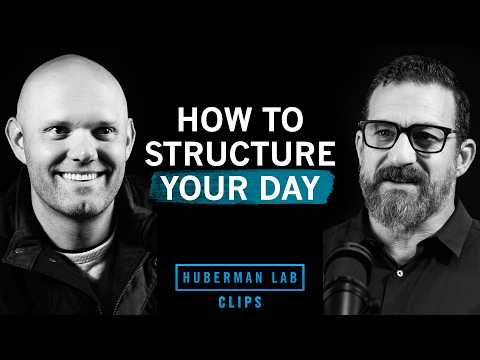
James Clear and Dr. Andrew Huberman discuss why the order of habits matters as much as which habits you choose. Exercise, reading, and writing form a stack where each one fuels the next. The conversation also touches on why "T-shaped" expertise — broad reading anchored to one deep specialty — is the engine of creative connection.
1. Timing and Control Over Your Day
Clear emphasizes timing and sequence. The earlier in the day a habit happens, the more likely it is to actually happen — because as the day unfolds, other people's plans, emergencies, and small interruptions accumulate.
But the right time is personal. The question isn't whether you have enough time, but how much of your time you can control. Someone without kids might meditate at 7 a.m.; a parent of small kids cannot. Identify the hours that are reliably yours and place your important habits there.
2. The Three Core Habits That Make a Good Day
Clear's daily anchors are simple: exercise, reading, and writing. Even if it's only five minutes of reading or one sentence of writing, the streak matters.
Among the three, exercise is the linchpin. Reading and writing both come more easily after exercise, thanks to the mental clarity and energy it provides. Huberman adds the science: exercising in the first three hours after waking — or roughly 11 hours before bed — aligns with cortisol rhythms, helps daytime cortisol stay low, and supports sleep and mood.
3. Reading and Writing: A Two-Way Synergy
Clear's writing got harder, not easier, as he wrote more. The reason: he was reading less. Writing depletes the well; reading refills it.
"Almost every thought you have is a result of what you consume."
He compares writing and reading to driving and refueling. The point of having a car isn't to live at the gas station, but you can't go anywhere if you never refuel. To write well, especially on a specific topic, the most reliable input is reading deeply on that topic until ideas push their way out.
4. T-Shaped Expertise and Creative Connection
Huberman likens Clear's behavior to a child who watches baseball and immediately runs outside to play — consumption flowing directly into creation. Many creators have a similar "warm-up" act: Joni Mitchell painted before she wrote songs.
Clear formalizes this with the T-shaped expert model: broad in many domains (the horizontal bar) but deep in one (the vertical). Most people focus on the horizontal — they keep reading widely. The real leverage is the vertical: a clear specialty or current project that acts as an anchor. With that anchor, every podcast, article, and conversation becomes a potential connection point.
"Creativity is rarely a brand-new idea. It is mostly the synthesis of two things that hadn't been connected before."
Conclusion
The framework: identify your controllable hours, stack core habits early, exercise first to fuel the rest, read to fuel writing, and keep one specialty deep enough to act as a magnet for ideas you encounter elsewhere. Order is the multiplier.