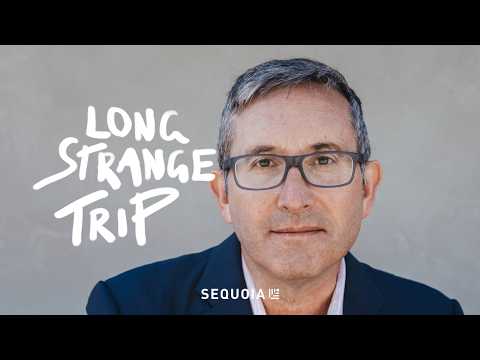
This video features a deep conversation with Tom Hale, CEO of Oura Ring, covering the realities of the CEO role and the challenges of scaling a company. It focuses especially on the pitfalls and solutions that emerge during the "messy middle" of growing from 200 to 2,000 people, while sharing insights into Oura Ring's subscription model transition, partnership strategy, and the hardware business. The hard truths and rewards of being a CEO, as well as the key elements of successful leadership, are explained in a candid and accessible way.
1. How He Ended Up on the CEO Path — and What It Cost Him 🚶♂️
The conversation opens with Brian sharing a story from his own past. Four years ago, Brian was in a snowmobile accident in Woodstock, Vermont — a near-death experience that led him to decide to make a major change in his life. One of those decisions was to stop being a CEO.
"I was on a snowmobile and went off a cliff. The snowmobile was destroyed, my son and I were destroyed. I was convinced we were both going to die that night. And I sat there thinking, 'I need to make some big changes in my life.' The biggest of those was, 'I don't want to be a CEO anymore.'"
Tom Hale, by contrast, pursued the CEO role in his early fifties — driven by a sense of challenge and a personal bucket list item, after years of working as a corporate executive.
But he confessed that being a CEO was far harder than he had expected. The biggest burden, he said, wasn't the work itself — it was the weight of responsibility and stress. There were many moments of waking up at 4 a.m. wondering whether things would work out, and a constant sense of pressure knowing that board members, employees, and customers were all counting on him.
"It was harder than I thought. Any CEO in the world will agree with you. It's much harder. Much harder than I thought." "It's not the work that's harder. It's the accountability and the stress. It's waking up at four in the morning going, 'Oh shit, is this going to work out? And what's it going to take to make it work?' That's the pressure, that's the stress, that's the accountability. You have all these people — the board, the employees, the customers — they trust you. And you have to carry that. There's a saying, 'the buck stops here'? It really does."
Brian echoed this, sharing that during his time as HubSpot CEO he experienced panic attacks at the thought of 100 employees depending on him. Tom Hale noted that people tend to think of a CEO's life as far more glamorous than it is — that the glory of success goes to the team, while the blame for failure lands squarely on the CEO. He compared the CEO to a ship's captain: when things are going well, your job is to worry about what could go wrong; when everything is terrible, your job is to hold out hope.
"I think people think being a CEO is a lot more fun than it actually is." "No. I don't think so. It is fun. There are parts that are fun. But the ratio of kibble to caviar is much higher." "When you participate in a failure, the failure is yours. Because in many cases, it was your decision or your directive or the system you set up." "I called it the 'shit umbrella.' You have to absorb all the shit that rains down on the company." "My analogy is this: you're on a ship. And if the ship is sailing along beautifully, your job is that while everybody else is going 'hey, this is all great!' you're over here saying 'everything is terrible, we need to be thinking about that.' And vice versa. When everything is terrible, you go to the other side of the ship and say, 'Hey guys, there's light on that horizon. Where we're going is going to be great. It might feel terrible right now, but we need to get there.'"
2. CEO Leadership Philosophy and Company Culture 👨🏫
Tom Hale named Steve Jobs, Gandhi, and Maya Angelou as his mentors, with particular emphasis on Maya Angelou's quote: "People will forget what you said, people will forget what you did, but people will never forget how you made them feel." He argued that positively influencing employees as a leader is essential, and that unintended consequences are the greatest risk a leader faces.
"Steve Jobs would definitely be in there. He was a hero I admired. He was the person who saved Apple from ruin. And he was a champion of creative professionals." "Gandhi — not as a CEO, but partly as a leader of a people, and because humility is a value that matters to me personally and to CEOs. So Gandhi would be in there." "Maya Angelou — not because she was a great CEO, but because she said something I really believe: 'People will never forget how you made them feel.' And as a leader, unintended consequences are actually the biggest risk — not intended consequences. And if you make people feel things you didn't intend, that can be deadly for a company."
Asked about the trend of founders adopting Elon Musk's 996 work philosophy (9 a.m. to 9 p.m., six days a week), Tom Hale said he works at a similar pace himself — but emphasized that time for recovery and reflection is non-negotiable. Since Oura Ring makes products for health, he said the company never loses sight of the importance of rest and recovery for its own employees.
"If you work 996 or whatever your version of it is, but you exclude being thoughtful, recovering, being in a good mental place — if you're constantly anxious, constantly in motion, leaving no room for any kind of recovery or reflection — I think you're probably not doing it right." "At Oura, through our products we help people be healthier and find mindfulness and recovery in their lives. When I first joined, we needed to perform, but at the same time we never lost the value of the importance of rest and recovery. I think it's important to find that balance."
3. Finland and the U.S. — Two Cultures in Harmony 🌍
Oura Ring started in Finland, and today the company is split roughly evenly between Finland and the U.S. Tom Hale says the two cultures are very different. Finnish employees are accustomed to a socialist, flat, non-hierarchical culture, while American employees are far more capitalist in their orientation.
"Finland has traditionally had a very socialist, non-hierarchical society. So I go to Finland, and they're like, 'We're going to do sauna.'" "Americans are clearly very capitalistic creatures, and Finns are much more socialist. We talk about how you manage those two cultures."
He emphasized that this cultural diversity actually makes the company stronger. Rather than a single monolithic culture, two cultures coexist — cross-pollinating ideas and pushing each other forward.
After the COVID pandemic expanded remote work, Tom Hale said he worked hard to create opportunities for employees to connect in person. He supported teams staying together for immersive retreats, and personally used Slack to give direct feedback on employees' work — building a non-hierarchical communication culture throughout the organization.
"Culture starts and ends at the door. Finnish culture is genuinely different from American culture. And what makes the company strong is that these cultures can coexist and cross-pollinate, stimulating each other and spreading ideas. They're not one single culture — they're two cultures that generate ideas and activity in different ways. Honestly, I think that's one of the things that makes the company good. Having diverse cultures and perspectives." "Creating a non-hierarchical culture — one unconstrained by time, geography, or role — is genuinely powerful."
4. The Golden Zone for Growth: 200 to 2,000 People 🚀
Tom Hale says the 200-to-2,000-person stage is the most exciting phase for a company, because at that scale a CEO can still communicate directly with every employee and have real influence. Beyond 2,000, you're managing managers who manage managers, and the CEO's direct impact diminishes.
The biggest risks in this middle stage, he said, are what Steve Jobs called the "bozo influx" — mediocre people entering the organization — and the creep of bureaucracy. His advice to guard against this:
- Prevent bozos: Identify and address employees who have enthusiasm but lack the competence or commitment to deliver, early.
- Preserve passion: Don't let the founding energy, spirit, and sense of mission that got you to 200 people fade away.
- CEO visibility: It matters that the CEO shows direct interest in what employees are working on and gives real feedback.
"Steve Jobs famously said, 'Bozos come.' They do come. If you can preserve that passion, spirit, and sense of mission across 200 to 2,000 people, that's the most exciting time in a company." "Between 200 and 2,000, I as CEO can still directly communicate with and influence those 2,000 people."
He also introduced the fascinating concept of "the asymmetry between work and people":
- Startup: More work than people — you have to be ruthlessly selective about what to focus on.
- 200–2,000 people: More people than the volume of work — which means employees have real opportunities to grow their careers fast.
- 2,000+ people: When people outnumber the available work, politics emerge — people compete to grab the best assignments.
To prevent that political dynamic, he advises hiring non-political leaders and setting the example yourself.
"In a startup, you have this much work and this many people, so you have to be really careful about which work you choose." "At the 200-to-2,000-person stage, you have this much work and this many people. That actually means you can grow someone's career really fast." "Above 2,000, you have this much work and this many people. That means they're fighting to get the best work. And that's politics."
5. How to Keep Bureaucracy at Bay 🛡️
As companies scale, another inevitable challenge is bureaucracy and slowing velocity. Tom Hale offered several tactics to fight it:
- Keep layers thin: Eliminate unnecessary levels between the CEO and frontline employees — keep the org flat.
- Promote from within: Rather than hiring middle managers from outside, it's usually better to elevate ambitious, passionate people who are already inside the company.
"When I think about middle managers, I often prefer to promote people from inside the company into those roles rather than hiring from outside." "The worst thing is a middle manager with no ambition. That's Dilbert. He doesn't want his life to get complicated, and he's going to try to make his work life as manageable as possible."
- Delegate authority with accountability: Give middle managers real ownership, then hold them accountable for results.
"You can't feed a dog and then tell it to bark. You have to hire someone and say, 'This needs to happen, and I'm going to hold you accountable for it.'"
- Foster a risk-taking culture: Create an environment where people feel safe taking risks, and offer support and guidance when things go wrong.
6. Staying Close to Customers and Insights on the Hardware Business 🗣️
As companies grow, the distance between the CEO and the customer naturally widens. Tom Hale stressed that the voice of the customer must be continuously brought into the organization and shared widely.
- NPS surveys and feedback sharing: Share NPS (Net Promoter Score) results broadly and incorporate direct customer feedback into meetings through regular rituals and forums.
- Expand employee touchpoints with customers: Encourage every employee to interact with customers and make it an explicit performance expectation.
"I think you have to build a culture where one of your job expectations is that you interact with customers. Whether you're browsing Reddit, talking to people on planes, or talking to customers in a B2B context — you just do it. It's part of the job expectation."
- Customer-centric thinking: Build a culture where every decision starts with the customer's needs and the problem being solved.
Because Oura Ring is a health product, powerful customer stories — "it saved my life," "it helped me get pregnant," "it made my life better" — have an outsized impact on employee motivation. Tom Hale said these stories can drive an additional 10–30% of performance beyond what metrics alone could inspire.
7. The Subscription Model Transition and the Gucci Partnership 💰
Oura Ring sparked significant backlash when it shifted from a one-time hardware purchase model to a $6/month subscription. Tom Hale explained that this was a deliberate strategic choice. To be the most competitive hardware company in the world, you have to be a great software company — and to do that, you need a subscription model that lets you deliver continuous software value.
"To be the most competitive hardware company in the world, you need to be a really great software company. And to be a really great software company, we needed a business model and a mechanism to deliver recurring software value."
With a hardware-only model, the value is fixed the moment the product ships. With subscriptions, you deliver new value to customers every month — a win for both the customer and the company. After making the switch, Oura Ring saw remarkable customer retention rates that validated the model.
"The power of the subscription model is that every month you have to prove your worth to your customers."
Despite fierce early backlash — including a torrent of criticism on Reddit — Tom Hale held firm, convinced that as long as the value-to-price ratio stays at 1.5–2x or better, customers will ultimately recognize the value and return.
Oura Ring also had a remarkable experience through its partnership with Gucci. Gucci collaborated with Oura Ring to launch a co-branded product, and — to Tom Hale's shock — priced it at $999, far above Oura's own retail price of $299. The Gucci CEO said flatly, "You don't know the value of what you have," and he was right: the product sold out in five weeks.
"When we partnered with Gucci, they had this stunning design — a black ring with a gold torchon. I described it as the ring a Roman emperor would have worn when deciding who lives and dies at the gladiatorial games." "They said $999, and I said, 'No way.' This is the Gucci team. I was dealing with their CEO, Marco Bizzarri, who is a genius. He said, '$999? Don't even think about it.'" "We priced it at $999. My jaw dropped — I was terrified it wouldn't work. And when we launched it, we sold out in five weeks."
This partnership gave Oura Ring a key insight: hardware products can transcend utility and become fashion objects. It also opened Tom Hale's eyes to the importance of offline retail channels, leading the company to expand into Target, Best Buy, Costco, and beyond.
8. Competing with Apple Watch? 🍎
Tom Hale expresses genuine confidence that Oura Ring can compete effectively despite the existence of Apple Watch. His reasoning:
- Complementary relationship: Two-thirds of Oura Ring users also wear another wearable, like an Apple Watch. Oura Ring captures data during sleep at night; Apple Watch handles activity tracking, notifications, and screen interaction during the day — they are complementary, not redundant.
- More accurate data: The finger produces a signal 50–100 times stronger than the wrist, yielding far cleaner and more precise data — a crucial advantage for AI-powered health predictions.
- The importance of data: He predicts the wearables market will move toward an ecosystem where multiple devices share data and work together to improve health outcomes.
"We measure at night. At night, the Apple Watch is often charging. They provide utility during the day — notifications, alerts, a screen. We work quietly, like the check-engine light for your body. That's how we're complementary." "The accuracy of measuring from a finger is very different from measuring from the wrist. Our signal strength is 50 to 100 times stronger."
9. The Future of Hardware Business and AI 🤖
Tom Hale's core advice for the hardware business is: resist shortcuts. For example, Oura Ring famously did not manufacture in China for a long time — and is now actually opening its own factory in the United States, for customers who care deeply about security and privacy. Those decisions cost more and take longer, but they are what build durable competitive advantage.
"For a long time, we famously did not manufacture in China. And now we're actually opening a factory in the U.S. — for customers who care deeply about security and privacy." "Resisting that shortcut is important. That was the competitive advantage. It allowed us to build the art and science of making the ring in a way that others simply couldn't replicate."
He also emphasized the importance of treating hardware and software as one integrated product and delivering value through the subscription model. Finally, he predicted that AI will transform the hardware industry — enabling faster design iteration and testing — and said AI-driven development will become a defining element of hardware product creation.
10. Advice for Aspiring CEOs 🌟
Tom Hale advises those who want to become CEO to deliberately accumulate experience across many different functions. He himself worked in call center operations, sales, product management, M&A, and more — building broad exposure across the business. That breadth, he says, is invaluable as a CEO: it helps you understand every function in the company, evaluate the leaders you hire to run them, and grasp the dynamics between departments.
"In the middle portion of my career, I was very intentional about running every function. I ran call centers. I was in sales. I was a trained product person. I spent a lot of time in the field. I was also an M&A executive. I ran internal startups. I ran big businesses." "That breadth of experience as a CEO gives you empathy for all the different functions you ultimately have to oversee, and helps you evaluate the leaders you've chosen to lead those functions."
Closing 👋
This conversation provided deep insight into just how much responsibility and anguish the CEO role entails beneath its surface — and how to navigate the cultural, organizational, and strategic challenges that come with scaling a company. The story of Oura Ring's subscription model transition and the Gucci partnership stood out as vivid examples of how bold business model innovation and courageous strategic decisions can become the engine of a company's growth. The role of the CEO, it turns out, demands far more than operational execution — it requires a complex, layered leadership that encompasses employees, customers, and the constant churn of market change. 🌟