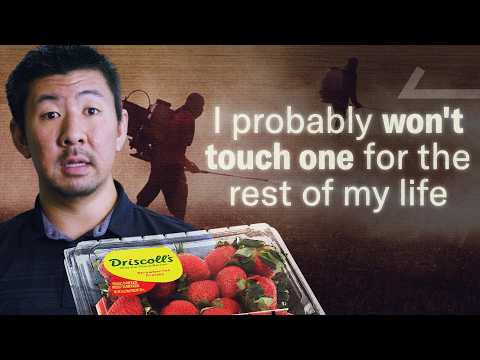
Behind the declining flavor and quality of supermarket berries—and the collapse of small local farms—is the monopolistic distribution structure of Driscoll's, the largest berry company in the United States. Driscoll's does not grow berries itself. Its business model uses seed licensing, packaging sales, and contracts with growers to shift risk outward, creating serious concerns about avoiding responsibility for pesticide-limit violations, labor exploitation, and environmental damage. As giant agricultural companies consolidate the market, independent farms that cultivate healthy ecosystems lose their place, while consumers face a structural crisis in which food loses flavor and nutrition.
1. The Disappearance of Flavor and Questions for a Berry Empire
Many people have noticed that supermarket produce—especially strawberries and blueberries—seems less flavorful or more watery than it used to. Why have underripe tomatoes and fruit that tastes like grass come to fill our tables?
"If fruit and vegetables are becoming less delicious, who is responsible, and what can we do about it?"
To seek an answer, the story visits Hugh Kent, who grows blueberries with ecological farming practices in central Florida. His farm resembles a state-park trail, with dense pine woods and a rich community of soil microorganisms. The blueberries grown there have extraordinary flavor, yet they cannot be found in ordinary supermarkets.
"We feed the microorganisms, the microorganisms feed the plants, and the plants feed us. The secret to flavor isn't love; it is healthy soil and nature."
At the supermarket, meanwhile, shoppers encounter a single giant berry brand that dominates the United States: Driscoll's. 🍓
2. The Business Model of a Berry Giant That Grows None of Its Fruit
Driscoll's is the second-highest-selling brand in American grocery stores after Coca-Cola. In 1989, it set a goal of supplying the four major berries—strawberries, blueberries, raspberries, and blackberries—throughout the year. After the North American Free Trade Agreement took effect in 1994, it expanded huge production bases into Mexico, Peru, Chile, and elsewhere.
But a surprising fact lies behind that enormous success.
"I like telling people that Driscoll's sells one out of every three berries in America, yet it does not grow a single berry itself."
Driscoll's resembles a genetics and seed-patent company more than a farming company. It licenses valuable plant genetics to contract growers and sells them packaging, earning substantial profits while leaving the farms to bear climate and harvest risks.
- Exercising complete control: It tightly controls what contract growers must purchase and to whom they may sell.
- Dominating distribution: Major retailers such as Walmart prefer a single giant supplier capable of delivering a steady volume year-round, excluding small local farms from large grocery chains.
One independent farmer described being rejected by a large grocery chain after it demanded year-round supply. The result is a distorted market in which farmers who grow with the seasons cannot survive, while giant intermediaries that broker four-season distribution can.
3. Whistleblowing and the Shadow of Avoided Responsibility
Economic risk is not the only thing Driscoll's allegedly shifts onto others. David Harada, a former employee and whistleblower, recently made disturbing allegations about the company's approach to safety and compliance.
In late 2022, he discovered that contract farms were applying pesticides above legal limits and reported it to a supervisor. The response was unexpected.
"I received a random call from the director of agronomy, who asked whether we could maintain plausible deniability about the problem. I was speechless: instead of asking, 'How do we fix it?' he was asking, 'How do we hide it?'"
An internal audit allegedly found that, between 2022 and 2024, roughly half of $100 million worth of berry shipments exported to Canada contained at least one tray exceeding legal pesticide-residue limits. Driscoll's denied the allegations, saying it maintains a rigorous food-safety program with independent laboratory testing and audits. Nevertheless, indications that it reduced farm-safety manuals in an attempt to shift legal liability onto contract growers have raised serious concern. ⚠️
4. The Price Paid by Farmers, Workers, and the Environment
The expansion of the giant berry industry imposes serious costs on workers' health and the environment.
- Worker safety and treatment: Workers on contract farms in California and Mexico are exposed to hazardous pesticides for long hours without adequate safety training, while enduring low wages and poor working conditions.
- Environmental destruction and water depletion: In Baja California, Mexico, where water is extremely scarce, industrial berry production is depleting groundwater and has even prompted the construction of desalination plants. The berries are soaked with water while farmworkers' homes have no running water—a tragic contradiction.
"Driscoll's found a clever way not to become the public face of agricultural violations such as unsafe working conditions, pesticide exposure, and extremely low wages in the fields."
This unfair competitive structure is forcing honest independent American farms that comply with environmental and labor standards to lose price competitiveness and close one after another.
5. Seeking Sustainable Food and Alternatives
Even as small farms disappear, some farmers are finding a path to survival outside major wholesale networks through direct-to-consumer sales. Consumers who remember exceptional quality and authentic flavor seek out farms and order from them directly.
Experts argue that repairing the broken food system requires several policy changes:
- Tax the companies at the top of the supply chain—including Walmart and Driscoll's—that profited enormously from deregulation and consolidation.
- Return the revenue to local communities and small farmers who actually grow food.
- Subsidize farming that produces healthy, high-quality crops rather than merely maximizing volume.
In blind tastings, participants often describe mass-distributed berries in the same terms: "They taste like water and fiber," or, "They have no flavor at all."
Closing
The bland fruit in supermarkets is not a coincidence. It is the bitter outcome of giant monopolies maximizing profit while outsourcing responsibility. Once intelligent, conscientious small farmers disappear, their place may never be restored. To protect both our sense of taste and healthy ecosystems, it is time to resist excessive consolidation in agriculture and pay more attention to local farms that cultivate the soil honestly. 🌿