This essay argues that people collect countless tactics in pursuit of success but lack the strategy that decides where and how to use them. Through examples from chess, the military, business, and personal life, the author explains that strategy is the long-term process of building an advantageous position, which requires a clear vision, self-analysis, resource allocation, concentration, and continuous adjustment. The core is not simply acting more, but developing the ability to think about what actions to take and toward what end.
1. People addicted to tactics
The author says many people are racing toward success right now, yet very few will actually get there. The reason is that people fixate on immediate, easy-to-copy tactics — trending AI tool tricks on social media, "5 steps to start a business" — rather than on what success actually requires.
The internet, books, and conversations with AI are already overflowing with information about making money and building businesses. The reason everyone doesn't get rich anyway is that obtaining information and combining it to fit your own situation to produce results are completely different things. The author suspects the very craving for "actionable steps" may itself be the problem.
"The 'actionable advice' you crave so badly will take you nowhere if you don't know how the pieces you pick up fit into the whole puzzle."
The author identifies two problems.
First, endless tactic collection becomes a new form of cheap dopamine. You feel like you're making progress as you learn a new skill, build a website, or register a company. But you avoid the core action of asking a real customer for money or attempting a sale. The author says this state can be more dangerous than endlessly scrolling rage-bait videos, because on the surface it looks like productive activity.
Second, people have no strategic framework that would let them use tactics to maximum effect. He criticizes the fact that instead of thinking for themselves and setting a direction, they are swept along by the stimuli that skilled internet marketers throw at them.
He confesses he fell into the same trap six years ago. He started several businesses — Facebook ads, SEO, dropshipping, digital art — but they were closer to hobbies than money-making businesses. He learned "high-value skills," built websites, and registered an LLC, but when it came time to actually charge for a service, he disappeared.
"I did everything except make money."
The missing piece he found was not a strategy document but the ability to think strategically.
2. What chess reveals about the nature of strategy
The author explains the difference between strategy and tactics through a chess game. Instead of attacking or capturing pieces early, one player places a rook on an open file, opens the bishop's diagonal, and brings a knight near the center. On the surface these look like boring, unremarkable moves.
But not every square on the board has equal value. A piece in the center can influence more places, and a rook on an open file becomes powerful. The opponent, meanwhile, has pieces blocking each other, strong pieces trapped behind their own pawns, and a king that cannot move to safety. The opponent only ever reacts to the first player's moves.
Eventually the first player moves the knight to attack the opponent's king and queen at once. In chess this tactic is called a fork. The opponent can only save one; moving the king loses the queen. The tactic itself could be executed by anyone who reached that position. What matters is that it did not appear by chance — it became possible because the earlier "boring" placements accumulated.
"Tactics flow from a superior position."
— Bobby Fischer, chess grandmaster
The author sums it up this way:
"Strategy is moving yourself into a superior position while simultaneously pushing your opponent into a worse one."
Strategy, in other words, is not one flashy move. It is the process of accumulating a gap by making your position a little better and your opponent's a little worse each time. Once the gap is large enough, the winning tactic appears almost naturally.
In life, uniquely, you are both the player and the opponent. Your choices change your future position, and many people don't even recognize what position they currently occupy. That is why the author stresses that whether you want a side business, better health, or any life goal, strategy must come before tactics.
3. Unconscious living and the need for strategy
The author believes most people do no strategic thinking at all and are therefore dragged along by repetitive routines and social expectations. On life's important choices — when to marry, developing expertise, dependence on AI, choosing between money and meaning, debt, bad relationships, a dead-end career — many people repeat predictable mistakes.
The problem is that even when there is hardship, they don't see it as a problem to be solved. People repeat the same day without much thought of changing direction to reach a more advantageous position.
"If you want to get ahead of 99% of people, stop, think, and actually try to overcome the difficulty in front of you. At the same time, consider a path where you won't have to face that same degree of difficulty again in the future."
The author says that before adulthood, parents, culture, and the education system effectively set your life strategy for you. For many people the default path is to go to school, get a job, and retire at a set age. Yet you can live that path while ignoring the inner voice telling you it will end in regret.
Once you're an adult, bills, responsibilities, emotions, and career worries all arrive at once. Modern society is comfortable enough that you can survive while just doing "what you're supposed to do" and enduring meaningless days. The author contrasts this with commanders in past wars, who had to think deeply about strategy because their lives were at stake, while modern people can play games or drink after work and put off solving fundamental problems.
Here the author argues, somewhat provocatively, that if you won't make a strategy, you should deliberately create pressure that you stand to lose from: move into a place that is hard to afford, buy a plane ticket somewhere unfamiliar, or spend money on business tools, education, or coaching to create financial pressure. This is the author's personal view, however; the essay's practical message is less about reckless risk-taking than about breaking out of false security and becoming conscious of the consequences of your choices.
4. Miyamoto Musashi on the posture of a strategist
The author introduces the nine principles of the strategist from Miyamoto Musashi's The Book of Five Rings. For Musashi, a strategist is someone who has dug deeply into one field and discovered the universal principles at its foundation — someone who notices patterns that recur even across seemingly unrelated domains such as swordsmanship, chess, business, and relationships.
The nine principles are:
- Do not think dishonestly.
- The way is in training.
- Become acquainted with every art.
- Know the ways of all professions.
- Understand gain and loss in worldly matters.
- Develop intuitive judgment in all things.
- Perceive what cannot be seen.
- Pay attention even to small things.
- Do nothing that is of no use.
The author explains that the modern generalist — someone who knows many fields shallowly — is different from Musashi's strategist. A strategist is closer to a master who understands many fields while producing deep achievement in one particular field. They hold the advantages of both generalist and specialist.
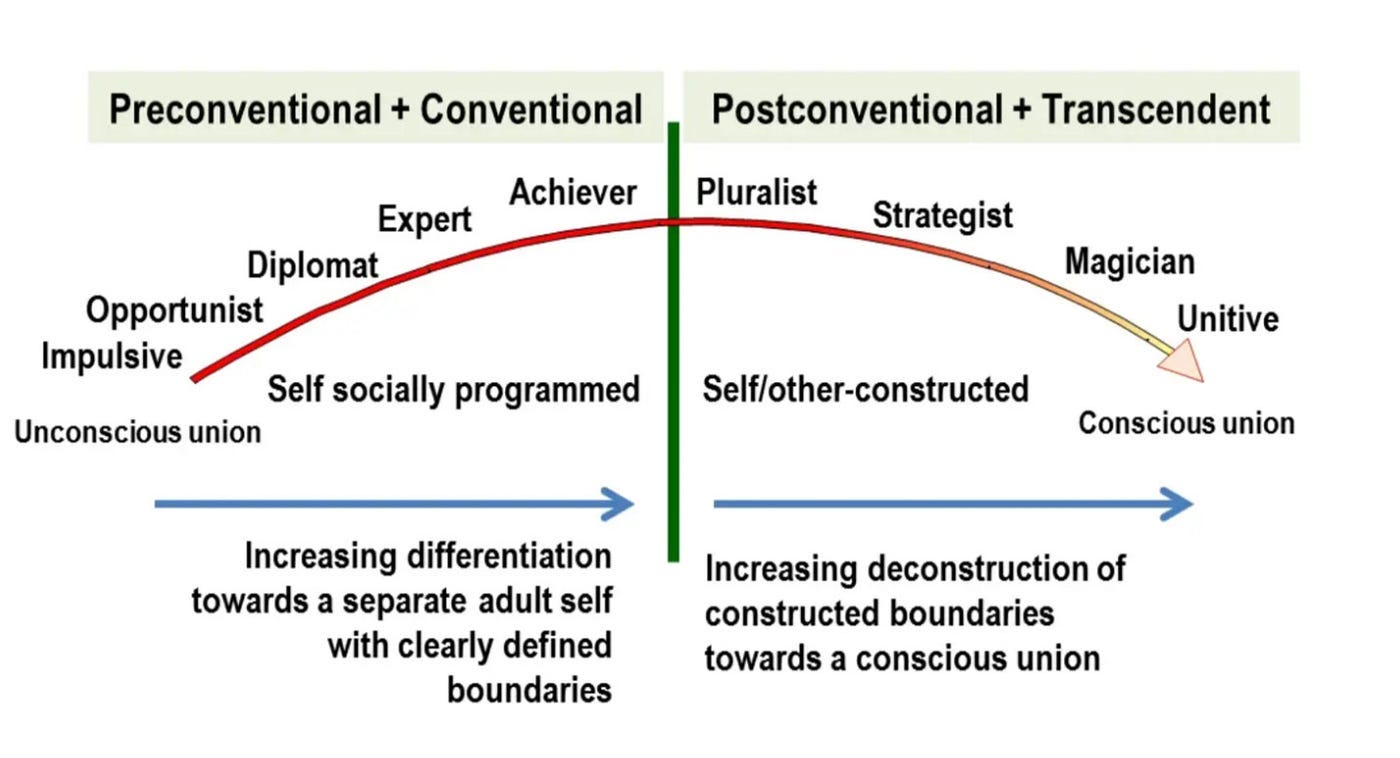
The modern traits of a strategist the author proposes are:
- Systems thinking: instead of seeing one success formula, seeing multiple competing systems and perspectives together.
- Tolerance for paradox: being able, for example, to favor AI while criticizing its dangers. Not hastily resolving contradictions into black-and-white logic.
- Process over outcome: looking not only at what was obtained but at the principles and process by which it came about.
- Awareness of constraints: knowing what your assumptions, values, and mental frames let you see and prevent you from seeing.
- Metacognition: being able to observe the way you assign meaning to the world.
- Principled flexibility: clear values, but methods that flex to suit the environment.
The most important trait is the ability to hold multiple perspectives and frames at once. The author sees the extreme arguments on social media as a result of people lacking the mental room to move past black-and-white logic. Over-identifying with religion, pro- and anti-AI positions, or daily-shifting trends leads to self-deception and distance from the truth, he warns.
"The principle 'do not think dishonestly' connects to the principle 'do nothing that is of no use,' because a state of constant lying and unconscious calculation is useless."
5. Seeing problems as solvable
The author argues that many people's lives are hard not simply because of bad luck, circumstances, or lack of opportunity. More fundamentally, it is because people don't see their problems as puzzles to be solved. They merely endure their problems, without the perspective that time and resources invested over the long run could actually solve them.
He cites the case of having to build an engine first in order to build a rocket. Space travel once looked impossible, but it became possible thanks to a long-term strategy that solved the prerequisite problems in order. Personal health, business, and financial problems can be approached the same way.
The author says strategic principles have been tested over a long time in military, business, and sports history, and apply just as well to an individual life. He then presents vision as the starting point of the strategic principles that follow.
"No one suddenly gets lucky. If the stars appear to have suddenly aligned for someone, consciously or not they have already been aligning them — choosing where to live, who to learn from, who to marry, their friends, their lifestyle, the risks they take, the vision they believe in."
— @orangebook_ on X
6. Setting direction with vision and anti-vision
According to the author, without a vision a person gets lost. Even holding the bold choices that determine life outcomes, you cannot know where to throw them without a target board.
A vision is not a vague wish but as concrete an expression as possible of the end state you want. It must be powerful enough to guide daily behavior, and only when the vision is clear can you design actions backward from it.
For example, the goal "by 35, be emotionally resilient, deeply self-aware, and financially independent" becomes a standard for evaluating daily behavior. You can judge whether two hours on social media helps in that direction.
Or with the vision "within 18 months, build a newsletter with 50,000 subscribers in personal growth and earn enough to quit my job," you can evaluate every content, platform, and monetization choice against that goal. You don't need to chase every trending tactic — you can select only what fits your strategy.
But the author believes you cannot build a vision by repeatedly asking only "what do I want?" Instead, he recommends starting with an anti-vision and a post-mortem.
- Anti-vision: imagine, in vivid detail, the failed life outcome you absolutely do not want.
- Post-mortem: trace backward why that failure would have happened. Examine what mistakes and choices produced that outcome, and how they could be avoided.
- Minimum viable vision (MVV): based on the anti-vision analysis, build a vision that is imperfect for now but actionable. Then sharpen it progressively through action and experience.
The author introduces his own "life strategy prompt" and personal branding tools for this, but the core message is less the tools themselves than making the direction of your life explicit in sentences and filtering your choices against that standard.
7. Principles of intelligence gathering, risk management, and concentration
Strategy begins with gathering information before acting. Just as a general in war sends scouts to learn the terrain and the enemy's habits, an individual must analyze their own habits, emotional reactions, capabilities, and sources of interference.
"Worry less about which job skills AI will replace, and more about whether you are training yourself and your children to be proactive, insightful, self-motivated people who can navigate an unknowable future with an adaptable mind."
— Devon Erickson
The author says that even when starting meditation or a spiritual practice, don't immediately pick the first app you see in a social media ad. Compare various traditions and techniques, read the research, talk to people who have practiced a long time, and understand your own psychological patterns and triggers. When creating content, likewise, research competitors' results, market response, and the niche you could enter.
Next you have to understand your resources and deficiencies. Money, time, knowledge, skills, where you live, relationships, and emotional regulation are all strategic resources. Before attempting a big change like quitting a job, ending a relationship, starting a business, or launching a new project, he advises building a financial runway, cutting expenses, and putting the necessary emotional skills and support systems in place.
This amounts to hedging against risk. Bigger goals tend to carry bigger risk, so you have to manage that risk in a way you can absorb. The author offers the example that information products can carry relatively low risk and high return, whereas a SaaS business — even as it becomes easier to build — can carry greater risk due to operating costs and competition.
For young people in particular, the biggest resource may not be money but time and freedom. So he argues you should lower your costs and control the variables you can, maximizing the room you have to build your own work. Even here, though, the point is not irresponsible debt or impulsive decisions but coolly calculating and preparing for what you stand to lose.
Concentration means gathering limited resources in one place
The author applies the military principle of concentration of force to life. In 1940 France had more tanks and troops than Germany, but spread its forces evenly along the front. Germany, by contrast, concentrated its tanks at a single point in the Ardennes forest, which France had not defended. Advantage went not to the side with more resources but to the side that concentrated resources at the decisive point.
In life too, people try to change everything at once — diet, sleep, exercise, meditation, relationships, side businesses. But the author says it is faster to concentrate on the single biggest bottleneck. Solve the financial problem first, for example, and it becomes easier to secure healthy food, time, and energy, which in turn becomes the foundation for improving relationships and other areas of life.
"Is there a point where doing more does not produce more? Is there a point where doing less but thinking more actually produces better results?"
— Greg McKeown, Essentialism
The same holds for business and social media growth. Rather than dispersing effort by posting content on every platform at once, it can be more effective to build influence and relationships on one platform first and then extend to others.
"Strategy is choosing how to allocate limited resources against infinite options."
— Alex Hormozi
8. A strategic life of repeated execution and adaptation
The author says that executing strategy properly requires moving continuously between the macro view of vision and the micro view of daily action — repeatedly checking that today's choices connect to the larger direction.
The execution sequence he proposes is:
- Keep recalling the vision. Write it down and review it daily, so repeated exposure makes it part of your identity.
- Reflect on the information you gain from observing yourself and your environment. Don't let your research wash past you — think about it, connect it, and find patterns.
- Identify your greatest resource. Find your own leverage: time, freedom, capital, an online audience, distinctive experiences and interests, skill with AI.
- Choose the decisive point to concentrate on. Find the highest-leverage problem that will unlock progress in multiple areas at once.
- Reverse-engineer the vision into a goal system. Come down through one-year goals, 90-day goals, weekly priorities, and daily habits, keeping every level connected to the vision.
But the author strongly emphasizes that strategy must not become rigid. The world changes especially fast, and the tools, Notion templates, AI techniques, and content strategies that work today may mean little in three to six months. What must not change is your intent and direction in life; what must change is the tactics for reaching that direction.
"To experience a sense of control you have to be willing to give up the protective safety of routine. Only when an uncertain outcome is at stake, and you can influence that outcome, can a person truly know whether they are in control."
— Mihaly Csikszentmihalyi, Flow
For instance, if a change in your work schedule makes it hard to keep a morning routine, you don't have to abandon the goal of "becoming a disciplined, stable person." You only change the timing or method of achieving it. If your meditation technique or business approach loses its effectiveness six months later, don't cling to it — experiment and adjust.
To this end the author recommends putting three things on the calendar every week:
- Review: check whether this week's actions matched your goals.
- Reflection: think about what worked and where you got stuck.
- Prediction: forecast where your current direction leads if you continue, and correct it if needed.
9. Strategy is a lifelong discipline
At the end of the essay, the author suggests treating strategy itself as a lifelong field of study. Because strategic principles operate across many domains, understanding the principles lets you create your own moves in new situations rather than merely copying someone else's success.
He suggests studying the following fields to develop strategic thinking:
-
Formal systems
- Cybernetics: the study of feedback, control, and self-regulating structures.
- Systems theory: examining wholes, connections, flows, emergence, and leverage points.
- Thermodynamics: understanding entropy — that ordered systems decay when left alone and require energy to maintain.
-
Philosophical traditions
- Taoism: action that fits the flow of nature rather than forcing, that is, wu wei, and complementary opposites.
- Perennial philosophy: the view that there are fundamental truths common to diverse wisdom traditions.
-
Integrative meta-frameworks
- Ken Wilber's integral theory: attempting to map reality across developmental stages, states of consciousness, and perspectives.
- Spiral dynamics: examining how the value systems by which humans construct meaning develop.
-
Symbolic and psychological traditions
- Hermetic principles: offering lenses such as mentalism, correspondence, vibration, polarity, rhythm, and cause and effect.
- Jungian alchemy: exploring how deep transformation occurs in individuals and systems.
-
Strategic and mathematical fields
- Game theory: zero-sum and positive-sum games, the prisoner's dilemma, Nash equilibrium, and other strategic interactions.
- Evolutionary theory: understanding the principles of selection, adaptation, variation, and retention.
The author says all of these fields are lenses illuminating different aspects of reality. Studying such subjects over a year, he argues, raises not only a specific skill but the level of nearly all your other learning and judgment.
10. Closing
The core of this essay is not that you should collect more secret tactics for success. It is that you should stop the temptation to collect tactics, define the position in life you want, coolly analyze your current resources and problems, and concentrate on the most important bottleneck. 🎯
Strategic thinking is not the ability to predict everything perfectly but the ability to hold your vision while continuously changing tactics to fit reality. The author concludes that in the end the people who make the biggest difference are not those who replicate others' actions but those who understand the principles of reality and create the next move that fits their own life.