
In today's tech market, AI is a far more unforgiving environment than SaaS or mobile ever were — wrong strategy leads to swift failure. To survive and succeed in a rapidly shifting AI landscape, companies must go beyond simply bolting on AI features. What matters is a solid AI product strategy built on cost efficiency, differentiated competitive advantage, and a scalable business model. This article uses cautionary examples of failed companies to drive home the importance of AI product strategy, then offers a concrete guide — through the 4D Framework and pricing and positioning strategies — for how AI companies can chart a winning path.
1. The Brutal Reality of the AI Market and Why Strategy Matters 😱
Many companies are struggling to navigate the AI wave. Some get swept up in the hype, accumulate enormous costs, and crash. Others ride the current to build a durable moat, dominate their markets, and achieve success that can last more than a decade. The AI market, unlike SaaS or mobile, does not forgive flawed strategies — and the consequences can be severe.
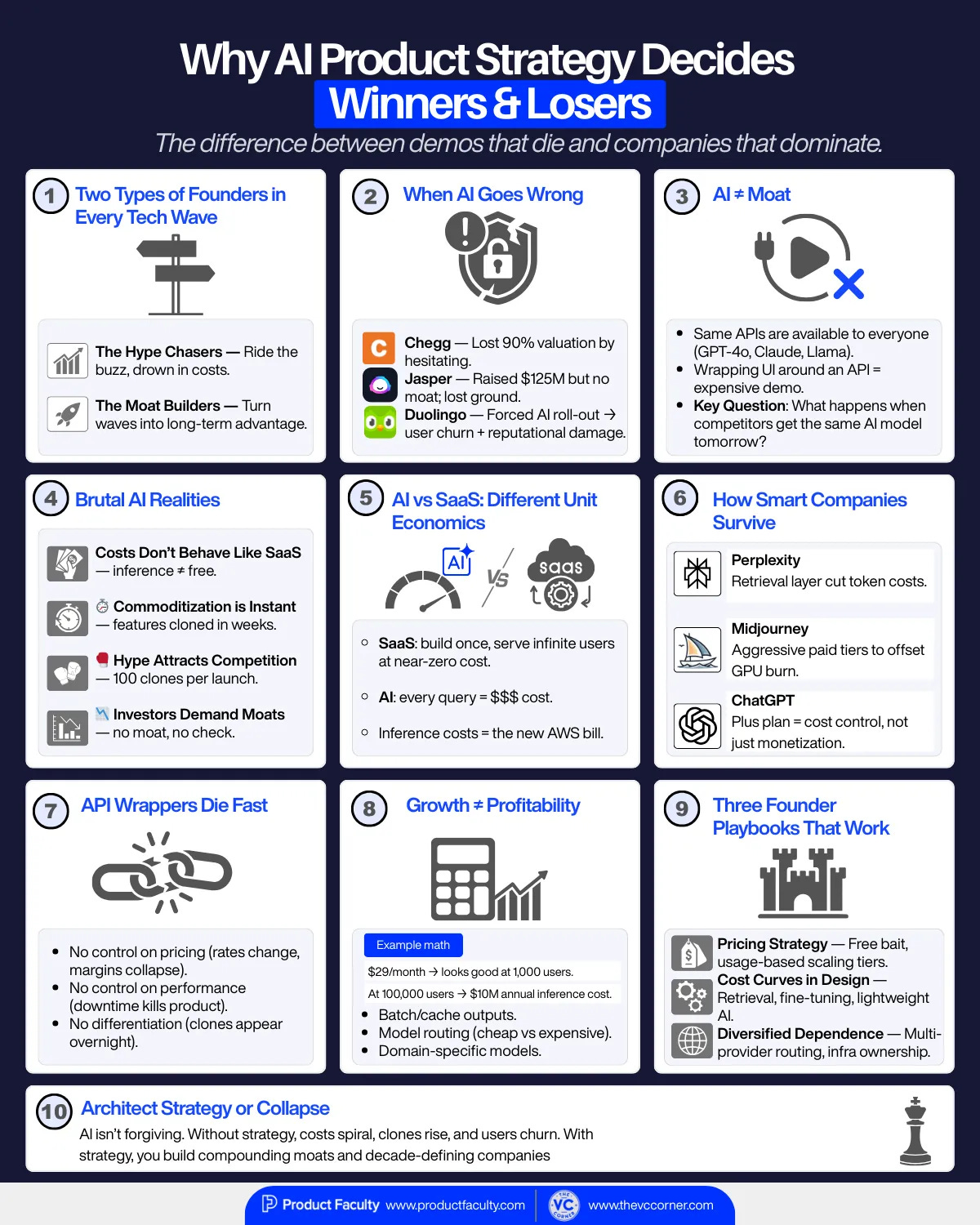
Take Chegg, the education platform. It failed to respond quickly to AI while students flocked to ChatGPT, and lost 90% of its market value. Then there's Jasper, the AI writing tool once valued at $1.25 billion after raising $125 million and hailed as the flagship "AI wrapper" — but without a genuine moat, its SaaS-style cost structure and mismatched pricing saw users defect to ChatGPT, and it collapsed rapidly. Language-learning app Duolingo pushed AI tutors too aggressively while laying off staff, sparking a backlash that drove away hundreds of thousands of users and badly damaged its reputation.
These cases show that simply grafting on AI, releasing flashy features without considering the economics, or reacting too late will not earn a second chance in this market. In AI, adoption cycles compress from years to quarters, and commoditization happens in weeks rather than months. Investors, users, and the market punish hesitation harshly — which makes AI product strategy the core key that determines whether a company survives and grows.
2. Why AI Is Different from SaaS 💡
These days, "AI-powered" appears on the first slide of every pitch deck, and founders believe it boosts credibility — but AI itself cannot be a moat. Models like GPT-4o, Claude, Llama, and Mistral are accessible to anyone, and the barriers to entry are nearly zero. If your strategy is "use OpenAI's API and wrap a UI around it," that's not a company — it's an expensive demo that can be cloned overnight.
The question that separates winners from losers is this:
"What happens when your competitors get access to the same AI model tomorrow?"
If your answer is "we'll build faster," you've already lost.
Here's why the AI market is so brutal:
- A different cost structure than SaaS: In SaaS, you build a product once and the marginal cost per user drops to nearly zero. In AI, every query, every generation, every inference incurs a real cost. Tokens, GPUs, hosting — without strategy, costs can grow faster than revenue.
- Overnight commoditization: In SaaS, copying a feature might take years. In AI, it happens in weeks. The only defense is a strategic moat: proprietary data, trust, or distribution.
- Hype invites competition: Every time a new AI feature drops, Product Hunt floods with clones. Most disappear — but if you're not defending your market with strategy, some of them will erode your share.
- Smarter investors: In 2021, the word "AI" alone could raise millions. In 2025, VCs ask: "What's your moat when GPT-5 launches?" and "How do you handle inference costs at 100 million queries per month?" Without answers, there is no investment.
AI is not about building the flashiest demo. It's about designing systems around AI — thinking through how you generate revenue when usage grows 10x, how you retain customers when base models get cheaper and better every month, how you turn your distribution into a compounding advantage, and how you build trust in an environment where hallucinations and privacy issues can erode it.
The winners will not be founders who simply "add AI" — they'll be founders who design AI into a scalable, defensible, compounding product strategy. And the gap between winners and losers will widen faster than in any prior tech wave, because when costs spiral out of control you have months — not years — to fix it, and when commoditization hits you have weeks — not quarters — to respond.
2.1. Inference Cost Is the New AWS Bill 💸
The SaaS profit model was simple: build the product once, acquire users, and marginal cost per user converges toward zero. The more customers you add, the more profit grows — SaaS companies routinely hit 70–80% margins.
AI doesn't follow SaaS rules. In AI, marginal cost is real. Every AI query costs money. For example, a single ChatGPT query costs OpenAI a few cents depending on the model. At millions of users, a "free tier" alone can burn millions of dollars a month. In SaaS, scale reduces cost. In AI, if efficiency isn't designed into the product, scale can increase cost.
This is the harsh reality: inference cost is the new AWS bill. Just as early startups were wrecked by runaway cloud charges, today's AI startups are being squeezed by uncontrollable token fees.
- Perplexity spotted this early. Rather than running raw GPT calls for every query, it combined a hybrid search layer with an LLM — fetching relevant documents first, then summarizing — which dramatically reduced token usage. Lower costs, faster responses, and better citations translated into a better user experience.
- Midjourney grew through community-driven word of mouth on Discord. But the hidden story is that GPU costs were enormous — every image rendered consumed compute. That's why it moved aggressively to paid plans quickly: free users simply weren't sustainable.
- ChatGPT grew explosively to 100 million users in two months, but nearly exhausted OpenAI's compute budget in the process. That's why "ChatGPT Plus" launched at $20 per month — it wasn't just monetization, it was a cost-containment strategy.
The pattern is clear: founders who survive long enough to scale are the ones who designed unit economics in from the start.
2.2. The API Wrapper Trap 💀
Most early AI startups are API wrappers — 100% dependent on OpenAI, Anthropic, or another foundation model. That's fine for a prototype but fatal for a company.
Why?
- No control over pricing: If OpenAI raises API prices, your margins collapse.
- No control over performance: If the model lags or goes down, your product stops working.
- No control over differentiation: If everyone can use the same API, what stops another founder from cloning your entire product over a weekend?
That's why API-driven AI products disappear quickly. They confuse building a demo with building a company.
Consider a simple thought experiment:
- You charge $29 per user per month.
- The average user runs 500 queries per month.
- Each query costs $0.002 in tokens.
- Pure inference cost: $1.00 per user per month.
- Gross margin: roughly 97%. Looks great.
Now scale it:
- Users grow from 1,000 to 100,000.
- Queries go from 500,000 to 50 million per month.
- Costs rise from $100,000 per month to $10 million per year in inference alone.
- Suddenly your AWS bill looks small by comparison.
That's the trap. Margins look fine at 1,000 users — they collapse at 100,000. To fix this, you need to:
- Intelligent batching or caching: don't regenerate the same output 50 times.
- Model routing: use cheaper models for simple tasks, expensive models only when necessary.
- Build proprietary infrastructure: train small domain-specific models that are cheaper to run.
Honestly, most AI startups right now are unprofitable even as they appear to be growing. They're subsidizing user acquisition with VC money while ignoring the economics.
The companies that succeed do three things differently:
- Strategic pricing:
- The free tier is a hook.
- Paid tiers use usage-based pricing that kicks in fast and scales with cost.
- Midjourney, for example, killed its "free" generations because of cost pressure.
- Cost curves baked into the design:
- Perplexity's search step is a cost moat.
- Grammarly's incremental fine-tuning reduces the cost of corrections over time.
- Canva's AI tools are lightweight enhancements, not cost-heavy core features.
- Diversified dependencies:
- Route across multiple providers (OpenAI, Anthropic, Cohere, Mistral).
- Train domain-specific models where possible.
- Own infrastructure directly as you scale.
Build AI without modeling unit economics and you'll mistake growth for success. The faster you scale, the faster money leaks, and one day margins go negative and investors lose patience. But design economics into your product from day one and the dynamic reverses:
- Costs decrease as usage grows (thanks to caching, routing, and infrastructure efficiency).
- Competitors can't undercut you on price (because your economics are structurally superior).
- Growth compounds into a genuine moat, not just hype.
That is the difference between a demo and a company that shapes the next decade.
3. The 4D Framework: A Compass for AI Product Decisions 🧭
When you build an AI company, you don't lose because your idea is bad. You lose because your strategy can't withstand scale, commoditization, or cost.
Drawing on experience building, scaling, and successfully exiting AI companies — and watching hundreds of other founders succeed or fail — a 4D Framework emerged to validate every product decision. Think of it as a survival map. If you don't run your company through these lenses, you're building a skyscraper with your eyes closed.
(This is a foundational framework; the AI product strategy cohort covers advanced frameworks and detailed examples.)
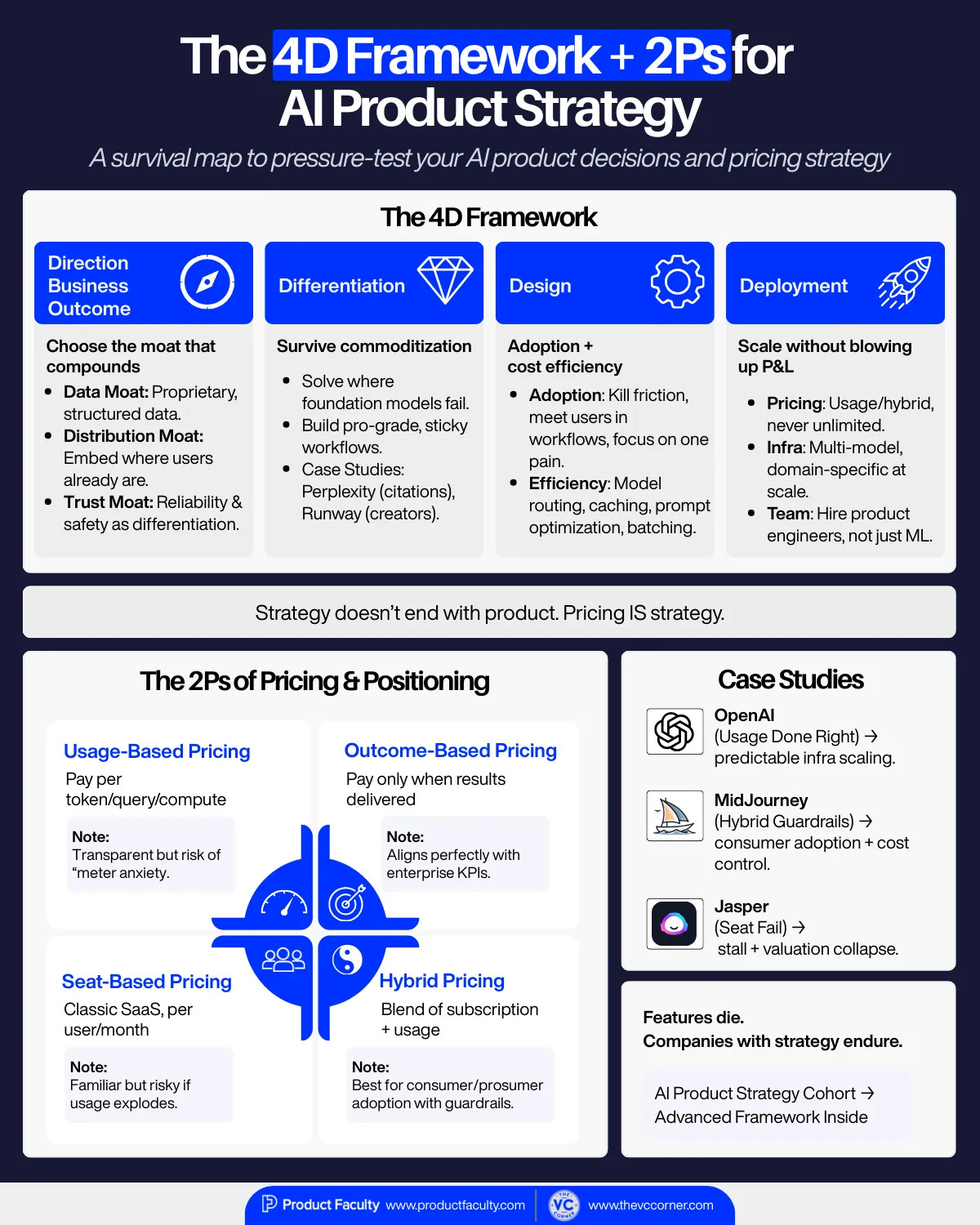
The 4Ds are:
- Direction: Choosing a moat that compounds over time
- Differentiation: How to survive when features get commoditized
- Design: Designing a product that balances adoption with cost efficiency
- Deployment: Scaling without destroying your P&L
Let's go through each one.
3.1. Direction: Choosing a Compounding Moat 🏰
Here's the reality: AI features are temporary, but moats are permanent. The market doesn't reward you for cleverly wrapping GPT-5, because someone can build the same thing tomorrow. What the market rewards is whether your product gets stronger with every new user who signs up. That's the essence of Direction: intentionally choosing which compounding moat you'll invest in and defend.
There are only three moats that truly matter in AI.
3.1.1. Proprietary Data 💾
The most durable and defensible moat in AI is proprietary data. If your product generates unique, defensible, structured data every time it's used, you can outpace competitors in ways they can't copy or buy — with every additional user you add.
Example: Duolingo. They didn't just add AI — they fine-tuned models on years of proprietary student learning data: which exercises tripped students up, which corrections worked, how learning paths evolved across regions and demographics. This dataset is a treasure chest no new entrant can replicate regardless of how much capital they raise.
Why it matters: Data moats compound. Each new user generates more unique data → which produces smarter, cheaper, more personalized models → which creates better user experiences → which attracts more users. It's a virtuous cycle that only grows stronger over time.
Questions to ask yourself:
- Am I collecting data that competitors can never access?
- Is that data high-quality, structured, and improving over time?
- Can I design a feedback loop where the product gets better the more it's used?
3.1.2. Distribution 🚀
Distribution has always been a moat in business, but in AI it is everything.
Example: Notion. When Notion added AI, it didn't need to spend millions on customer acquisition. Tens of millions of users were already embedded in existing workflows — adding the feature produced immediate, massive adoption.
Example: Canva. Rather than marketing "AI image generation" as a standalone gimmick, Canva embedded AI directly into the design workflows users already relied on, making it feel like a natural extension of the product.
Why it matters: If you don't own distribution, you're fighting ChatGPT, Gemini, and whatever foundation model launches next. Distribution makes your product get used not because of a feature, but because customers are already in your product.
3.1.3. Trust 🤝
The most underrated moat in AI is trust. Users don't just want powerful AI — they want AI that is predictable, safe, and reliable. In many industries, trust is not optional; it is the entire value proposition.
Example: Anthropic. Anthropic didn't try to beat OpenAI on raw scale or parameter count. Instead, they positioned themselves as the company obsessed with safety and alignment. That single positioning choice captured enterprise customers who couldn't afford the reputational risk of deploying a misaligned model.
Example: OpenAI enterprise contracts. Many organizations could technically build their own models or buy cheaper alternatives — but they pay OpenAI millions because of trust in governance, compliance, and reliability. That trust is worth more than pure model performance.
Why it matters: Trust builds slowly, but once earned it becomes a moat stronger than any feature. It can be shattered by a single hallucination or breach — but consistent reliability creates customer lock-in that competitors with slightly faster or cheaper models can't break.
If you don't explicitly choose your Direction, the market will choose it for you. And when the market chooses, it almost always means commoditization — the path on which startups die.
3.2. Differentiation: Surviving Commoditization 🛡️
The harsh truth: if your product is simply "AI that does X," OpenAI (or another foundation model company) will eventually eat you. These companies are shipping features horizontally — documents, spreadsheets, email, images, audio — at a breathtaking pace. If your only differentiation is "we added AI," you're already roadkill.
Differentiation means building a defense against inevitable commoditization. It means answering: "Even if OpenAI or Anthropic ships something similar for free or as a bundle, why should customers still choose you?"
Questions to ask yourself:
- What specific failure mode of the base model does my product solve better than anyone else?
- Where is the generic model too slow, too expensive, or too generic — and where can I build a targeted solution that outperforms it?
- How do I design workflows, UX, and integrations so customers keep using the product even if competitors technically replicate the core feature?
Case studies:
- Perplexity AI: Any LLM can answer questions, but Perplexity differentiated by providing citations, sources, and a search-centric workflow. This wasn't just a feature — it was a positioning wedge: "trustworthy AI search."
- Runway AI: Rather than chasing generic video generation capabilities, Runway focused deeply on creators, editors, and filmmakers. Its differentiation wasn't "we generate video." It was "we are the pro-grade tool for professionals who need production-quality output."
Differentiation doesn't mean adding more features. It means owning a use case so deeply that the market sees you as the default — even when others can technically replicate the core functionality.
3.3. Design: Balancing Adoption and Cost Efficiency ⚖️
This is the graveyard where most AI startups die. They focus on building "wow demos" that set Twitter on fire for a week — but adoption doesn't follow, and the economics buckle under the weight of inference costs. Good Design in AI means finding the balance between user adoption and a sustainable cost structure.
3.3.1. Design for Adoption ✅
- Remove friction: Don't expect users to learn "prompt engineering." Translate natural behavior into AI output. Grammarly didn't ask users to type "rewrite this in a formal tone" — it made that functionality available with a single button.
- Meet users where they already work: Rather than forcing users to a new app, embed AI inside their existing workflows (Notion, Canva, Figma, etc.). Leveraging existing habits makes adoption 10x easier.
- Minimum Viable Intelligence: Solve one painful point completely before pursuing AGI-level generality. Perplexity's focus on "AI + trustworthy answers" was enough to carve out a niche for growth. It didn't need to solve every problem at once.
3.3.2. Design for Cost-Efficiency 💰
- Model routing: Don't send every query to GPT-5. Use smaller, cheaper models for 80% of tasks — only escalate to expensive models when necessary.
- Caching: If 1,000 users are requesting the same thing, don't pay 1,000x for identical output. Cache intelligently.
- Prompt optimization: Every token costs money. Keep prompts concise and efficient.
- Batch processing: Where possible, bundle multiple requests into a single inference call.
Why it matters: Successful founders design products where the cost per user decreases as adoption grows. Everyone else builds demos that burn cash and collapse at scale.
3.4. Deployment: Scaling Without Destroying Your P&L 📈
Scaling is the final boss for AI startups. At this stage, you either become a unicorn or implode under your own costs.
The AI paradox is that your product can grow faster than any prior technology — but costs can outpace revenue just as fast. Deployment means building systems that protect your P&L as you scale.
3.4.1. Pricing Models 🏷️
- Shift to usage-based or hybrid pricing early.
- Tie customer cost directly to the value they perceive.
- Never promise unlimited AI features unless you're prepared to watch your margins evaporate.
3.4.2. Infrastructure ⚙️
- Use a multi-model approach. Don't lock yourself to a single vendor. Route intelligently across OpenAI, Anthropic, Mistral, or open-source models and foster competition between providers.
- Specialize as you scale. Once you hit meaningful volume, train domain-specific models that are cheaper and faster than general-purpose APIs.
- Own infrastructure directly when scale demands it.
- Build evaluation systems that monitor quality, accuracy, latency, and hallucinations at scale.
3.4.3. Team 👨👩👧👦
- Don't only hire ML engineers. Hire product engineers who understand the tradeoffs between user experience, speed, and GPU costs.
- The best hire may be someone who can say "no" to expensive demos that look great on stage but destroy margins in production.
Every decision you make as an AI founder should pass through these four lenses:
- Direction: Are we building toward a defensible moat, or creating another wrapper?
- Differentiation: Will this still matter if OpenAI ships the same thing tomorrow?
- Design: Does each new user improve our economics — or worsen them?
- Deployment: Can we scale 10x without destroying our margins?
If you can't answer "yes" to all four, stop. You're building a feature, not a company. Features die; companies with strategy survive.
4. Pricing and Positioning: The Two Core Ps of AI Survival 💰🗣️
When founders talk about pricing, they usually treat it as something to figure out later: "We'll sort it out once we find product-market fit."
That might fly in SaaS, but in AI it's fatal. Because in AI, pricing isn't just how you make money — it's how you control costs, shape user behavior, and build your moat.
Get it wrong and adoption will drain you. Get it right and pricing itself becomes your competitive advantage.
4.1. Pricing Is Strategic Leverage, Not an Afterthought 🪝
In SaaS, you could price low early, absorb AWS costs, and make it up through scale — because marginal costs approached zero.
In AI, marginal costs are stubbornly real. Every query generates token, GPU, latency, and inference costs. That means your pricing is your economic survival strategy.
It controls:
- Who you attract: casual users vs. high-value enterprises.
- How they behave: rationing queries vs. abusing the product.
- When you break even: month one vs. year three.
- What positioning you signal: premium vs. utility, professional vs. consumer.
4.1.1. Usage-Based Pricing 📊
How it works: Customers pay directly proportional to the exact amount of AI resources consumed — measured in tokens processed, queries run, or GPU time used. Every unit of consumption has a clear price tag, making the cost structure granular and easy to calculate.
Best for: Usage-based pricing works best for APIs, infrastructure products, and enterprise tools, where consumption is predictable, measurable, and directly tied to business value. Companies that position themselves as a "platform layer" rather than a final-user product tend to prefer this model because it aligns with how developers and enterprises think about scaling workloads.
Examples:
- OpenAI API: Charges per 1,000 tokens with transparent per-model pricing.
- ElevenLabs: Charges by audio minutes generated, aligning price with output.
Strengths: Revenue scales directly proportional to costs, creating transparent alignment between usage and value. Customers feel they're paying exactly for what they consume, and the company avoids the trap of subsidizing heavy users. It also builds credibility with developers and enterprises accustomed to AWS-style pricing.
Weaknesses: The main downside is what's known as "metering anxiety." Fear of unpredictable bills makes users hesitant to experiment or adopt at scale. This can limit adoption in consumer markets or creative applications where usage is unpredictable. Usage-based pricing is also harder to position as "accessible" or "friendly" because it feels transactional rather than subscription-like.
4.1.2. Outcome-Based Pricing 🎯
How it works: Instead of charging for raw consumption, you charge based on outcomes delivered — per lead generated, per fraud case detected, per conversion achieved, or even per line of shipped code. The core idea is that customers pay not for tokens or minutes, but only when the AI creates a measurable business impact.
Best for: This model works best for enterprise AI products where the value of an outcome can be measured in dollars and tied directly to KPIs — sales, marketing, fraud detection, compliance. In these domains, enterprises care far more about results than the technology itself.
Examples:
- AI sales platforms: Charge per qualified meeting booked.
- Fraud detection systems: Charge per fraudulent transaction caught.
Strengths: It creates perfect alignment between the company and the customer — you only win when they win. This enables premium positioning in the market ("we only win if you win"), and dramatically reduces sales friction because customers feel no wasted spend.
Weaknesses: Much harder to implement for consumer or creative apps where outcomes are subjective or difficult to measure. It also transfers risk to the AI company — if model performance is poor or outcomes are delayed, revenue takes an immediate hit even if the system is used heavily. Operational complexity of measuring outcomes at scale can be substantial.
4.1.3. Seat-Based Pricing 🧑💻
How it works: The classic SaaS model — customers pay a fixed monthly or annual fee per seat or per user. It's simple, predictable, and familiar, which is why many AI startups default to it even though the underlying economics differ from SaaS.
Best for: Seat-based pricing works best for workflow AI products that integrate directly into team collaboration and productivity. When the product becomes part of daily work, tying cost to the number of users makes intuitive sense — each additional user expands the value of the platform within the organization.
Examples:
- Jasper AI (early): Used a SaaS-style seat model for its writing tool.
- Notion AI: Folded AI features into its existing per-seat SaaS plan.
Strengths: Seat-based pricing is highly familiar to buyers, especially enterprises. CFOs can forecast spend easily; procurement teams don't need to learn a new model. It also supports a compelling positioning story — "enterprise SaaS with built-in AI" — that makes both investors and buyers more comfortable.
Weaknesses: The risk is that AI doesn't behave like SaaS. If per-seat usage explodes and one user consumes 100x more AI than another, the company absorbs those costs unless usage is carefully tiered or throttled. This creates a dangerous mismatch between revenue and cost, and is risky for high-load AI workloads with variable usage.
4.1.4. Hybrid Pricing 💡
How it works: Hybrid pricing combines the psychology of a subscription with the control of usage-based pricing. Typically, this means a base subscription that unlocks access, plus usage add-ons or limits. Users feel like they're paying for access, but the company has guardrails to prevent abuse and better align costs with revenue.
Best for: Hybrid pricing works best for consumer and prosumer AI applications where usage varies widely. It's also effective for products that need to scale across segments ranging from hobbyists who want predictable pricing to enterprises that require usage-based flexibility.
Examples:
- Midjourney: Monthly flat-rate plans with caps on GPU compute time — allows offering an "unlimited" plan while capping runaway costs.
- ChatGPT Plus: $20/month flat rate for priority access, while enterprise contracts rely on usage-based pricing for scale management.
Strengths: Hybrid pricing captures the best of both worlds. On one side, it meets consumer psychology with "unlimited" plans that feel accessible and predictable. On the other, limits, caps, or overage charges protect the company from abuse. It's also flexible enough to grow with customers — from individual hobbyists to large enterprise deployments.
Weaknesses: The weakness is complexity. Hybrid pricing requires careful packaging, clear communication, and ongoing adjustment as model performance, costs, and market expectations evolve. Poorly managed, it leaves users confused about tiers, and the company either loses revenue by setting limits too generously or frustrates customers with overage charges.
4.1.5. Pricing Strategy Case Studies 🧠
- OpenAI API:
- Clear per-token pricing tied directly to compute.
- Transparent, scalable, enterprise-friendly.
- Positioning: "We are the rails of AI."
- Result: Predictable revenue that scales proportionally to costs. No consumer adoption — but infrastructure market dominance.
- Midjourney:
- Subscription tiers ($10–$60/month) with GPU time caps.
- Quickly killed the "free trial" when GPU costs exploded.
- Positioning: "Accessible creativity — but paid."
- Result: Explosive consumer adoption + cost control.
- Jasper AI:
- $59–$499 per seat per month. Looked like SaaS.
- Problem: Inference usage exploded while pricing didn't match costs.
- Worse: Commoditization (ChatGPT) killed the differentiation.
- Positioning failure: "We're SaaS with AI built in" — but without a moat, they were just a middle layer.
- Result: ARR stagnated at $125 million; valuation collapsed.
Ask yourself:
- What is my moat? (Data, distribution, trust.) Pricing should reinforce it.
- Data-centric → usage-based fits (aligns with infrastructure positioning).
- Trust-based → outcome-based fits (we only win when you win).
- Distribution-centric → hybrid fits (acquire consumers, monetize power users).
- What behavior do I want to incentivize?
- Casual adoption? → flat rate.
- Efficient usage? → usage-based.
- High-ROI users? → outcome-based.
- What story do I want to tell the market?
- Infrastructure (usage).
- Partner (outcome).
- SaaS (seat).
- Democratizer (hybrid).
4.2. Positioning: The Story That Survives the AI Era 📖
Founders obsess over models, features, and infrastructure — but the real battlefield is positioning.
Positioning is how the market perceives you. It's the story that comes to mind when customers think of your product. In the AI era, where technology can be commoditized overnight, the story itself is often the only sustainable advantage. And most founders get this completely wrong.
4.2.1. The SaaS Positioning Trap ❌
Many AI startups lazily borrow SaaS positioning: "per-seat pricing," "enterprise SaaS workflow tool," "we're like Salesforce but with AI."
Problem: You are not building SaaS.
- SaaS = zero marginal cost; scale loves you.
- AI = every inference burns real money.
Borrowing SaaS positioning tells the market: "We're just software." But you're not. You are economics + infrastructure + strategy, all built into the product.
What to do instead: Position as AI-native. Acknowledge the cost dynamics. Build pricing and messaging that signal you understand AI economics — not SaaS economics.
4.2.2. Overpromising and Lack of Transparency 🤫
Nothing destroys trust faster than an unexpected bill. Many founders try to make the story "smooth" by hiding inference costs behind flat subscriptions or "unlimited use."
Result: Users abuse it, GPU costs explode, and when prices change later the company looks dishonest.
Positioning problem: You packaged yourself as "magical, unlimited AI" — but the business reality can't support it.
What to do instead: Transparency = trust. OpenAI didn't sugarcoat anything. They showed per-token pricing, which positioned them as predictable infrastructure. Midjourney capped GPU time, positioning itself as a premium creative tool, not a toy.
Users don't need "free." They need to trust that you're not going to deceive them.
4.2.3. Misalignment Between Product Story and Pricing Model 🎭
This is subtle but fatal. Founders often fail to align their product story with their pricing model.
- Usage-based but marketed as a consumer app: Users leave because they expect "a fun app," not "an AWS bill."
- Flat subscription but losing money because of inference costs: Investors roll their eyes. You're growing adoption while margins collapse.
Why it matters: Misalignment signals you don't know who you are. And if you don't know, why should users or investors trust you?
What to do instead: Align pricing and narrative.
- If usage-based, position as infrastructure/rails.
- If subscription-based, position as consumer/prosumer with clear limits.
- If outcome-based, position as an ROI partner.
Your business model is not just finance — it's messaging.
4.2.4. The Absence of a Clear Narrative 🗣️
This is a quiet killer. Features and pricing alone are not enough. You need a story that investors, press, and users can repeat in a single line.
Think about it:
- "They're the AWS of legal AI." → Instant credibility.
- "They're the Canva of AI video." → Clear, viral, consumer story.
- "They're a growth partner, not a tool — they charge based on outcomes." → Trust-building, results-oriented.
If you don't craft this narrative, others will. And when others define your positioning, you've already lost.
What to do instead: Write the story before you build the pitch deck. Decide which mental space you want to occupy — infrastructure, tool, partner, or democratizer — and let pricing, packaging, and GTM flow from that.
5. The Quiet Killers of AI Startups 🔪
The brutal truth about AI startups is that most don't die because of competition. They die because of their own strategic blind spots.
Time and again, founders waste millions of dollars, surrender entire markets, or implode under their own costs — not because the technology failed, but because the strategy failed.
Here are the major failure patterns that keep appearing:
- Chasing features instead of moats: Every founder wants to show off flashy features. "Our AI writes blogs, generates images, and summarizes PDFs." The problem is features can be copied; moats cannot. Founders who survive don't ask "what can AI do today?" They ask "where can AI compound into something defensible over time?"
- Blind API reliance (and sudden margin collapse): Many early AI startups are simply wrappers around OpenAI, Anthropic, or another foundation model. Fine for prototyping; fatal at scale. One founder built an AI "assistant" app, acquiring 50,000 users in three months — incredible growth. Then the OpenAI API bill arrived: $120,000 in a single month. Revenue was under $10,000. Margins collapsed overnight. Investors pulled out. The startup was gone within six months.
- Mispricin AI features as "free add-ons": This is a classic trap for SaaS founders. They add AI to an existing product but treat it as a "free included service" within a pricing tier. Works fine at 100 users. Fatal at 10,000 — because usage grows exponentially while revenue doesn't. One B2B founder included AI-powered reporting in a $99/month seat license. Within a year, 20% of all queries were AI-driven, generating thousands of dollars in costs per customer. The plan hadn't been priced with inference costs in mind. They scrambled to repackage — nearly tanking their churn rate in the process.
- Ignoring evals and user trust: In SaaS, you can ship fast, patch later, and usually survive. In AI, a single bad hallucination can destroy trust forever. One fintech founder said their AI onboarding tool accidentally generated fake compliance recommendations for a customer. The customer caught it. Trust was gone. The deal was dead. Another consumer AI app launched without an evaluation system. A viral tweet exposed the app's bias and adoption cratered overnight. Evals are not optional. They are your quality assurance, your safety net, and your trust moat. Ignore them and the market won't forgive you.
- The delusion that "scale will fix our economics" (it often makes them worse): This is the most lethal misconception. "Sure, margins are thin now — but once we scale, costs will balance out." Wrong. In SaaS, scale improves margins. In AI, scale often worsens them, because every new query costs money. One story involves a founder who raised $20 million, convinced that scale would save them. They subsidized free usage to drive adoption. At 100,000 users, they were spending over $1 million per month on compute. At 200,000 users, they were dead.
Every one of these founders thought they could solve it later. AI doesn't allow that luxury.
5.1. Five Ways to Avoid the Quiet Killers: The AI Playbook 📚
Warnings are useless without an action plan. Here's how to dodge each killer.
5.1.1. From Features → Moats
- Ask: What compounds with every user we add?
- Build: Proprietary data loops, churn-resistant workflows, or brand trust.
- Framework: Connect every feature idea to a moat. If it doesn't strengthen data, distribution, or trust, deprioritize it.
5.1.2. From API Reliance → API Strategy
- Start with APIs (for speed), but build toward hybrid infrastructure.
- Use multi-model routing (cheap models for simple tasks, LLMs for specialized cases).
- Identify "data residue" from usage → fine-tune smaller, cheaper models over time.
- Set runway triggers: "When API costs exceed 20% of revenue, begin infrastructure investment."
5.1.3. From Free Add-ons → Aligned Pricing
- Always tie pricing to usage or value delivered.
- If bundled into SaaS, cap usage per tier.
- Track "AI cost per user" weekly. If it exceeds 30% of the user's plan price, you're losing money.
- Tell the story early: "AI has real costs, which is why it's premium." Customers will respect honesty.
5.1.4. From Ignoring Evals → Trust Moat
- Build an evaluation pipeline before scaling. Measure accuracy, bias, and latency.
- Set thresholds: "We don't ship if accuracy is below 90%."
- Communicate trust. Publish reliability metrics publicly (Anthropic's alignment story is a positioning moat).
- Train your team: AI QA is not optional.
5.1.5. From "Scale Will Save Us" → Scale Discipline
- Model costs at 10x and 100x scale before launch.
- Stress-test: if 10x users destroys your P&L, you don't have product-market fit.
- Only scale what improves margins — caching, infrastructure, routing.
- Remember: scale amplifies mistakes. Fix unit economics first.
The danger in many AI strategy discussions is that they're impressive-sounding but lack concrete, actionable specifics. Founders nod along at panels and podcasts, then return to their roadmaps on Monday morning wondering what they should actually do differently.
That's why this playbook matters. It's not theory. It's five moves you can use right now to make AI strategy executable inside your company. Think of it as the discipline that separates demos from businesses.
Closing 🚀
Every wave of technological innovation creates winners and losers. The internet, SaaS, mobile — all of them did. But AI is different. It isn't just another wave — it's the fastest-moving, most brutal, and most unforgiving wave we've ever experienced.
The market is already saturated. Hundreds of "AI-powered" apps launch every week; investors are buried in pitch decks; customers are overwhelmed by too many options. Features get commoditized in weeks, APIs get cheaper and faster and more accessible every month.
Yet paradoxically — while the market is saturated, genuine strategy is rare.
Most founders chase demos, wrap APIs, ignore economics, misprice features, and hope scale will save them. It won't.
AI is the only wave where wrong strategy wastes money faster than any prior tech era. In SaaS, bad unit economics might take years to surface. In AI, one month of runaway inference costs can sink a company. In SaaS, you could hide behind features. In AI, commoditization can make your "unique" feature irrelevant overnight.
That's precisely why founders who master AI product strategy right now will dominate the next decade. They will:
- Build moats instead of chasing features.
- Turn pricing into positioning instead of hiding costs.
- Use stress-tested economics instead of hopeful models.
- Build trust with evals instead of gambling on user confidence.
- Treat AI as a system, not a gimmick.
The gap between winners and losers will widen faster than ever before — and once it opens, it won't close again. The market will remember the founders who mastered AI strategy at this moment. Everyone else will be forgotten. Which founder will you be? 🤔