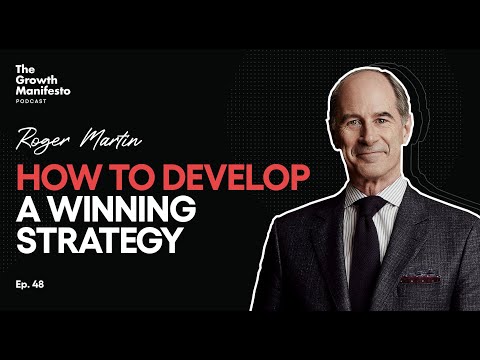
1. Definition of Strategy and Common Misconceptions
-
What is strategy?
- Roger Martin defines strategy as "choices" — an integrated set of choices that determine what to do and what not to do.
- The core of strategy is defining "Where to Play" and "How to Win."
-
The difference between strategy and planning
- Strategy requires creativity and the ability to design the future, which is different from simply making plans.
- "A plan can succeed if executed thoroughly, but a strategy must create a better future through creative and innovative thinking."
-
Misconceptions about strategy
- Many people mistake strategy for simply a "plan" and call it a "strategic plan," but this misses the essence of strategy.
- Roger emphasizes that "strategy and planning are complementary, not substitutes."
2. Core Elements of Strategy
-
Two key strategic questions
- Where to Play?
- Includes various choices such as market segments, customer types, regions, and stages of the value chain.
- Examples: Premium consumers vs. budget consumers, specific regions (Australia, U.S., etc.), upstream or downstream stages of the value chain.
- How to Win?
- Methodology for how to combine resources to secure competitive advantage in the chosen segment.
- Examples: A unique value proposition that meets customer needs, building capabilities that competitors find difficult to imitate.
- Where to Play?
-
The essence of strategy
- "Strategy presupposes competitors. But there doesn't necessarily have to be a direct competitor."
- Example: The early development of the automobile wasn't competing with horse-drawn carriages, but with "nothing."
-
The goal of strategy
- Not simply to compete, but to make competitors move elsewhere.
- "The best strategy guides competitors to different places so that each serves different customers."
3. The Strategy Development Process
-
First step: Define the problem
- "Strategy is a problem-solving tool. Therefore, you must first define the problem you want to solve."
- A good way to define the problem is to ask "How Might We?"
- Examples: "How might we solve the problem our customers are experiencing?" or "How might we win back lost customers?"
-
Explore diverse possibilities
- Present at least 3-5 diverse strategic possibilities.
- "Possibilities must be completely different directions. Similar options with only slight differences should be excluded."
-
Selection criteria
- For each possibility, ask:
- What must be true about the customer?
- What must be true about our capabilities?
- What must be true about the competition?
- "The most important question in strategy is not 'What is true?' but 'What must be true?'"
- For each possibility, ask:
-
Identifying barriers
- Identify the "most concerning things that must be true" for each possibility.
- These are called "Barriers for Choice," and you design tests to address them.
4. Execution and Continuous Monitoring
-
Strategy execution
- Execute the chosen strategy while checking daily whether "the things that must be true are still true."
- "Strategy is something you must think about every day, not something you review only annually."
-
Capability building
- Build the capabilities needed for strategy execution and develop specific plans for them.
- Examples: Investment in new technology, talent, and systems.
-
Management systems
- The key to making strategy sustainable is the management system.
- Example: The Four Seasons Hotels case
- Employee hiring: All employees must pass 3 in-person interviews, with the final interview conducted personally by the hotel general manager.
- Low turnover: While the hotel industry averages 70% turnover, Four Seasons maintains 5%.
- "Management systems are essential for building unique capabilities and maintaining competitive advantage."
5. Measuring Strategic Success
-
Measurement criteria
- Strategic success is measured through clear goals and metrics.
- Examples: Customer satisfaction, market share, profitability.
- "A good goal is one aligned with strategy. If the goal is simply to create shareholder value, it won't be motivating."
-
Long-term perspective
- Successful strategy considers all stakeholders (customers, employees, suppliers, the environment, etc.).
- "Good strategy builds human-friendly systems, which lead to greater success in the long run."
6. Key Insights
- Strategy is a thinking activity.
- "Strategy is not simply making plans — it's designing the future through creative and innovative thinking."
- Competition aims for coexistence, not destruction.
- "The best strategy guides competitors to different places so that each serves different customers."
- Management systems ensure strategic sustainability.
- "Management systems are essential for building unique capabilities and maintaining competitive advantage."
Recommended Resources
- Book: Playing to Win: How Strategy Really Works (Roger Martin & A.G. Lafley)
- An essential read for easily understanding the basic concepts and practical examples of strategy.
- Medium Series: "Playing to Win Practitioner's Insights"
- Strategy-related articles written weekly by Roger Martin. Available for free.
- Website: www.rogerlmartin.com
- Over 100 strategy-related articles available.
Closing
Roger Martin's strategic philosophy goes beyond simply winning in competition, aiming for sustainable success that positively impacts all stakeholders. His insights are powerful tools applicable not just in business but across all areas of life.