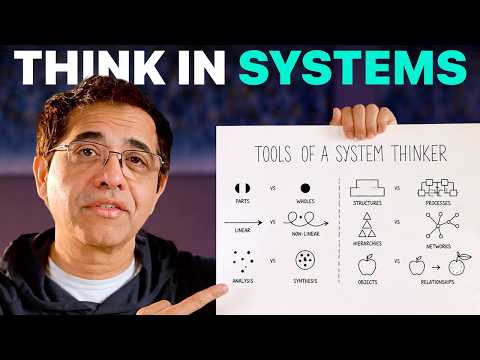
This video explains why even smart people make mistakes and emphasizes the importance of systems thinking. You'll learn how to understand systems, identify the four types of systems (clear, complex, complex, and chaotic), avoid incentive traps like the Cobra Effect, understand delayed feedback loops, and apply the DART framework to make better decisions amid uncertainty. This provides useful guidance on how to identify hidden patterns in various situations in life, understand small changes that can lead to unintended consequences, and how to respond appropriately according to the system.
1. Importance and concept of systems thinking 💡
The beginning of the video points out that we often make unintentional mistakes because we have a faulty system model, emphasizing how important systems thinking is in getting to the bottom of the problem and taking the right action. The speaker shares his experience from homeless youth to monk to CEO and board member of a multi-billion dollar company, explaining how systems thinking transformed his life.
The speaker says:
"Every week, someone smart makes a costly mistake. Not because they lack intelligence, but because they misunderstand the systems they run. We all have good intentions, but we end up with faulty mental models of the systems we operate in. Systems thinking is the ability to identify patterns before acting. In a world where AI is replacing smart people faster than expected, this is the most important skill you can have."
The simplest way to understand systems thinking is to see it as a 'set of connected parts that continually create patterns'. Our companies, careers, and marriages are all examples of systems. Taking a coffee shop as an example, customers, menus, cashiers, baristas, espresso machines, etc. are all 'parts' of the system and are connected by the idea of 'order flow' to create the pattern by which coffee is made. Observing connections and patterns beyond parts like this is the core of systems thinking.
2. Why is systems thinking confusing? 🧐
There are three main reasons why we find systems thinking difficult.
2.1. I don't know what system I belong to 🤷♀️
The first reason is that you often don't know what system you are in. The video introduces four types of systems and explains that each type requires a different approach to solving problems. So if you don't know what system you're in, it's difficult to find the right approach to solve your problem.
2.2. Cobra Effect (Incentive Problem) 🐍
The second is the 'Cobra Effect' or Incentive Problem. In the early 1900s, British officials in India, concerned about the growing cobra population in Delhi, implemented a policy of paying a bounty for each dead cobra. However, instead of catching cobras, people bred them to collect more bounties, and eventually the number of cobras increased.
The speaker says this about this phenomenon:
"Policies were designed to reduce the number of cobras in the city, but ended up increasing their numbers. This is a perfect example of the incentive problem. If you give rewards to the wrong things, people ignore the goals of the system and optimize the system for rewards. Humans confuse the system."
In other words, when the original goals and incentives of the system are misaligned, people follow the incentives and distort the system.
2.3. Delayed Feedback Loop ⏳
The third is delayed feedback loop. The effects of some actions do not appear immediately and may be observed only after a very long time. For most of the 20th century, cigarettes were part of the culture, and the instant gratification of smoking was great. However, the deterioration in health caused by smoking appeared decades later. Since one or two cigarettes did not seem to cause lung cancer, people did not immediately realize its seriousness. The time lag between immediate gratification and long-term damage makes the system difficult to understand.
3. Four system types and response strategies 🗺️
Although all systems look similar, the way a problem is solved varies depending on the type of system. The video presents four major types of systems and strategies for responding to each.
3.1. Clear System ✨
A clear system is a system in which cause and effect relationships are directly observable or easily identifiable. The results are predictable, and if you follow established procedures, you will get the results you want.
- Features:
- Cause and effect are clear.
- If you follow the procedure, you can predict the results.
- Accuracy and precision are important; innovation or originality is not necessary.
- Example:
- Van Halen's M&M Chocolate: The rock band Van Halen included a clause in its 400-page contract that 'M&Ms, except brown M&Ms, will be backstage.' If a brown M&M was found, it was taken as a clear sign that the venue had not read the terms of the contract properly and a stage safety inspection was conducted immediately.
"If a band goes backstage and finds a bowl of brown M&Ms, they immediately know the venue didn't read the contract very closely. And if the venue missed a small detail, they probably missed something dangerous in their stage set-up as well."
- Cooking Recipes: Follow the recipes to create delicious dishes.
- Pre-operative hand washing procedures: There is a clear system followed by a strict protocol for surgeons to wash their hands at a set time and method before surgery.
- Van Halen's M&M Chocolate: The rock band Van Halen included a clause in its 400-page contract that 'M&Ms, except brown M&Ms, will be backstage.' If a brown M&M was found, it was taken as a clear sign that the venue had not read the terms of the contract properly and a stage safety inspection was conducted immediately.
- Response Strategy:
- Use a checklist: It is important to follow a clear process and execute it with precision. Even experienced doctors and pilots use checklists to reduce mistakes.
- Observation: When a problem occurs in the system, clear signals (e.g. brown M&Ms) provide insight into the status of the entire system.
3.2. Complicated System 🧠
Complex systems are systems where cause and effect relationships are not immediately clear, but can be understood through analysis or expert help. It is difficult to understand because many factors are intertwined, but the answer exists.
- Features:
- It is difficult to understand the relationship between cause and effect.
- Professional analysis and knowledge are required.
- The answer exists, and experts can find it.
- Example:
- Chest pain in emergency room patients: When a patient complains of chest pain, there can be dozens of causes. Professional diagnosis (analysis) is required.
- Home Purchase and Mortgage Selection: Complicated factors such as loan structure, fixed/variable interest rates, terms, etc. need help from a professional (financial expert) to understand and make the right decision.
- Medical diagnosis, financial modeling, tax planning, aircraft repair and more.
- Response Strategy:
- Slow down and analyze: You should take enough time to analyze the problem without rushing.
- Find an expert: You should seek help from a professional (CFO, lawyer, mechanic, etc.) with knowledge and experience in the field.
3.3. Complex System 🌀
Complex systems are systems in which cause and effect relationships become clear only after the fact, are difficult to predict, and are constantly changing. Even expert predictions are difficult to understand, and there is no set answer.
- Features:
- Causes and effects become clear only after the fact.
- It is difficult to predict and is constantly changing.
- Even experts find it difficult to come up with a perfect solution.
- Example:
- Cultural integration after a corporate merger or acquisition: When a large technology company where the speaker worked as COO acquired another company, it looked perfect on paper, but the differences in the two companies' cultures created serious problems. The outcome was unpredictable, and failure only became clear after the fact.
"What brings the two companies together is a complex system. In such a system, cause and effect are only visible after the fact. In these situations, hiring experts doesn't help much."
- Change in the way employees work after introducing AI tools: Hiring AI experts to introduce new AI tools is a complex system, but Change Management, in which employees accept these tools and change the way they work, is a complex system. Only time will tell whether it will be successful or not.
- Teen Parenting: Raising a teenager whose mood and behavior changes every week is a complex system that is difficult to solve with only a set manual or expert advice.
- Cultural integration after a corporate merger or acquisition: When a large technology company where the speaker worked as COO acquired another company, it looked perfect on paper, but the differences in the two companies' cultures created serious problems. The outcome was unpredictable, and failure only became clear after the fact.
- Response Strategy:
- Small experiments and real-time adjustments: Since we don't know the answer, we need to repeat small-scale experiments and make real-time adjustments based on the results.
- Maintain Direction: It is important to remain 'directionally correct' rather than precisely correct.
- Adaptability: Requires high adaptability to change.
3.4. Chaotic System 🌪️
Chaotic system is a system where cause and effect relationships are completely impossible to understand, and information is incomplete and constantly changing. Prediction and even analysis are impossible, and immediate action and stabilization are top priorities.
- Features:
- The connection between cause and effect is completely broken.
- Information is incomplete and unpredictable.
- Immediate survival and stabilization are most important.
- Example:
- Tylenol Injection Incident (1982): When someone poisoned Tylenol capsules, killing several people, Johnson & Johnson had no idea the extent of the risk, whether the product was safe, or whether additional deaths were possible.
"No one knew how widespread the risk was. No one knew which diseases were safe. No one knew if there would be more deaths. It's a chaotic system."
- Earthquake Occurs: When an earthquake occurs, there is no time to analyze patterns or respond. Immediate action is the only way to ensure safety.
- Tylenol Injection Incident (1982): When someone poisoned Tylenol capsules, killing several people, Johnson & Johnson had no idea the extent of the risk, whether the product was safe, or whether additional deaths were possible.
- Response Strategy:
- Stabilize the situation by acting immediately: Analysis, expert help, checklists, etc. are meaningless; stabilizing the situation with immediate action is the top priority. (Example: Johnson & Johnson immediately recalled 31 million bottles of Tylenol.)
- Analysis after ensuring safety: Only after the situation has stabilized can the cause be identified and understood.
- Avoid analysis paralysis: You must avoid 'analysis paralysis', which is when you only analyze to get all the information in confusion and then do nothing.
4. DART Framework: System Diagnostic Tool 🎯
In real life, there is no clear distinction between system types, so you need a tool to figure out which system you are in. The speaker presents the DART framework for this purpose.
- D (Deconstruct): Deconstruct. Break the problem down into smaller parts to figure out what the system consists of. Let's look at whether these parts are stable or constantly changing.
"D is for Deconstruct. Divide the problem into sub-parts. Are these parts stable or constantly changing? Before you decide anything, you need to see what the system is made of."
- A (Analyze): Analyze. Understand how cause and effect are connected.
- Is it clear?: Then it is a clear system.
- Can it be discovered through analysis?: If so, it is a complex system.
- Emerging, constantly changing, and only known after the fact?: If so, it is a complex system.
- Is it completely disconnected?: If so, it's a chaotic system.
"This single question will tell you what system you are in. And once you know, you'll know what to do next."
- R (Recognize): Recognize. Ask if they have seen a similar pattern before. The ability to recognize similar patterns in different systems, even if they aren't exactly the same situation, is a great skill.
- T (Test): Test. Run the smallest possible test before committing to a full response. However, it is important to remember that in a chaotic system there is no time for testing.
5. Step outside the system and observe 🔭
The system we are part of is quietly training us. The problem is that when we are in a system, it is difficult to see where it is taking us. It's like when you're at a train station and it's hard to know whether your train or the train next to you is moving. In times like these, you need to take an outsider's perspective.
Here are three ways to do this:
- Mentor: A mentor outside of our world who has no conflict of interest and can watch our train from the platform.
"A mentor is someone who stands on the platform. Someone who is outside your world and has no stake in your story. They can see your train from the platform."
- Data: Numbers don't tell our stories. Data that shows what a system actually does is our greatest asset, revealing the objective truth, contrary to what we believe.
- Time: Time tells the greatest truth. If you compare yourself to who you were a year ago, a month ago, or a week ago, you can see which direction the system is moving.
The narrator uses his own experience as a teenager trying to become a monk as an example, and says that with the help of mentors, honest data, and truth-telling friends, he realized that he was running away from his father rather than finding true meaning.
6. Breaking stereotypes and redesigning the system 🚀
In business, we are often faced with the binary choice of whether to build a 'Ferrari' or a 'Toyota'. In other words, is it a high-margin luxury product or a mass-produced everyday product? However, the speaker points out that this dichotomous choice is a limitation of system design, not a limitation of reality.
The speaker emphasizes this point by citing the example of Apple.
"Most of these binary choices are limitations of system design, not limitations of reality. Look at Apple. They make 350 iPhones every minute, not every hour, but every minute. Mass-market luxury products shouldn't exist, but they do. That's because Steve Jobs and Tim Cook built a system that hasn't been around for 20 years. They rejected that binary choice."
Ultimately, the most difficult systems are the ones we build in our heads: the stories we accept about ourselves and our beliefs about our limitations. But this story, like any other system, can be completely reimagined. We can be both 'Ferrari' and 'Toyota' at the same time. The world will treat us according to our level of boldness and hope.
In conclusion
This video emphasizes that systems thinking is an essential skill for understanding a complex world and making wise decisions, and presents four types of systems, corresponding response strategies, and the DART framework for diagnosing situations. Additionally, it is important to step outside of the system and gain an objective perspective, encouraging the courage to redefine one's own limitations and open up greater possibilities. If you want to understand complex problems clearly, the wisdom of systems thinking will help you create a better life! 😊