This article deals with the Longevity Industry, which emerged as interest in healthy longevity increased. We explain in detail how changes in people's health management trends, the development of wearable devices and AI technology affect the longevity industry, and what efforts global companies and domestic startups are making in this field. In particular, it highlights the challenges facing this industry along with billionaires' investments in reversing aging and suggests future directions.
1. All roads lead to a healthy long life 🏃♀️💨
These days, people's perception of health care has changed a lot. The 'healthy pleasure' culture, where people choose zero-sugar drinks instead of alcohol, make exercise a part of their daily routine, and take care of their bodies, is becoming popular.
1.1. NOLO(No and Low Alcohol) Trend 🥂🚫
Recently, domestic alcohol consumption has decreased by the largest amount ever, and the preference for 'non-alcoholic/non-alcoholic (NOLO)' products is increasing, especially among the 2030 generation. This can be confirmed by statistics showing that 44% of E-Mart's non-alcoholic beer purchasers are in their 20s and 30s, and by a Gallup survey showing that the adult drinking rate in the United States has reached an all-time low.
1.2. Spread of health data sharing 📲📊
As the spread of wearable devices expands, the culture of routinely collecting and sharing personal health data is spreading. Reddit even has a 'r/QuantifiedSelf' community where people share their body and life data. People are actively exchanging information, sharing sleep patterns, changes in heart rate, and even changes in body condition after a cup of coffee.### 1.3. Growth of Longevity Industry 🚀📈
1.3. Growth of the Longevity Industry 🚀📈
Rock Health, an American healthcare accelerator, has already classified the 'Longevity Industry' as the 'Developing' stage. This means that Longevity has moved beyond just a fad and entered a verifiable industry category. Rock Health predicted that in the future, "competition will shift to a layer that 'translates' the influx of body data into specific consumer behavioral guidelines."**
2. My data pinned to my wrist, ring, and toilet ⌚💍🚽
What supports the trend toward healthy longevity is technological advancement. A variety of companies, from big tech companies such as Apple and Google to startups such as WWOOF, Oura, and Withings, are entering this market and leading technological innovation.
2.1. Wearable device band, ring 🖐️👂
The global wearable market is expected to grow to approximately $83.5 billion (approximately 126 trillion won) in 2025. Rock Health assessed, "As the range of wearable form factors continues to expand, there will be a transition from mere novelty to practical adoption by 2025."* Apple Watch: In addition to heart rate and electrocardiogram (ECG), a 'high blood pressure notification' function has been introduced with permission from the U.S. Food and Drug Administration (FDA) starting in September 2025. Sleep apnea notification and sleep score functions have also been added, evolving into a health data hub on the wrist. Apple expects to identify more than 1 million undiagnosed patients with high blood pressure in the first year through the high blood pressure notification function alone.

- Whoop: This is a smart band created by the American startup Whoop. It measures heart rate, respiratory rate, skin temperature, and blood oxygen saturation to determine 'Recovery score' and 'Strain score.' Starting with 'Oop 5.0', released in May 2025, we are expanding the scope of longevity coaching by introducing biological age and aging speed indicators. We are using a business model that only charges a subscription fee ($199 to $359 per year) without the cost of the device.
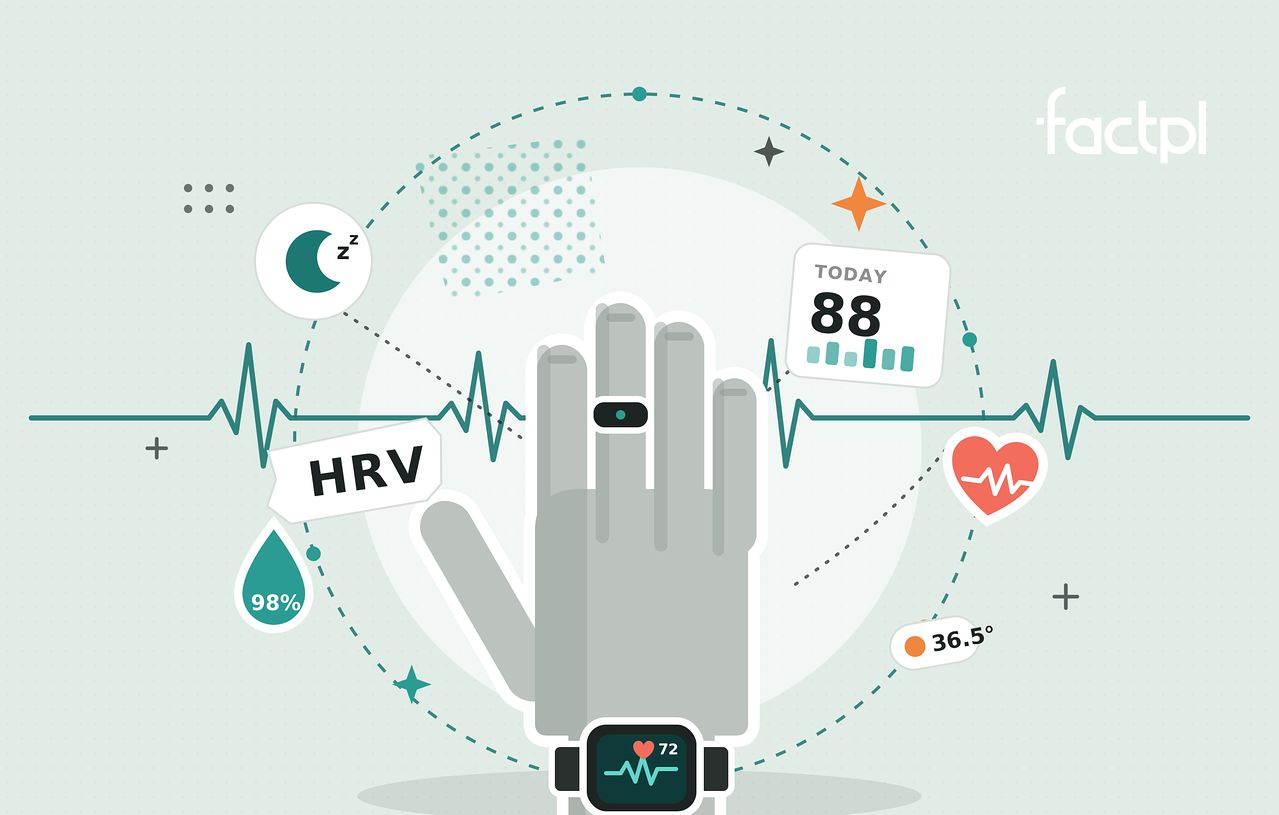
- Oura Ring (Oura): This is a smart ring from Finnish startup Oura. It collects data such as HRV (heart rate variability), heart rate, body temperature, sleep stage, and blood oxygen saturation and analyzes sleep, resilience, and stress indicators. It is said that the finger has an advantage in measuring sleep and recovery because blood flow signals are captured more stably than the wrist.

2.2. Importance of HRV (Heart Rate Variability) data ✨
There are three reasons why companies pay attention to 'HRV (Heart Rate Variability)' data.
-
Measurement cost is low: It is cost-effective because the measurement is automatically collected 24 hours a day through wearable devices such as smart bands or rings.
-
A variety of health conditions can be inferred: You can determine various health indicators at once, including stress, sleep, blood sugar, and recovery status.
-
Advantageous for user retention: Since the value changes every day, it becomes a factor that keeps users accessing the app.
However, HRV values can fluctuate significantly depending on age, gender, device, and measuring position, and individual trends are said to be more important than absolute values, so be careful. How accurately and reliably this wavering signal is interpreted is the key to technological competitiveness!
2.3. Non-wearable devices 🛀🚽
The market for 'non-wearable longevity devices' is also emerging for people who find it inconvenient to wear something on their body.* Into the most secret space: French healthcare company Withings introduced 'U-Scan,' a home urine biomarker analysis platform, at the 2025 CES. The biochemical sensor attached to the toilet analyzes the pH, vitamin C, and moisture status of urine and transmits it to the app. Kohler, an American company, also released a smart device called 'Dekoda' that can be installed inside a toilet to detect blood in feces and analyze water intake status.

- AI startup's human body scanner: Image generation AI startup Midjourny has unveiled an underwater ultrasound full-body scanner called 'Midjourny Scanner'. It is said that when you submerge yourself in a circular water tank, it emits ultrasonic waves for about 30 seconds to scan your entire body, creating a 3D map of the inside of the human body down to the millimeter level. Neko Health was also recognized for its corporate value of $1.8 billion with its 15-minute full body scanning technology. Their weapon is to provide data such as organs, blood vessels, and body composition more cheaply and conveniently than MRI, but there are concerns in the radiology community that it may lead to unnecessary additional tests and patient anxiety.
3. Companies moving straight into 'health data' 🚀🏢
The development of the Longevity industry is closely linked to the development of AI technology. AI가 미세한 신체 데이터를 더 정교하게 해석하기 시작하면서 이 산업은 더욱 가속화되고 있습니다.
3.1. Where are global companies going 🗺️
- From measurement to inference: The Apple Watch Series 11's high blood pressure notification function does not directly measure blood pressure, but rather observes blood vessel response patterns with an optical sensor and analyzes them with AI to inform "Go to the hospital because there are signs of high blood pressure." This shows the major trend of recent technology moving beyond data 'measurement' to 'inference'.
- AI companies are also eyeing: AI companies are also aiming to become personal health data hubs. OpenAI launched 'ChatGPT Health' in January of this year, providing the ability to answer user questions based on medical records and body data. Antropic also released 'Claud for Healthcare', and Google reorganized the Fitbit app into the 'Google Health' app and introduced the Gemini-based 'AI Health Coach'.

3.2. K-startups are also running 🇰🇷
Domestic startups are also targeting niche markets by precisely interpreting minute numbers and providing solutions that are helpful in everyday life.* Personally customized healing sound: Founded by CEO Bae Ik-ryeol, who has a doctorate in nursing, 'Stress Solution' analyzes HRV data and provides 'healing beats', a sound tailored to each user's heart waveform. CEO Bae said "Algorithm accuracy in data measurement is improving, but I think the question of what to do with this data is still blank." Healing Beat is used in massage chairs, stress management consulting for insurance companies, mental management for sports players, etc., and an AI camera-based customized sound space called 'Healing Box' is also being installed.

- Couldn't we make decisions based on micro-signals?: Taeho Kim, CEO of TapZero, based on his experience starting a business in Silicon Valley, founded 'TapZero', a 'personal digital twin' solution that provides customized feedback by integrated analysis of personal biometric data centered on HRV. He explained "As AI technology has matured, it has become possible to remove noise and extract meaningful health indicators from fragmented microscopic body data." The 'HRV Works' app, currently in beta testing, measures biological age and recovery score, and provides advice such as "I recommend a recovery-focused routine rather than intense exercise this morning." In addition, 'Fasting Works' analyzes the nutritional content of a single meal photo, and in the future, plans to build an intelligent AI agent that links this data with personal schedules to help make business decisions.
4. Bezos and Altman also jumped in 💰🧐Taeho Kim, CEO of TapZero, said "Already 10 years ago, when Silicon Valley founders gathered, they talked about only two topics. One was space development, and the other was eternal life." If the wearable device and wellness software market is the public entrance, then there is the billionaires' bet on 'reverse aging' at the end.
4.1. The bigger picture that billionaires draw 💸
- Jeff Bezos: Amazon founder Jeff Bezos invested $3 billion (approximately 4 trillion won) in Altos Labs, a startup developing aging reversal treatments based on 'cell reprogramming' that returns old cells to young cells.
- Sam Altman: OpenAI founder Sam Altman invested $180 million in Retro Bioscience, a startup developing new drugs that regenerate cellular aging.

- Peter Thiel: Palantir founder Peter Thiel has invested more than $700 million in 12 companies researching life extension, etc., and is also interested in 'parabiosis' technology.
4.2. The mountain that needs to be climbed 🏔️
There are several challenges that must be addressed for the Longevity industry to succeed.* Health device or wellness: Many companies are positioning themselves as 'wellness' companies to avoid the regulatory risks of medical device certification. In fact, WWOOF received a warning from the FDA after pushing the blood pressure estimation function to wellness. Even in Korea, institutional barriers still remain in the business of linking health data to medical care.
- Lack of a 'translation layer': No matter how precise the measurement technology becomes, if it only measures microscopic values in milliseconds and gives vague advice such as "Don't overexert yourself and take a break today", it will be difficult to be chosen by consumers. As Rock Health's analysis shows, the role of the 'translation layer' will become important, and in the end, the real success of this industry depends on beyond 'how well you measure it', it depends on how well you interpret the numbers and change the daily lives of users.
Conclusion ✨
The Longevity industry is growing rapidly due to the continuous human desire for a healthy long life and technological advancements. From wearable devices to AI-based health analytics and billionaire investments in aging reversal, our health care is expected to become more personalized and sophisticated in the future. However, for this industry to truly succeed, it will be essential to develop a 'translation layer' that goes beyond simple data measurement and provides meaningful solutions that can positively change users' lives based on that data. We look forward to seeing how Longevity Industry will change our daily lives and health in the future! 😊