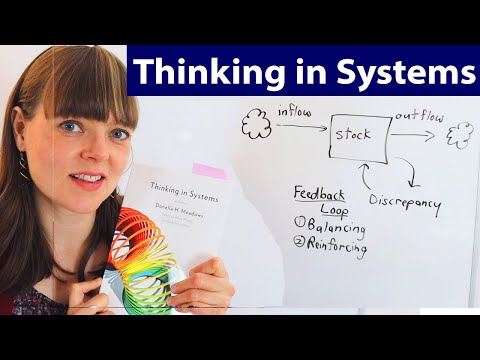
This video explains the core concepts of systems in an easy and fun way through Chapter 1 of Donella H. Meadows' book 『Thinking in Systems』. We learn what a system is, its constituent elements, connections, and purposes with various examples, and we cover in detail the concepts of stock and flow, as well as balanced feedback loops and reinforcing feedback loops, which are essential for understanding the dynamic characteristics of the system.
1. What is a system? 🧐
Professor Ashley Hodgson introduces Donella H. Meadows' book 『Systems Thinking』, emphasizing that this book provides very useful tools and vocabulary for structuring thought experiments and thoughts not only in economics but in all fields.
To answer the most basic question, "What is a system?", Meadows presents three key elements:
- Elements: The parts that make up the system, that is, the static appearance of the system. It can be described as "when you take a snapshot of a system and try to diagram it, it's what's in the system at that moment."
- Connectors: This is the part that connects elements to each other, forms relationships, and creates dynamic movement. Professor Hodgson says that from an economist's perspective, this 'link' is the same as incentive.
"Incentives essentially create dynamics within the system."
- Purposes: This refers to why the system exists, i.e. what the system actually does or achieves. The important point here is that stated objectives do not always match actual objectives.
Understanding various system examples 💡
Professor Hodgson explains various systems as examples to understand the concept of these systems.
- School System:
- Elements: teachers, students, buildings, etc.
- Link: Salary system (forming relationships between teachers and administrators), contracts (acting as incentives)
- Purpose: Education (stated purpose)
- Legal System:
- Elements: Laws, judges, lawyers, etc.
- Link: Legal review process (process of applying law and reviewing precedent)
- Purpose: Crime deterrence
- Digestive System:
- Elements: stomach, small intestine, large intestine
- Links: body signals (e.g. stomach discomfort), chemicals, nervous system
- Purpose: To nourish the body, sustain life.
- Health Care System:
- Elements: Insurance companies, hospitals, doctors, patients, pharmaceutical companies, etc.
- Link: Contract between insurance company and doctor, contract between patient and insurance company
- Purpose: Improve health (triple aim: high population health, reduced cost per capita, patient satisfaction)
Professor Hodgson explains the purpose of the health care system, highlighting the gap between stated and actual purposes.
"When I teach this, I teach the Triple Aim, which is what the purpose of a health care system should be. And that's where some of the differences arise between the stated purpose and the purpose that is actually achieved."
He points out that sometimes the system aims to increase its size, which can be linked to increasing power at the top of the system.
2. Important features of the system 🌟
Meadows provides important insights into the essential properties of the system.
"A system is more than just the sum of its parts."
This means that a system is not simply a collection of individual elements, but a complex that achieves something through dynamic interactions between the elements.
The system is also said to have self-organizing and self-healing. Just as our body's immune system heals itself when injured, some economic systems also have natural forces that lead to stability and self-maintenance.
What is especially noteworthy is that information flow plays a very important role in the linkage of the system.
"Many interconnections operate through flows of information."
In modern society, information constitutes a significant portion of society's resources, and this can be seen in a variety of areas, including business improvement, health care, and lifestyle.
Why connections are more important than elements 🌐
Interestingly, Meadows points out that when people think of a system, they tend to focus on elements. Elements are easy to visualize and clearly look like a snapshot of the system. But she emphasizes that it is actually the 'links' between the elements that are more important in determining the purpose of a system.
To explain this point, I use a basketball team analogy.
"If you replace every player on a basketball team with someone else, it doesn't change the system much. But if you change the rules of the game, the system is completely different."
In other words, changing the rules (links) has a much greater impact on the entire system than changing the members (elements).
3. Dynamic characteristics of the system: stock and flow, feedback loop 🔄
The concepts Stock and Flow and Feedback Loop are very important in understanding the dynamic aspects of the system.
Stock & Flow 🌊
Meadows explains stock and flow using a bathtub analogy.
- Stock: The state of the system at a specific point in time, i.e. the amount of water in the bathtub. This represents a snapshot without dynamics.
- Flow: A dynamic movement that changes the amount of stock.
- Inflow: A factor that increases stock, like water flowing into a bathtub when you turn on a faucet.
- Outflow: A factor that reduces stock, such as water escaping through a drain.
Stock at any given point in time is determined by previous inflows and outflows. The key insight here is that the stock of the system cannot change on the fly.
"You can't get rid of all the water in the bathtub in an instant. You have to allow the water to drain out."
This suggests that system change always takes time, and immediate change is often difficult. This stock and flow concept is also used in economics.
Feedback Loops 🔁
Meadows describes feedback loops that operate cyclically within a system, broadly dividing them into two types:
-
Balancing Feedback Loop: A loop that tends to return the system to a state of balance.
- Example: Budget and bank balance management 💰
- Stock: Money in your bank balance
- Inflow: Monthly income
- Outflow: Monthly expenses If your bank balance is less than your target (mismatch), you are motivated to spend less, which in turn affects your balance and brings you closer to your target. Checking your budget every month is a little balancing feedback loop.
- Example: Budget and bank balance management 💰
-
Reinforcing Feedback Loop: This is a loop that causes the system to move out of balance and move in a spiral.
- Example: Meadows and her younger brother fighting as children 😠
- Stock: Favorable feelings (goodwill) between siblings. If a younger brother teases a younger sister, the younger sister tries to react more harshly, and the younger brother reacts even more violently. This creates an escalating spiral where the fight gets bigger and bigger as they stimulate each other. This process of getting worse and worse until the fight stops is an interesting example of a reinforcing feedback loop.
- Example: Meadows and her younger brother fighting as children 😠
4. Conclusion
Professor Hodgson concludes the summary of Chapter 1 by emphasizing that systems thinking is very useful in understanding complex systems and will also be of great help to economists in broadening their thinking. Through this book, you will be able to clearly understand the elements, connections, and purposes that make up the system, and by applying the concepts of stock, flow, and feedback loop, you will be able to analyze complex phenomena around you more deeply. 📚