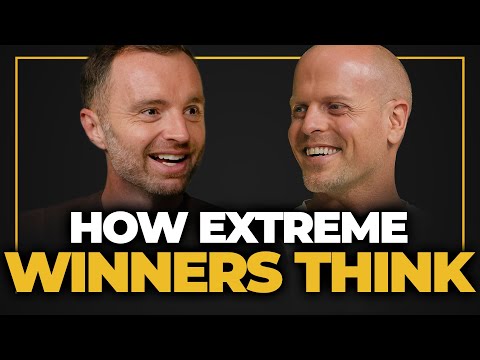
Drawing on nine years of studying the lives and mindsets of over 400 of history's greatest founders and entrepreneurs, David Senra explores the mindset of extreme winners, differentiation strategies, what lies behind success and failure, and unique approaches to content creation. The conversation is rich with striking insights about the relentless focus, self-care, obsessive pursuit of one's own path, and the true meaning of growth and impact that most "extreme winners" share.
1. Differentiation and Obsession: What Winners Have in Common
Founders who achieve extreme success share a common trait: they are obsessively devoted to one thing. David frequently cites James Dyson and Edwin Land as prime examples.
"Edwin Land always said, 'My personal motto is: never do anything that someone else can do.' Differentiation is survival itself. And yet, remarkably few people truly understand that."
Dyson, too, insists on his own principle: "Products must be different, no matter what. Even if performance suffers slightly, differentiation comes first."
Three key attributes of the differentiation and obsession these individuals pursue are emphasized:
- A uniquely personal approach and tenacity that no one else can replicate
- A near-obsessive drive to explore quality and performance
- A strong internal motivation rooted not in success itself, but in 'why I must do this'
"At Dyson's level, even if something isn't perfect, I insist on obsessing over the one point where it's 'different.'"
2. The Exceptions Who Run on 'Positive Fuel'
While many extreme achievers are driven by deprivation, wounds, and a sense of insufficiency -- dark and gloomy motivations -- a small number like Brad Jacobs, Ed Thorp, Sol Price, and Brunello Cucinelli draw their motivation from positivity and love.
"Brad is driven by love. He's a rare exception -- someone who works because of positive energy, not negative motivation."
These individuals share the following traits:
- They nurture harmonious relationships with family and those around them
- They stop pursuing wealth or status beyond a certain threshold
- They place work at the center of life, but do not treat it as everything
The fact that this type accounts for only 1--2% of the total underscores that positive motivation is an extremely rare trait even among extreme winners.
3. From Information Consumption to Behavioral Change: The Essence of True Learning
The insight emerges that simply consuming more information does not change you -- that "learning" is only meaningful when it leads to behavioral change.
"If more information were the answer, we'd all be billionaires with model physiques."
David confesses about himself: "I had no mentor, so I read biographies obsessively, trying to make the great figures in those books my surrogate mentors."
"What I do is a one-way conversation. I cram the lives of great founders into my head, then organize and translate that into action. That is real change."
He repeats the routine of reading, note-taking, reviewing, and organizing-then-executing with extreme tenacity. His conclusion: "If you haven't changed your behavior, it's all just mental gymnastics."
4. Extreme 'Obsession,' Critical Thinking, and the Art of Note-Taking
David reveals that he has "OCD-level obsession." When reading any book, he underlines by hand, attaches post-it notes, and brings an almost artisanal level of care.
"I always carry a ruler and scissors to draw lines properly. I cut my notes neatly and write key points and connections on post-its."
He stores these accumulated materials in databases like Readwise, periodically re-reading them to "reactivate" insights.
He also emphasizes a specific execution routine: "I create an index at the front of the book and always specify at least one next action."
5. The Diverse Archetypes of Founders -- There Is No Single Model: Designing Your Own Path
Founders who achieve extreme success cannot be explained by a single common model. Various archetypes coexist -- business, art, analyst, negotiator, craftsman, and more.
"Bill Gates, Larry Ellison, and Elon Musk have completely different DNA. You shouldn't blindly follow a model. Instead, you should reflect on your own 'how' and synthesize something that fits you."
Key points here:
- Relentless focus
- Long-term vision
- A business model that feels 'natural' to you
- Your own 'inner standards'
Advice received from Daniel Ek (Spotify) is particularly memorable:
"The reason people find it easy to help you is that you're clear about what you want. Not every founder needs to be Steve Jobs or Elon Musk."
6. The Power of Indifference and Low Self-Reflection, and Instinctive Focus
The best practitioners in the field actually have low "unnecessary self-reflection" -- once they find their path, they enter the 'immediate execution/focus' stage.
"Someone like Sam Walton doesn't agonize every day about 'what am I feeling, what does today mean?' He just focuses on building one more Walmart and making it better."
On the other hand, a realistic warning is added: uncritical imitation or excessive self-justification can lead to immoral or sociopathic behavior.
7. Failure and 'Luck,' and the Question of Trainable vs. Innate Traits
Following the success stories of various individuals naturally raises the question: 'Does a similar personality and method always lead to success?' Here, David emphasizes:
- Innate traits and trainable traits must be clearly distinguished
- Ultimately, your own judgment and ability to calibrate matters most
- Luck, timing, and external circumstances cannot be ignored
"James Dyson's relentless obsession led to success, but someone equally obsessive and stubborn could just as easily get the opposite result. Nobody can give you a formula."
8. Impact and Satisfaction: The Ultimate Measure of Success
After deep exchanges with recently successful founders, the conclusion is that simple happiness is not the goal of life. As Daniel Ek puts it, 'impact' can be the core motivation.
"Not happiness -- impact. That is real life."
Additionally, building up the "best day possible" each day, rather than long-term planning, is the true source of self-satisfaction and sustained growth.
"Good days add up to a good life. I try to design today and tomorrow well, not one year or five years from now."
9. 'Scaling Relationships' and the Meaning of Podcasting
Describing the podcast medium as 'relationship-building at scale,' the conversation emphasizes that building truly meaningful relationships and trust is far more important than short-term revenue or fame.
"I'm not building a media company -- I'm building 'relationships' at scale."
He also stresses that walking alongside a few truly helpful, truly trustworthy people over the long term is more meaningful than a shallow network of hundreds or thousands.
"In a life where you meet thousands of people, what matters most is spending nearly all your time with the few who are truly meaningful."
10. Obsessive Craftsmanship and the Essence of Energy
"No matter how big my platform gets, I still personally work on my podcast scripts, clips, and thumbnails," he says, asserting that craftsmanship and the outpouring of energy are the power of living and the source of competitiveness.
"MrBeast would tell me to 'use an editor,' but I'm only satisfied when I do it myself. As a beginner, I kept creating for five and a half years even when nobody was listening. That's the real thing."
11. Staying Realistic While Running Two Podcasts
Starting a new interview-format podcast ('David Senra'), he openly shares his concerns about building his own team and balancing the two formats.
- 'Founders' is a solo operation; the interview show is team-based
- Booking and recording locations maximize accessibility in New York/LA
- He intuitively senses when his inner energy is about to run out and calibrates accordingly
"I choose a life of filling each day to the brim rather than making long-term plans. I may not know where I'll be in two or five years, but the most important thing is feeling proud of what I did today."
12. Books, Reading, and the 'Operating System of Life'
Toward the end of the conversation, the metaphor emerges that 'books' are a kind of 'philosophical operating system' for designing one's own life and philosophy. They exchange real experiences and advice about what attitudes, mindsets, and opportunities they've gained from specific books.
"In the end, through books and the people within them, you can temporarily try on your own philosophical system."
Conclusion
This episode vividly conveys "the power of being the most relentlessly devoted person in the world," "the essence of true learning, growth, and relationships," and "how pursuing your own tenacious approach to the very end only bears fruit after a very long time."
In particular, rather than blindly believing in simplistic success formulas or mythologized models, the episode demonstrates with empathetic quotes and real experiences that your own inner motivation and approach, obsessive immersion in one thing, and good human relationships are the true foundation of success.
"If you have real passion, you can keep going for five and a half years even when nobody is there. The results naturally follow."
"The person who reflects on the 'how' of successful founders and adapts it to themselves, and the person who doesn't stop and keeps going -- that could be you. The important thing is to make one more 'best day' today."
Keyword Summary:
- Near-obsessive immersion, differentiation and tenacity, the key to information-to-behavioral-change, surrogate learning to overcome the absence of mentors, note-taking and execution routines, diversity of founder archetypes, naturalness/reflection/focus, luck and lessons of failure, impact vs. happiness, the power of relationship-building and trust, craftsmanship/energy management, reading as a philosophical operating system
Final Thoughts
This long conversation weaves together in universally relatable language the idea that "growth that comes only when you push forward tenaciously in your own authentic way, along with the imperfections, wounds, and real learning hidden within." The memorable takeaway is that even people who seem extraordinary are all repeating the cycle of their own flaws, trial and error, and small steps toward something new.
Today and tomorrow, may we all continue making one more "best day" on our journey.