In the medical AI market, "early detection" is the hottest topic — but it also carries a demanding challenge: to earn reimbursement, companies must prove a positive impact on treatment outcomes. This market divides into four quadrants based on a technology's level of structurization and the tangibility of the target disease, and the difficulty and strategy for proving value differ across each quadrant. To survive, startups need more than technical innovation — they need the flexibility to prove value in the language the healthcare system demands, or to pivot toward the B2C wellness market.
1. Crossing the Valley of Death: The Early Detection Dilemma and Classification Framework
In today's medical AI market, Early Detection is a burning issue. If you can catch a disease before symptoms appear, you raise patient survival rates and cut national healthcare costs — in theory, a win for everyone. But from a business perspective, this space is a "valley of death" that startups can easily fall into and struggle to escape.
To earn money (reimbursement) in the medical market, you must prove that your technology had a positive impact on treatment outcomes.
Regardless of whether the solution takes the form of diagnosis, treatment, or something else, earning medical reimbursement requires demonstrating a positive effect on treatment outcomes.
The problem is that early detection sits furthest from the final outcomes of "treatment" or "cure" in the clinical timeline. Because it sits at the very front of the care workflow, proving the causal link — that a patient recovered because of this test — is extraordinarily difficult.
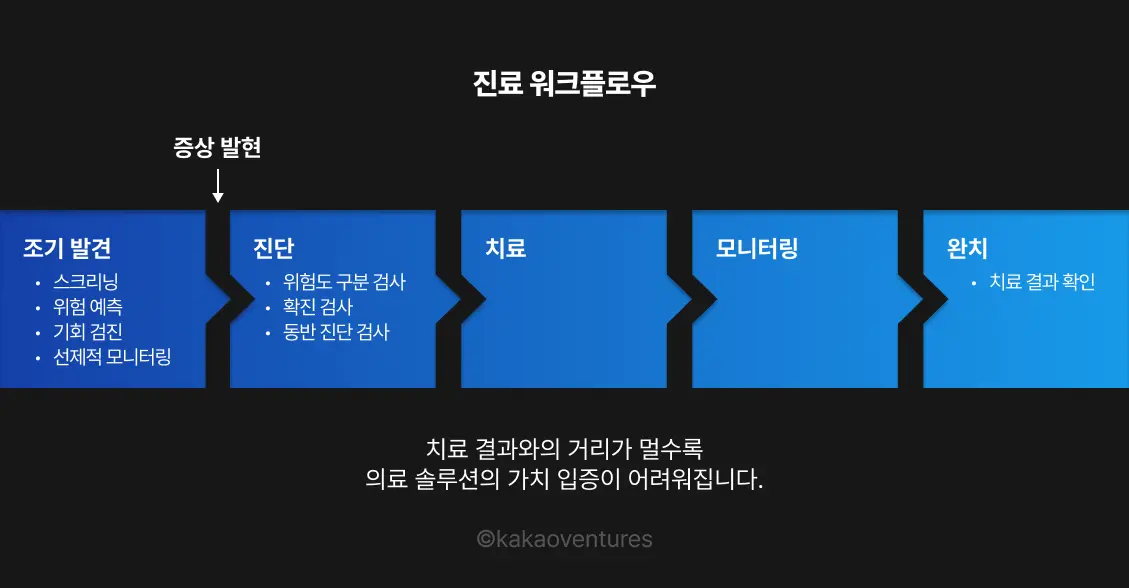
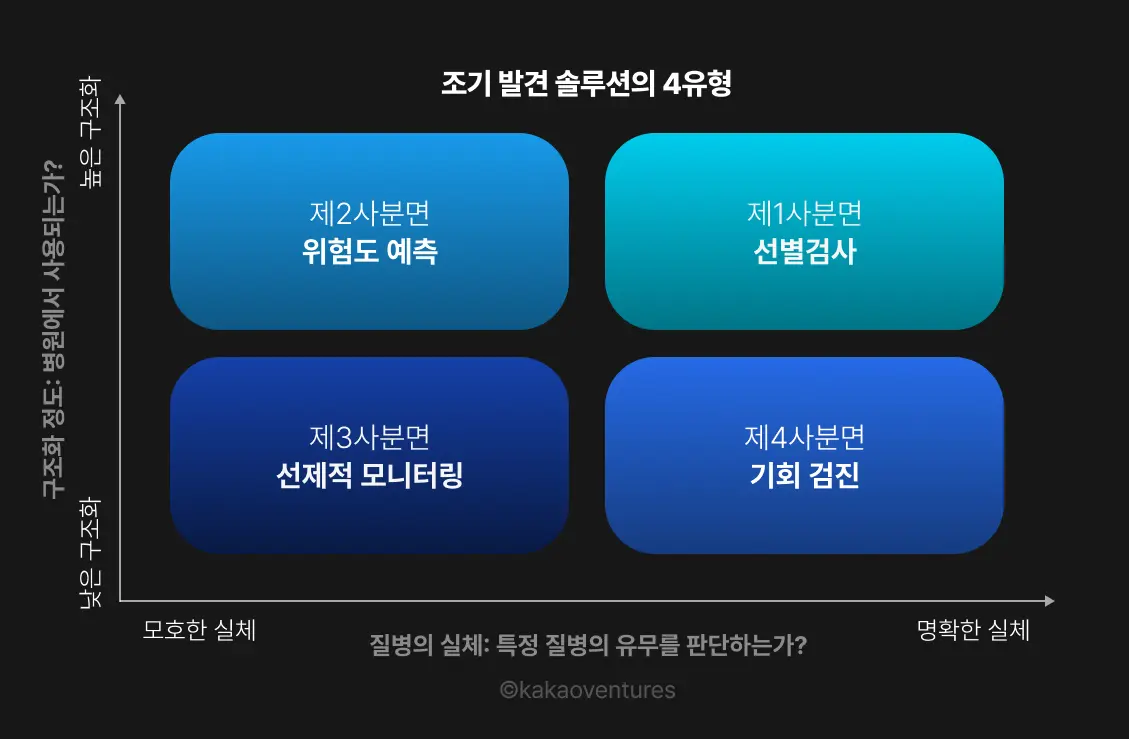
To build a successful business model through these obstacles, you need a clear understanding of the market. Kakao Ventures classified the early detection market using the following two criteria:
- Level of structurization: How well is the technology embedded within a hospital's standard clinical guidelines and physician workflow?
- Tangibility of disease: Does the test result yield a clear "disease present/absent" answer, or a probability like "15% chance of developing the disease"?
Applying these criteria, the early detection market divides into the four quadrants below.
2. Quadrant 1 [Screening]: Layering AI onto an Already-Paved Road
Screening refers to tests performed periodically to detect specific diseases — think gastric or colonoscopic endoscopies, or mammography. This quadrant features diseases with clear, tangible targets and is already embedded within the hospital care system (structure). As a result, it has the highest likelihood of earning medical reimbursement among the four quadrants.
A prime success story is Digital Diagnostics' LumineticsCore — an AI that diagnoses diabetic retinopathy and received FDA authorization as an autonomous medical AI.
The formula for success was clear: it demonstrably improved healthcare access and reduced costs by enabling primary care settings to perform a test that previously required an ophthalmology specialist.
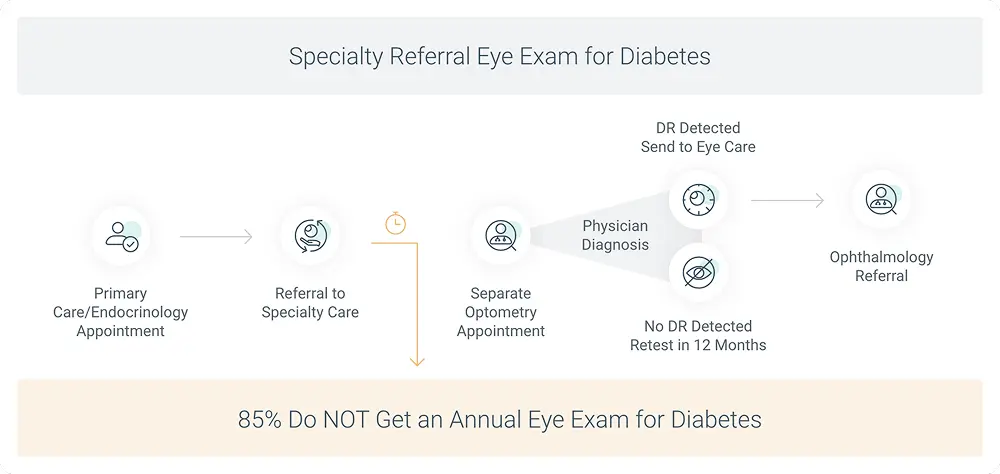
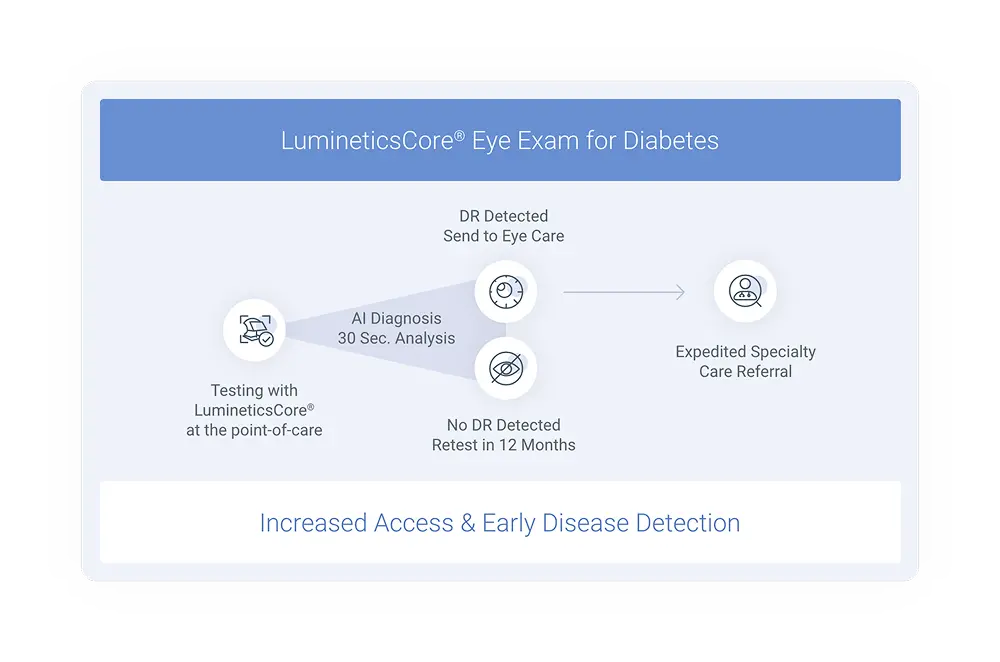
Entering an existing screening market where value is already established is relatively straightforward. However, for companies trying to introduce an entirely new test — like multi-cancer early detection (MCED) — the bar is far higher: you must prove from scratch that "this AI reduces total healthcare costs" or "dramatically improves survival rates," requiring vastly greater investment of time and money.
3. Quadrant 2 [Risk Prediction]: Moving Beyond a Simple Warning to Drive Action
Sometimes a hospital test comes back with a result like: "You don't have cancer right now, but you have an elevated probability of developing it within five years." This is the domain of risk prediction.
The problem is that insurers and the medical community won't pay simply for a calculated "you're at risk" score. If the physician has no concrete prescription or action plan to offer the patient, the risk score is just a number.
Insurers see no medical value beyond consultation in a tool that merely calculates risk from data they already possess. There's simply no reason for them to issue additional reimbursement for it.
To succeed in this quadrant, you must embed your solution within the standard clinical guidelines (structure) of the medical establishment.
Companies like iCAD and Lunit are good examples. Their AI analyzes mammography images and assigns a future risk score even in the absence of current cancer. Crucially, that score gives physicians the medical basis to say, "Your risk score is elevated — let's order an additional MRI."
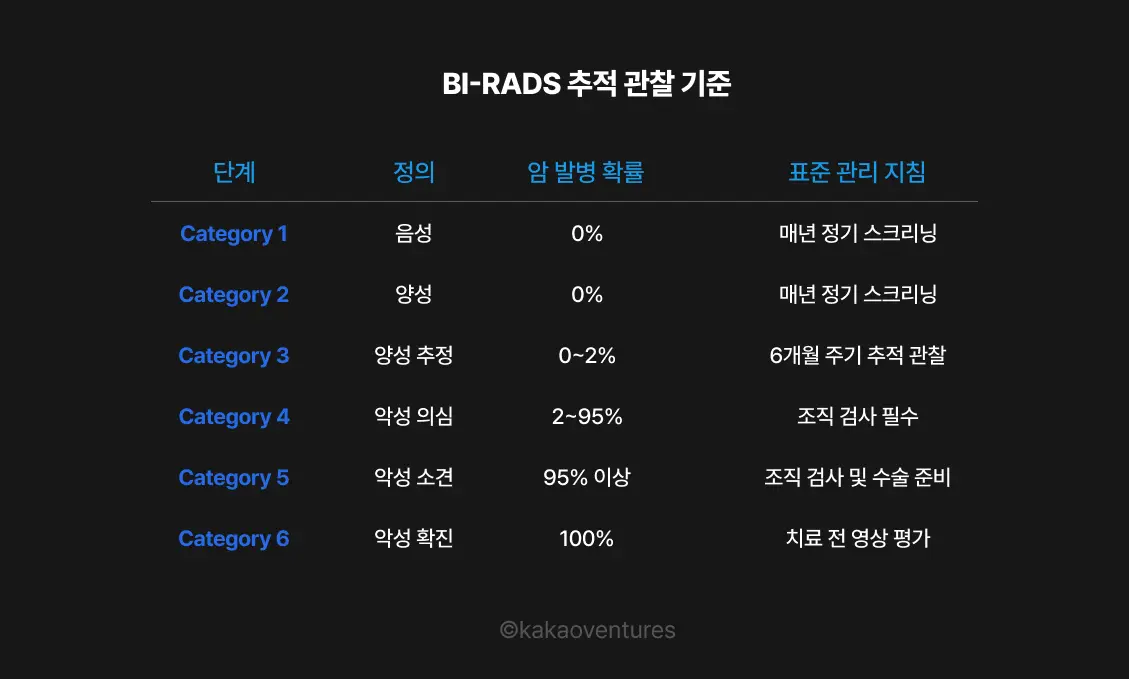
In other words, the key to Quadrant 2 is to go beyond probability calculation and clearly specify "What should be done next (Action Plan)" — becoming part of the clinical practice guidelines.
4. Quadrant 3 [Proactive Monitoring] & Quadrant 4 [Opportunistic Screening]
Quadrant 3: Proactive Monitoring (Between Medicine and Wellness)
This is where things happen outside the hospital. Think of healthy people using wearables like an Apple Watch to track heart rate or blood glucose. Bluntly speaking, this quadrant attracts the least interest from the clinical world.
Physicians are already too busy seeing acutely ill patients to pay attention to data a healthy 25-year-old collected during a workout. On top of that, if device errors drive unnecessary clinic visits, the field risks being criticized as a waste of medical resources.
Rather than forcing this quadrant into medical reimbursement, the more realistic strategy may be to position it as an appealing wellness service that consumers pay for out of their own pocket.
Quadrant 4: Opportunistic Screening (Turning Chance into Certainty)
When a CT scan ordered for lung cancer happens to reveal osteoporosis, that unintentional discovery of an unrelated disease is called opportunistic screening. As AI technology advances, previously discarded imaging data can be analyzed comprehensively, increasing the frequency of these "incidental findings."
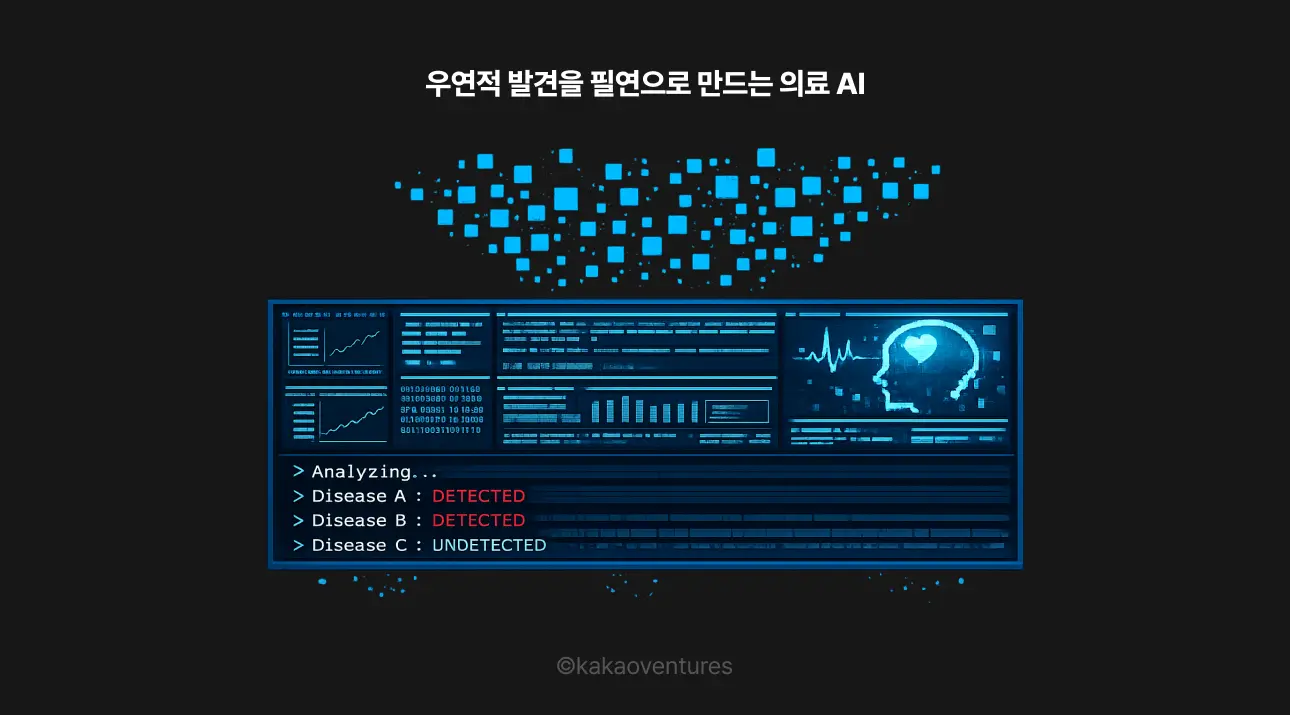
But there are significant hurdles. Insurers worry about rising unnecessary costs, and hospitals face the dilemma of increasingly complex referral pathways to treat incidentally discovered conditions.
Two conditions are required to succeed in this quadrant:
- Proven value: The disease must be one — like osteoporosis — where the benefit of early detection is already established.
- Immediate intervention possible: There must be a clear treatment option (medication, surgery, etc.) that can be initiated right after discovery.
5. Closing Thoughts: Translate Innovation into the Language of the System
To summarize: the most stable path to revenue in the early detection market is Quadrant 1 (Screening). So what should startups in the other quadrants do? As of 2026, two main survival strategies emerge.
- Enter the system (move toward Quadrant 1): The orthodox approach — invest in clinical trials to establish medical validity and work to have your technology incorporated into standard hospital screening procedures, even at significant cost.
- Capture the market (go B2C): Instead of fighting for the narrow gate of medical reimbursement, lean into the characteristics of Quadrant 3 and evolve into a wellness service that consumers genuinely love.
Ultimately, no matter how impressive the technology, it alone cannot open the door to the medical market. What founders need above all is the ability to translate their innovative technology into logic that the healthcare system can understand and accept.
What I want to emphasize is that you cannot passively expect reimbursement approval based on technological innovation alone in the medical market. The ability to translate the innovativeness of your technology into the language the system requires — that, I believe, is the most essential capability for digital healthcare founders right now.