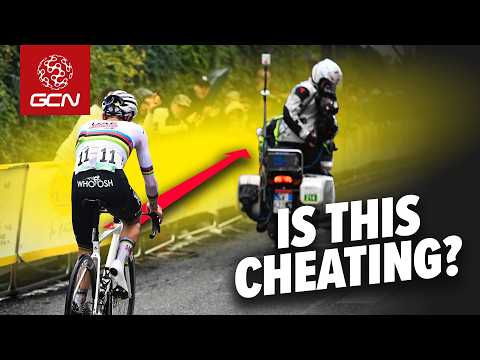
This video makes an interesting argument that the controversial 'motor doping' in professional cycling is affecting the game in different ways than we think. GCN's Dan and Simon take part in a hands-on experiment to find out just how significant the aerodynamic advantage is of riding behind a race bike, and delve deeper into how this can impact real-world race results. Comparing scientific findings with real-world experimental data, we ask the question of whether formula cars are making a fundamental difference to the results of world-class races such as the Tour de France.
1. What is the real meaning of 'motor doping'? 🏍️
One of the hottest controversies in professional cycling recently is 'motor doping'. The term usually refers to using motors hidden inside a bicycle to gain an unfair advantage, but the video talks about a different kind of 'motor doping'. In large competitions such as the Tour de France, over 100 official motorcycles are deployed for each stage, and the hypothesis is that these motorcycles can influence the outcome of the race by providing an aerodynamic advantage to the athletes. Dan and Simon set out on an experiment to directly test this hypothesis.
"That's not to say that motors aren't influencing the results of the Tour de France. There are over 100 official motorcycles for each stage of the race, so more and more teams, fans and scientists are speculating that these motorcycles fundamentally influence the results."
2. Experimental design: Measuring the effects of motorcycle drafting 🌬️
The experiment takes place on a flat, straight road 3km long. The participants are two former professional cyclists, Dan and Simon, and they use two high-end bicycles along with an electric scooter (a replacement for a motorcycle). What's especially noteworthy is the use of a red ribbon to accurately measure the distance to the motorcycle.
"Sorry. Electric scooters, to be exact. Electric scooters. We have two top-of-the-line bicycles that will be used in the Tour de France." "So we can measure exactly how far behind the motorcycle we ride. That's drafting."
The experiment is largely divided into four stages. First, to establish a baseline, we measure the power required to drive at 43 km/h without any assistance. We then measure the power required to ride at the same speed at distances of 5, 10, and 20 meters behind the motorcycle to compare the aerodynamic benefits at each distance. The speed of 43 km/h was set based on Tadej Pogačar's average speed in the 2025 Tour de France.
3. First Ride: Baseline Setting (Clean Air) 💪
The first ride was done without the assistance of a motorcycle. Maintaining a speed of 43 km/h in a strong headwind was a daunting task even for former professional athletes. Simon recorded an average power of 400 watts during this drive, vividly conveying the difficult situation.
"To be honest, it took a lot of effort to get down to 43 km/h. There was a huge headwind, the kind of headwind you don't usually see outside of hurricanes." "I hit 400 watts."
This experience once again made me realize how physically demanding it is to maintain high speeds without the assistance of a motorcycle. Dan described this ride as being like VO2 Max interval training and wondered if motorcycles really helped.
4. Motorcycle drafting driving: Effects by distance of 5m, 10m, and 20m 🌬️
Now we're ready to ride behind the motorcycle and measure the aerodynamic benefits.
4.1. 5m distance driving results 💨
When driven from 5 meters behind, the athletes were able to maintain speed with surprising ease. Simon felt so comfortable that he said, "It felt like I could run 3,500km up a mountainous section." This is an expected result that power consumption has been significantly reduced.
"I could probably run 3,500km like that. It was so easy. Damn, this is so easy."
4.2. 10m distance driving results 🍃
At 10m it wasn't as easy as at 5m, but I still felt a significant advantage. Dan commented that it was "definitely harder" than the 5m run. This suggests that the drafting effect decreases with increasing distance.
4.3. 20m distance driving results 🌬️
At 20 meters, the perceived benefit diminishes to the point where Dan says it was "really difficult." But it was still much easier than driving without any help. Dan added that fatigue may have already set in.
5. Data Comparison: Bigger difference than expected! 📊
The experimental results showed a much larger difference than expected.
-
Dan's data:
- Clean Air: 356W (4 minutes 6 seconds, 42.1km/h) 🥵
- 5m behind: 303W (15% reduction) ✨
- 10m behind: 333W (6.5% reduction) 😊
- 20m behind: 341W (4.2% less, 2 seconds slower) 😐
-
Simon's data:
- Clean Air: 404W (3 minutes 51 seconds) 🥵
- 5m behind: 30% reduction! 😲
- 10m behind: 14.4% reduction (1km/h slower) 💨
- After 20m: 8% reduction (372W vs 404W, same speed) 👍
Although their results were somewhat different (Simon's gains were greater), they explain that this may be due to "limitations of the n=2 (two participants) study." Nonetheless, it was clear that there were significant power savings when riding behind a motorcycle. In particular, it is impressive that there was a significant benefit even at a distance of 20m.
"From 5 meters behind, we saved a whopping 30%. ... 20 meters behind, at exactly the same speed, we saved 8%." "The power output being reduced by nearly 30% at 5m is huge."
6. What are the official rules? And scientific evidence 📚
So, are there any regulations to prevent this type of drafting? The video explains that there are no clear regulations from the UCI (Union International Cycling), but there are some guidelines.
"Race cars must not be allowed to interfere with the progress of the race or gain an advantage by slipstreaming, especially when athletes are fast."
Camera operators are usually instructed to shoot at a three-quarter angle, staying in front of the players but slightly off to the side. However, he points out that it is very difficult for motorcyclists to follow these guidelines perfectly, since the professional instinct is always to seek maximum slipstream. They say it is an issue that needs to be approached more carefully because the role of motorcyclists is essential to conveying the vivid scenes of the racing.
The experimental results in the video are also supported by actual scientific research. For example, in 2020, Dr. Bert Blocken's research team at Eindhoven University used wind tunnel experiments and computational fluid dynamics (CFD) to measure the drag reduction effect of riding behind a motorcycle.
- 10m behind: 23% reduction in drag (at 54km/h), which translates into time savings of more than 5 seconds per km. ⏱️
- 30m behind: 12% reduction in drag.
- 50m behind: 7% reduction in drag.
In particular, it is surprising that even at a distance of 50m, there is still a significant drag reduction effect.
7. Is this 'motor doping'? Impact on match results 🏁
In conclusion, it has been proven that racing motorcycles have a clear impact on an athlete's speed, drag, and power output. But can we call this 'motor doping'? And is it fair because it applies equally to all players?
- Fairness Issue: It can be considered fair if the conditions are the same for all riders, but different motorcyclists may have different ways of maintaining distance from the leader. Especially in time trials, a difference in distance as small as 5 meters can lead to a large difference in time.
- Celebrity Players and Motorcycles: When a celebrity athlete attempts an attack, not only TV camera bikes but also numerous photojournalist bikes can crowd in and form a giant windbreak. This means that big name players can have a bigger advantage.
"At the end of the day, if you have a guy in the lead going 70km alone and you can reduce that guy's drag just a little bit, it's going to make it easier for people who are already ridiculously strong."
The video discusses whether advances in drone technology could reduce dependence on motorcycles, but it is currently judged difficult to replace the visual beauty and realism that motorcycles provide. In the end, what matters is that race officials recognize the influence of motorcycles and manage them appropriately.
8. Closing ✨
Through this experiment and analysis, we learned that the term 'motor doping' in professional cycling goes beyond mechanical negativity and can affect the race in unexpected ways: aerodynamic advantage on racing motorcycles. Dan and Simon's fun and informative experiment made this complex problem clear and easy to understand.
This is an important topic that will continue to be discussed, and it will be important to see what efforts the UCI and race organizers will make to ensure fair competition for athletes. What do our viewers think about this issue? Please leave your opinions in the comments! 👇