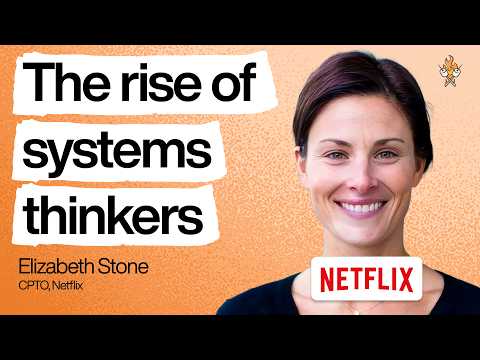
Netflix's Chief Product and Technology Officer (CPTO) Elizabeth Stone explains why Netflix values talent with systems thinking in the AI era, and emphasizes the importance of talent density, risk-taking, and a culture that makes excellence like an operating system in the changes brought about by AI. She shares Netflix's vision for the future of the entertainment industry and the role of AI, emphasizing that AI increases the usability of technology and improves the speed of work, but human judgment and responsibility remain important.
1. AI and role confusion: beyond the storming stage to the forming stage
Elizabeth Stone says that with the advent of AI, the boundaries between each job have become blurred, with PMs (product managers) writing code and designers writing PRDs (product requirements documents), resulting in role confusion of "What is my job?" She likens this phenomenon to the 'storming phase' that occurs when introducing a new technology, and explains that we are currently in the midst of it. Stone believes these changes will lead to a redefinition of people's roles, but emphasizes that the use of AI will not eliminate responsibility and professionalism.
"Any time a new technology comes out, especially one as transformative as generative AI, it goes through a stormy phase before anything takes shape. And we're in the middle of it right now."
She explains that while AI can accelerate idea development, prototyping, and writing initial code, that doesn't mean everyone should deploy all the way to production code themselves. Rather, role flexibility can speed up the team when the business problem is clear, but it still means working with engineering partners to think through productization, scalability, safeguards, and more. Rather than making functional expertise obsolete, Stone sees AI as helping teams move in specific directions faster. He emphasizes three things to do this:
- Clarify data sources: It is important to ensure the authenticity and reliability of data.
- Code Deployment and Testing Guidelines: You must establish standards for safely deploying and testing your code.
- Human responsibility for AI output: Humans remain ultimately responsible for AI-generated output.
2. AI era, changing jobs and talent
Over the past two and a half years, the emergence of AI has brought about major changes to many roles at Netflix. In particular, PMs, designers, and data scientists have taken on more roles in the product development lifecycle before engineering teams come to the fore. AI is used as a very powerful tool for summarizing information, analyzing, and deriving insights. Information that in the past could only be known by experts with decades of accumulated experience can now be accessed and utilized much more quickly through AI.
"AI is very powerful at extracting information, analyzing multiple perspectives, and deriving key insights. I would be hesitant to rely entirely on it, but I think it is a good starting point."
Stone says AI has accelerated the process of hypothesizing, prototyping, and deep-dive into problems, giving each function more flexibility. However, we still emphasize that the unique expertise of each job is important. For example, data scientists have expertise in data reliability, PMs have expertise in problem definition, and engineers have expertise in system scalability and quality control.
In the AI era, the type of talent Netflix wants to hire more people with systems thinkers. These are talented people with the ability to see the big picture across multiple business domains and abstract the key components needed in the AI era. For example, in the engineering field, talent with overall system understanding, such as distributed systems and infrastructure, has become important, and in the design field, talent with design system thinking for consistent user experience is preferred.
"We need more systems thinking talent in the AI era – people who can cross multiple business domains and abstract the key components needed in the AI era."
On the other hand, Netflix has tended to prefer generalists who can adapt to a variety of fields rather than talents with excessively narrow and deep expertise. Deep knowledge of a specific technology or domain is still sometimes necessary, but overall, talent with an open mindset willing to learn and grow across multiple functions has become more important.
3. How to develop systems thinking and career development in the AI era
Elizabeth Stone's practical way to develop systems thinking skills is to emphasize the "habit of taking a step back and looking at the bigger picture" when solving any problem. In other words, you must constantly question and reflect on what the problem you are trying to solve means in a broader context and what assumptions it assumes.
"Every time you try to solve a problem, take a step back and think, 'What am I assuming about the broader domain in solving this problem?'"
She also explains that it's helpful for team members to work from the perspective of, "What would you think if you were your own manager?" This leads to an attitude of understanding how one's work affects the entire organization and contributing to improving the system in a way that is beneficial to colleagues and the organization as a whole.
Rather than revamping career ladders to keep up with the AI era, Netflix is emphasizing the concept of 'AI fluency' as a core competency across all ranks and roles. AI fluency means understanding the usefulness and limitations of AI and being open-minded to use it to explore and try new things. Netflix evaluates experience in using AI tools and flexibility to change during the hiring process, and is actively embracing change by allowing the use of AI tools in coding interviews.
4. AI is widely used beyond coding
At Netflix, AI is having a transformative impact in a variety of areas beyond coding and prototyping.
Data analysis and insight generation
AI is exceptional at analyzing vast amounts of data, extracting information, and deriving insights. Netflix has been able to quickly integrate and analyze decades of accumulated experimental data, consumer insights, and stakeholder opinions through AI to make faster and more accurate decisions. This greatly helps stakeholders across the business, including PM, designers, and data scientists, as well as finance, content, and advertising, formulate initial hypotheses and make data-based decisions.
Content Creation and Production
AI also plays an important role in the content creation process. Netflix has historically used ML (machine learning) and AI to produce promotional assets, subtitles, and localize dubbing. In particular, generative AI helps shape creative ideas through 'pre-visualization'. "Interpositive (InnerPositive)," recently acquired by Netflix, provides AI-based technology that can modify the lighting, composition, and dialogue of videos after filming, helping to more perfectly realize the director's vision. These technologies have the potential to be used in a variety of ways, not only in film production but also in advertising and marketing.
5. Netflix's 'Excellence as an Operating System'
From its inception, Netflix has had a unique corporate culture of high autonomy, talent density, rapid experimentation, and market-leading treatment—a culture that is strikingly similar to the approach adopted by leading AI labs today. Elizabeth Stone describes this culture at Netflix as "an operating system for excellence." It's not just about autonomy or cutting process, it's based on the belief that it's the most effective way to achieve exceptional results.
The core pillars of this operating system are:
- Talent density: Securing the best talent is where it all starts. Only with outstanding talent can the decision-making level and innovation capacity of the entire organization increase.
- Risk-taking: It is important to learn and recover quickly from failure rather than avoiding failure. Cases such as Netflix's attempt at live events are prime examples of this culture.
- Performance Focus: Selflessness is important, focusing on bringing the best results to Netflix members and the business rather than individual success.
- Tolerating discomfort: Rather than involving even top management in every decision, maintain a culture that trusts team members to make their own decisions and learn in the process. When a problem arises, rather than immediately adding processes and controlling them, we encourage team members to reflect on their own and find ways to improve.
"Netflix's culture has always been about pursuing excellence like an operating system. It's about not doing what many big companies do and being willing to take that inconvenience."
Netflix's famous 'Keeper Test' is an important tool in this culture. This test means managers ask their team members, "If this person were to go to another company, how hard would I be to try to keep this person?" This question is not only a starting point for difficult termination decisions, but also a conversation starter to provide positive feedback to top talent and help them grow.
6. The future of entertainment and the role of AI
Elizabeth Stone predicts that the future of entertainment will not be limited to one form. Netflix is already expanding beyond movies and TV to include mobile and cloud games, live content, and podcasts. These changes are designed to meet the diverse expectations of consumers and their desire to experience entertainment in more formats, devices, and at different moments of the day. Netflix's challenge is to provide members with this wide range of content seamlessly to discover and consume.
AI is controversial in Hollywood, but Netflix views it through the lens of 'creator-enablement'. In other words, AI is used as a tool to help creators realize their vision more effectively. While some creators may reject the use of AI, others believe that it will allow them to create new storytelling or higher quality output that wasn't possible before. Netflix supports all these creators and wants to shape the future of entertainment together through a variety of tools and partnerships.
"Netflix's role is to support creators with whatever tools they want to use to bring their vision to life."
Stone believes that despite the proliferation of AI-generated content, human stories and emotions will remain at the core of entertainment. AI amplifies the creative process and enables new ways of expression, but the essence of storytelling that moves and connects people comes from humans.
In conclusion
Elizabeth Stone emphasizes that this is a time when innovation occurs at a very rapid pace as technology and consumer changes intersect. Netflix is at the center of these changes, focusing on fusing entertainment and technology to deliver products and experiences loved by people around the world. She concludes the conversation by once again emphasizing that Netflix's ultimate goal is not simply to develop technology, but to create great entertainment products that people love.