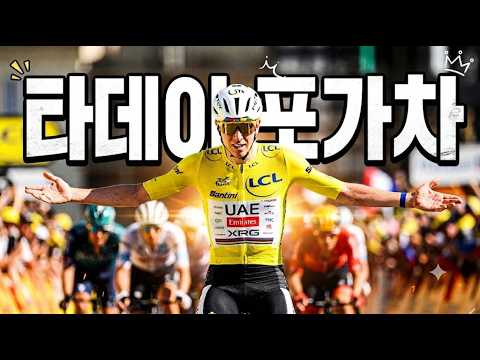
This video analyzes the position and bike fit of Tadej Pogačar, one of the world's top road cyclists, and argues that his strength cannot be explained simply by talent or hard interval training. The key is not merely to "push" the pedals, but to bring the body's center of gravity above the bottom bracket (BB, the crank axle) and use body weight to drive the rotation through the pedals. The position has advantages in power and aerodynamics, but it also comes at the cost of cornering stability and knee strain, so ordinary riders should adopt it very gradually as their bodies adapt.
1. Why Analyze Pogačar?
The video opens by introducing Pogačar as an "overwhelmingly dominant world No. 1" cyclist. Existing videos often repeat vague explanations that Pogačar is strong at intervals and climbs well, but the video points out that they do not actually explain what principle makes him strong.
"Most videos just offer vague talk about how he is strong at intervals and strong on climbs, without explaining exactly why Pogačar is strong."
The narrator says the video will analyze Pogačar's strengths from a modern-cycling perspective and discuss how ordinary riders can realistically adapt an elite athlete's approach. Pogačar is not merely a rider with exceptional talent; he is also an athlete developed through the systematic management and support of UAE Team Emirates, which makes enormous investments.
His equipment and position also immediately become industry trends, and other WorldTour riders study his changes. In that sense, Pogačar is an important reference point for understanding the direction of modern road cycling.
"When Pogačar uses something, it becomes a trend, and even most WorldTour riders follow Pogačar's trends."
2. The First Core Principle: Press with Your Weight, Don't Just Push the Pedals
The central idea of this episode is shifting the center of gravity forward. The narrator explains that Pogačar does not simply push the pedals with his leg strength; he drops the rider's body weight almost vertically toward the BB and places it onto the pedals.
"Pogačar does not push the pedals. He presses with his body weight."
The BB is the central axle around which the cranks rotate. When the body's weight is positioned close to above this axle, the force applied to the pedals can be transmitted in a more natural and efficient direction. Saddle angle, crank length, and upper-body position—the elements covered later in the series—are ultimately methods for creating one position: a position that places body weight efficiently on the pedals.
Many riders feel their thighs burning late in a ride while feeling that their power is not reaching the pedals properly. The video explains that this is not only a matter of insufficient fitness; it is also related to how force is distributed among the three contact points between the bicycle and the body: the saddle, pedals, and handlebars.
Citing research from the University of Colorado Boulder, the video says that as power output rises, a rider's pelvis tends to move slightly forward and the rider tends to sit toward the front of the saddle. In other words, in modern high-output pedaling, the center of gravity moves toward a position closer to directly above the BB axle, rather than remaining behind the saddle as it did in the past.
"The body's weight itself is used as a natural counterweight to cancel out the reaction force from pedaling."
3. How Vertically Dropped Body Weight Creates Propulsion
Pedaling efficiency is determined by the ratio of the force that actually contributes to crank rotation—the effective propulsive force—to the total force used. A large amount of torque is produced when the crank is roughly at the three-o'clock position. In that section of the stroke, placing body weight vertically downward in the direction of gravity is a simple way to convert force effectively into rotation.
"There is a simplest way to maximize effective propulsive force: simply drop your body weight straight down, in the direction of gravity."
In the past, bike fits commonly placed riders on relatively long saddles, sitting farther back on the bicycle. The video explains that this position can obstruct breathing in an aerodynamic posture and makes the rider turn the pedals by relying more heavily on leg-muscle strength than body weight, which can lead to fatigue more quickly.
More recently, short-nose saddles have become widespread, creating a trend for riders to sit toward the front of the saddle and shift their entire position forward. Tilting the pelvis forward allows the spine to straighten more naturally and opens the hip angle. This lets the weight of the upper body, the gluteal muscles, and the hamstrings work as one connected chain of force.
"When the weight of the upper body and the gluteal muscles and hamstrings—the largest muscles in the lower body—are connected as a core chain, the glutes naturally become more involved, reducing fatigue in the quadriceps."
Ultimately, the ideal sensation is not to forcibly "stamp down" on the pedals with the legs. It is to place the weight of the upper body and pelvis on the pedals around the BB and connect that weight to the rotation.
"You are not pushing the pedals with leg strength. You place the weight of your upper body and pelvis on the pedals around the BB and roll with it."
4. How Ordinary Riders Can Apply It
The narrator strongly warns riders not to pull the saddle sharply forward all at once just to look like Pogačar. Moving the center of gravity forward is not a simple adjustment involving only the saddle position; it is a change that requires the entire body—including the hips, pelvis, lower back, knees, and ankles—to adapt to a new position.
"Do not pull the saddle forward all at once to imitate Pogačar. Moving the center of gravity forward is not changing one position; it is a change that requires the entire body to adapt again."
The first step is not moving the saddle, but developing hip mobility and a sense of anterior pelvic tilt. The video recommends first learning the feeling of rolling the pelvis forward through movements such as a hip-hinge squat. If the saddle is moved forward without this sense of movement, the body may fail to adapt properly and excessive load may concentrate on particular joints.
Only after that should the saddle be moved in very small increments. The recommended change is no more than 5 mm at a time. After each adjustment, riders should check whether their bodies are following comfortably and whether they feel any discomfort in the knees or lower back.
- First learn the feeling of tilting the pelvis forward through a hip-hinge squat or a similar movement.
- Move the saddle forward by no more than 5 mm at a time.
- After each change, carefully check the pedaling sensation, knee pain, and lower-back load.
- Choose small adjustments and a long adaptation period over one major change.
5. The Cost of a Forward Center of Gravity: Cornering Instability
Moving the center of gravity forward is not unconditionally beneficial. The first disadvantage the video mentions is reduced cornering stability. The farther the body moves above the BB axle, the more likely it is that load will concentrate on the front wheel during high-speed corners.
A traditional rear-centered position distributes load relatively evenly between the front and rear tires in a corner, leaving more grip in reserve. A forward-centered position, however, depends more heavily on front-wheel grip while cornering. Power transfer and aerodynamic efficiency may improve, but the position can become more demanding depending on the road surface and entry speed.
"It is clearly advantageous for power and aerodynamic efficiency, but it comes with the distinct cost of cornering stability."
The video offers examples suggesting that Pogačar himself is not unaffected by this characteristic. At the 2025 Strade Bianche, he lost rear-wheel grip and crashed while taking a corner about 50 km before the finish, but got back up and went on to win. At the 2025 Paris–Roubaix, he reportedly slipped in a corner and even dropped his chain, forcing him to change bicycles; during that time, he lost the lead to Mathieu van der Poel.
"While Van der Poel took the corner comfortably, Pogačar's rear wheel lost grip and he crashed. Fortunately, he got back up and went on to win."
Through these examples, the narrator suggests that riders should consider their own cornering skills and riding environment rather than copying Pogačar's position exactly. The increased front load requires particular caution on courses with fast descents, wet surfaces, or rough roads. 🚴
6. Adapting to the Position While Reducing Knee Load
The second major concern with a forward position is knee load. When body weight shifts toward the BB, instantaneous load on the quadriceps and patellar area can increase around the top dead center of the pedal stroke. If the saddle is moved forward while its height is left unchanged, the knee may bend more deeply, potentially increasing the load.
The narrator presents four principles for reducing this risk.
Fine-Tune Saddle Height as Well
If the saddle has been moved forward, its height should also be adjusted slightly. The goal is to bring the changed knee-bend angle caused by moving forward closer to its original level.
"If you move the saddle forward, fine-tune its height as well. Raising it slightly by the amount it moved forward returns the degree of knee bend to its original level."
Don't Lower Your Cadence
Even at the same power output, a lower cadence creates greater instantaneous torque for the knees to withstand on each pedal revolution. Therefore, in a position that places weight forward, it is especially important to avoid the habit of pushing an excessively heavy gear at low revolutions per minute.
"Even at the same power, a lower cadence creates greater instantaneous torque on the knee with each revolution."
The video explains that one reason Pogačar maintains a high cadence is to manage the torque concentrated on the knees.
Adjust Cleats and Ankle Stability
When the saddle position moves forward, the cleat setup should also be reconsidered. Since the force of pressing the pedals with body weight becomes greater, ankle load may increase; the video says riders can consider stable support closer to the midfoot. It also mentions a toe-out setup, in which the front of the cleat points slightly outward within a range that allows the knee to move naturally in a straight line.
The key is not to follow a particular setup unconditionally, but to check whether the knees move naturally during pedaling instead of being forced inward or outward.
Wake Up the Glutes and Surrounding Muscles First
If the glutes, which help extend the hips and support the muscles around the knees, cannot produce force properly, the quadriceps have to take on too much of the work of extending the knees. Conversely, when the glutes participate actively, the reaction force that the knee joint must absorb is reduced.
"The more work the glutes share, the more the reaction force placed on the knee joint itself is reduced."
For that reason, it may help to include simple activation exercises for the glutes and muscles around the knees before riding. Strength training that develops the quadriceps, hamstrings, and glutes in balance is also necessary.
However, muscles and ligaments adapt at different speeds. Muscles respond relatively quickly to training, while ligaments adapt much more slowly because they receive less blood flow. Instead of applying excessive stimulus in an attempt to strengthen the ligaments, riders should first strengthen the muscles to protect the joints and place gradual load on the ligaments over a long period.
"Muscles become stronger relatively quickly with exercise, but ligaments receive little blood flow, so they adapt much more slowly and gradually."
7. Return Immediately If You Feel Pain
The most important safety principle is clear: if you feel knee pain after changing your position, immediately return to your previous setup. Pogačar's position is a fit for an elite athlete who handles enormous power over long periods; it is not a universal answer that suits everyone immediately.
"If you feel pain in your knees, return to your previous setup immediately."
"Pogačar's position is a fit for a rider who pedals with tremendous force; it is not a position that just anyone can adopt right away."
The message is that if you want to get stronger quickly, you actually need to change slowly. Apply small changes over several weeks, respect the speed at which your body can accept them, and adapt without injury—that is the fastest route.
"The fastest way is to take it slowly over several weeks, without injury, at the pace my body can accept."
Conclusion
This episode covers the forward center of gravity, the first principle running through Pogačar's position. The key is not simply moving the body toward the front of the saddle, but connecting the weight and force of the upper body, glutes, and hamstrings to the pedal rotation through open hips and a stable pelvis.
The next episode is expected to continue with more specific fitting elements, including why Pogačar points the nose of the saddle downward, crank length, upper-body angle, and how he holds the levers.