
This piece analyzes the "collapse of the existing world order" declared at the 2026 Munich Security Conference and the era of "great-power politics" that has followed, through the lens of Ray Dalio's "Big Cycle" theory. Dalio explains how relations between nations are governed by the logic of power rather than law, how trade disputes escalate into real wars, and diagnoses the current crisis through the example of World War II. Ultimately, he emphasizes that we must use power wisely and pursue mutually beneficial relationships to avoid catastrophe.
1. The Collapsed World Order and the Beginning of "Phase 6"
At this year's Munich Security Conference, world leaders officially acknowledged that the world order sustained since 1945 had effectively ended. The "2026 Security Report," titled "Under Destruction," laid bare this reality in stark terms. German Chancellor Friedrich Merz and other prominent figures warned that we have now entered a new era in which the old rules no longer apply.
"The world order that has persisted for decades no longer exists. We have now entered a period of 'great-power politics,' and in this new era, freedom is no longer a given."
— Friedrich Merz, German Chancellor
"The old world is gone, and so we are living in a new geopolitical era."
— Marco Rubio, U.S. Secretary of State
From my perspective, we are now in Phase 6 of the "Big Cycle" — a period of great disorder in which rules disappear, might makes right, and great powers clash. Drawing on what I described in Chapter 6 of my book Principles for Dealing with the Changing World Order, I want to explain in detail how order and disorder among nations cycle, and why this moment is so dangerous.
The Law of the Jungle: The Nature of Relations Between Nations
Relations between people and relations between nations may look similar, but there is one critical difference: relations between nations are driven by raw power dynamics.
Within nations, there are systems with coercive authority — laws, police, judges, and prisons. Between nations, none of these exist, or where they do, they are weak. International bodies like the UN have tried to maintain peace, but when the most powerful individual nations grow stronger than international institutions, the world ends up working according to those nations' will.
When a dispute arises between powerful nations, they don't call lawyers and appeal to judges. Instead, they threaten each other, reach an agreement, or fight. International order follows the law of the jungle far more than international law.
2. The Five Types of War and the Cycle of Peace and Conflict
Fights between nations take roughly five forms. They typically begin with bloodless wars and then escalate toward real ones.
- Trade/Economic War: Hurting the other side's economy through tariffs or import/export restrictions.
- Technology War: The struggle to protect key technologies related to national security rather than sharing them.
- Geopolitical War: Conflicts over territory and alliance relationships.
- Capital War: Squeezing the money supply through financial sanctions or cutting off access to capital markets.
- Military War: Wars involving actual use of force and casualties.
Most conflicts begin with the first four types of war. At this stage, great powers compete fiercely, testing each other's strength. But when these conflicts go unresolved and spread to existential issues — matters of national survival — all-out war ultimately breaks out. Once military war begins, all four of the preceding tools are also weaponized and brought to bear simultaneously.
The chart below shows the cycle of peace and conflict in Europe since the 1500s. As you can see, periods of peace (upswings) and periods of terrible war (downswings) have alternated on roughly a 150-year cycle.
The Principle for Avoiding War: Win-Win Strategy
Wars don't go according to plan and produce results far more terrible than imagined. We must therefore work to avoid them. The most dangerous moment is when 1) the military power of two sides is roughly equal, and 2) there are existential differences that cannot be compromised on. (The current situation between the U.S. and China over Taiwan falls squarely here.)
In such situations, to overcome the Prisoner's Dilemma and prevent the worst outcome, one must keep the following principle in mind:
To achieve more win-win outcomes, you need to negotiate by considering what matters most to the other side and to yourself, and to know how to trade those things.
Victory means getting what matters most and protecting what you cannot afford to lose. A war in which costs exceed benefits is foolish. Yet emotional appeals, misunderstandings, and the fear that "backing down means the end" often lead humanity into exactly these foolish wars.
3. Case Study: The Road to World War II
To understand the present through the past, let's look at the situation in the 1930s. The dynamics of that era suggest how today's economic war between the U.S. and China could escalate into a military one.
After the Great Depression of 1929, the world suffered economic pain, which led to internal conflicts. Nations began choosing more populist, authoritarian, and nationalist leaders — most notably Hitler in Germany and the militarist faction in Japan.
Germany's Rise and Economic Policy
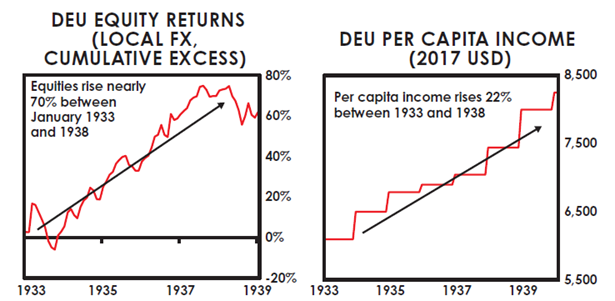
Hitler seized power by exploiting the humiliation of defeat and economic hardship. He wielded dictatorial power and purged his opponents, but at the same time revived the economy through massive fiscal spending and debt monetization (money printing). Unemployment fell to zero; the Autobahn was built; military power was expanded. Remarkably, from 1933 to 1938, the German stock market rose steadily.
America's Response and the Beginning of the Economic War
The United States was also struggling through the Great Depression, but its deep democratic roots kept it from descending into full authoritarianism. Instead, President Roosevelt strengthened protectionism through the Smoot-Hawley Tariff Act, raised taxes on the wealthy, and responded with large-scale government spending (the New Deal).
The war began with an economic war roughly a decade before the first shots were fired. Nations use the following as weapons:
- Asset freezing/seizure: Locking up or confiscating an enemy nation's assets.
- Capital market cutoff: Preventing them from borrowing money or receiving investment.
- Embargoes/blockades: Cutting off imports and exports of essential resources (such as oil).
4. The Start of Hot War and the Wartime Economy
When economic sanctions reached their limits, armed conflict ultimately broke out. Germany invaded Poland, and Japan attacked Pearl Harbor in retaliation for the American oil embargo.
Once war began, each nation shifted to a wartime economic footing — meaning government took complete control of the market.
- The government determined what was produced, at what prices, and at what wages.
- Rationing was introduced and foreign exchange transactions were blocked.
- Enormous debts were taken on to cover the cost of war, with central banks printing money.
The table below shows the economic control measures implemented by major nations at the time.

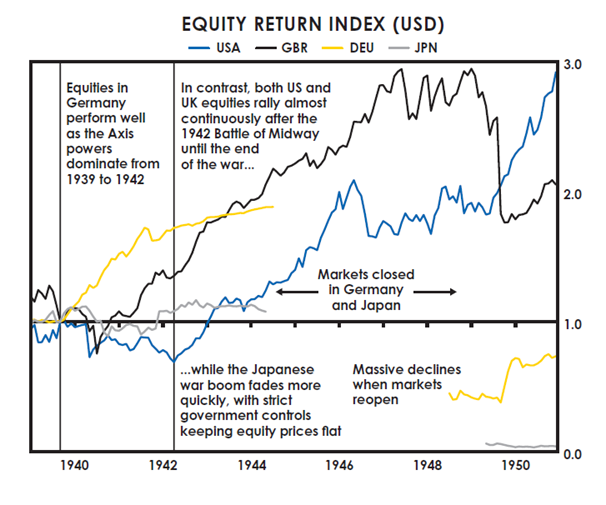
Controls over stock markets and capital flows also tightened severely. Defeated nations and those that became battlegrounds — Germany and Japan among them — shut down their stock markets for extended periods.

Changes in Asset Markets During the War
During the war, stock markets danced to the tune of the fighting. German stocks rose alongside early victories, then fell as the tide turned. American stocks, by contrast, continued rising from the victory at Midway until the war's end.
Most notable of all is the fact that the stock markets of the losing nations (Germany and Japan) were ultimately closed, and when they reopened, investors' assets were essentially worthless. During wartime, credit becomes unreliable, and only hard assets like gold retain genuine value.
5. Conclusion: History Repeats, but the Future Can Be Changed
Every empire rises and falls. That is an unavoidable cycle. Sometimes that decline is accompanied by terrible war and destruction. But if we maintain productivity, keep our national systems healthy, and build win-win relationships even with rivals, we can avoid a catastrophic end.
Have power, respect power, and use power wisely.
Using power wisely does not simply mean subjugating others by force. Pursuing mutual benefit on the basis of generosity and trust is the truly wise use of power. In 2026, amid this turbulent period, if we do not forget the lessons of history, we will be able to navigate the coming crises with wisdom.