RevenueCat's Growth Journey and Recent Series C
RevenueCat provides a subscription management platform for mobile apps, simplifying payment management on the Apple and Google app stores so developers can easily monetize subscription-based apps. Recently, RevenueCat made headlines by rejecting a $500 million acquisition offer and raising Series C funding at the same valuation.
"Turning down a $500 million acquisition offer messes with your head. That's generational wealth for my family." -- Jacob Eiting, RevenueCat Founder/CEO
Jacob Eiting shared a candid account of RevenueCat's growth, fundraising, and the decision to reject the acquisition offer -- including previously undisclosed internal details -- to help other founders and finance leaders.
The AI Boom and RevenueCat's Accelerating Growth
Most venture capital is currently flowing to AI companies, but RevenueCat is also benefiting significantly from the AI boom. Here's why:
3 Growth Drivers from the AI Boom
- New AI models launching mobile apps -- Latest AI models are releasing mobile apps, making subscription management platforms like RevenueCat essential
- Existing apps adding AI features and usage-based billing -- Complex subscription management is now needed as apps integrate AI
- Explosive growth in the number of app developers -- As anyone can now build an app, RevenueCat's customer base has expanded rapidly
Thanks to these tailwinds, RevenueCat's product strength, team, and timing aligned to make the Series C fundraise much smoother.
Series C Key Details
- Lead investor: Bain Capital Ventures
- Post-money valuation: $500 million
- Amount raised: $30 million (new investment) + $20 million (secondary)
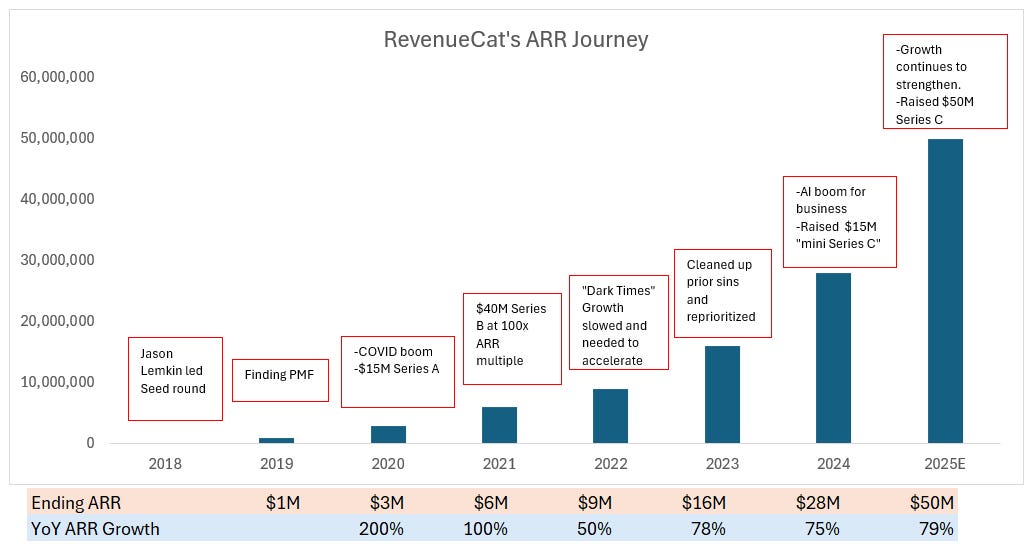
- Annual recurring revenue (ARR): ~$30 million (75% YoY growth)
- Cash burn: $0 (slightly profitable)
- ARR multiple: ~16x
"There are only 100 of us, and we're accidentally profitable."
RevenueCat is a roughly 100-person team that has achieved the rare feat of profitability in the SaaS industry. Jacob didn't aim for profitability from the start, but fostered a culture of frugality: "We only spend and hire what we need."
The Growth Curve: Ups, Downs, and Recovery
RevenueCat's revenue growth wasn't always smooth.

- Early stage: Rapid growth from $1M to $3M ARR in one year
- Next two years: Growth rate halved annually -- what Jacob calls the "Dark Times"
- 2023: Product improvements and the AI boom pushed growth rates back to nearly 80%
RevenueCat now manages subscriptions for one of the world's most popular AI apps.
Efficient Management and Capital Allocation
RevenueCat has raised roughly $80 million in total funding, but has only spent $20 million. Even before Series C, they held $30 million in cash.
"I don't really know what to do with the money. We'll figure out ways to use it."
Jacob explains the fundraise wasn't about immediate need, but about having reserve capital to seize opportunities quickly or restructure the business if needed.
Secondary Sales and the Story Behind the Acquisition Offer
Of the $50 million Series C, $20 million was a secondary sale, allowing founders and existing investors to cash out some shares.
- Purposes of the secondary:
- To ease the psychological burden of turning down a $500 million acquisition offer
- To balance desired ownership stakes for both new and existing investors
"After seven years of grinding, when a good acquisition offer comes along, it's really hard not to be tempted..."
Jacob had done some secondary sales previously but had sold less than 10% of his total stake, and still feels deeply attached to the company.
"I live in rural Ohio... I don't worry about money. I have enough."
"Continuing to build RevenueCat is the most valuable thing I can do in the world."
"I've never met a founder who sold their company and said it was the right call."
The Struggle of Rejecting the Offer and Investor Trust
In late 2024, RevenueCat received a $500 million acquisition offer and went through due diligence, but the deal fell apart due to a price gap. Jacob believed RevenueCat could grow 5-10x more, so he wouldn't sell at a price that undervalued the company.
"Our early investors checked in: 'Are you really sure you're okay turning this down?'"
Fortunately, RevenueCat's investors trusted the founder and backed his decision.
Jacob's Thoughts on Exit Strategy
"I don't think about exit options. I just don't care."
"I used to worry about IPO, direct listing, acquisition -- but now I believe that if you build a great company, the answer will come naturally."
Jacob says when the company is doing well, there's no need to think about exits. But if things level off, a more strategic approach to exits may be necessary.
Investor Communication and Business Philosophy
Jacob says he has sent a monthly investor update every single month for eight years, without exception.
"For the past eight years, I've sent an investor update at the end of every month. Never missed one or been more than a day or two late."
Consistent investor communication builds trust and ensures help is available in times of crisis.
"Unless an executive is truly exceptional, the hire itself is a net negative for the company. I'll be patient."
Jacob prefers to invest only at truly necessary moments rather than expanding headcount or spending indiscriminately.
"I'm good with computers, but I'm an idiot with finance. The OnlyCFO newsletter really helped me. It's the only newsletter I read every week because I actually understand it."
Rather than obsessing over complex financial metrics, Jacob has always treated cash flow as the most important indicator. "Cash doesn't lie."
Conclusion: Common Sense, Efficiency, and a Founder's Courage
The key message of this article is: even with venture funding, don't lose your common sense -- run the company efficiently. Jacob calls himself a "finance idiot," but he's building one of the most efficient, fastest-growing companies out there.
Key Terms
- RevenueCat
- Subscription management platform
- AI boom
- Series C funding
- $500 million acquisition offer
- Secondary sales
- Efficient management
- Cash flow focus
- Investor trust
- Exit strategy
Jacob and RevenueCat's story is a clear demonstration of how rapid growth, efficiency, and a founder's courage can take a company to the next level.
"Just because you took venture capital doesn't mean you should stop thinking. Common sense is what matters most."