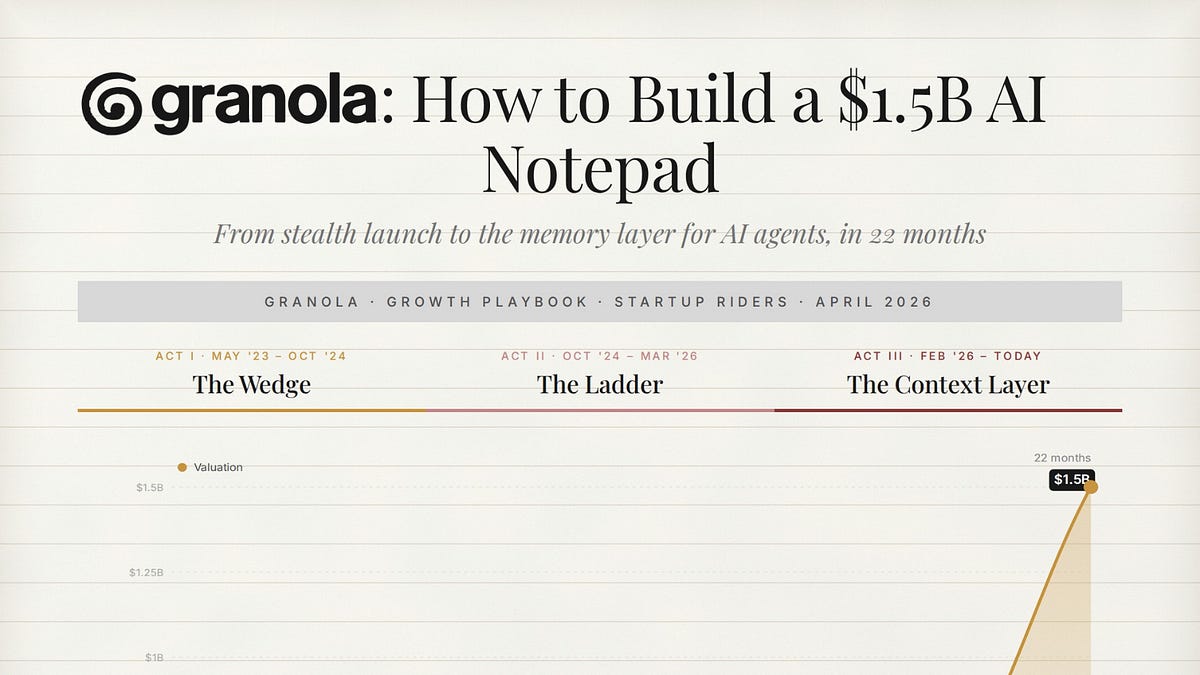
This article is a detailed look at how Granola grew from $0 to a $1.5B unicorn in just three years. It covers the company's distinctive stealth strategy, why it rejected meeting bots, and how it used frontier models, along with the five hidden rules of building AI products and the strategic use of VCs as a distribution wedge.
1. A Quiet Start: Growing in Stealth
Granola cofounder Chris Pedregal had previously sold Socratic, an AI-powered learning tool, to Google. In March 2023, right after leaving Google, he started playing with GPT-3 and was struck by its potential.
"Within a week of leaving Google, I started experimenting with the instruction version of GPT-3 that had just been released. It was amazing. I thought, 'Wow, this is new. Something is different. I don't know exactly what it is, but it is different.'"
While looking for a cofounder, Pedregal found the profile of Sam Stephenson, a designer based in London, and cold-emailed him. They started Granola together. Within two months they raised a $4.25M seed round from Lightspeed, but then stayed in a deliberately quiet stealth mode for a full year.
That stealth period was not about secrecy. It was about improving the product through a fast feedback loop. Before the public launch, they manually onboarded users and worked closely with about 150 people.
Pedregal explained it this way on the MAD podcast:
"What is the fastest way to learn? Is launching publicly faster, or is not launching publicly faster? For about a year, our conclusion was that not launching publicly was the faster way to learn."
At the earliest stage, launching publicly would have made it harder to change the core interaction model and could have damaged users' trust. The team expected that they would need to make several major changes.
For the first six months, they built a version where Granola would autocomplete notes in real time when users typed keywords during meetings. It made for an impressive demo, but it also made users read notes during the meeting and distracted them from the conversation. That directly conflicted with Granola's core promise: helping people be more present in meetings.
So they threw away that interaction model and rebuilt the product as a calm text editor that worked like magic after the meeting ended. It was less flashy as a demo, but it was a much better product.
Pedregal later reflected on this in Invest Like the Best:
"If we had launched that feature publicly, we never could have changed it. Users would already have become used to the new behavior, and we would not have retained many of them."
The stealth period ended with the team cutting about 50% of the core functionality. Pedregal calls this one of Granola's most underrated growth decisions. They removed a tangled set of features and focused the product on the core value.
As with many successful startups, Granola showed a willingness to move quickly and make hard product choices.
"During that year in stealth, we kept adding features, adding views, adding more and more. Eventually we had a version of Granola where swiping opened all kinds of panels: meeting notes, personal notes, notes in other languages, everything. We looked at it and cut 50%."
That ability to rapidly iterate on the core interaction is one of the most important assets for an early AI product. Stealth mode gave Granola room to go through multiple rounds of trial and error.
Granola officially launched on May 22, 2024 with a team of four. The pricing was simple: the first 25 meetings were free, and after that it cost $10 per month.
2. Strategic Spread Through VCs: From the Smallest Market to the Largest Influence
Pedregal chose venture capitalists as Granola's first specific user persona. On the MAD podcast, he explained:
"We needed a type of user who had lots of meetings, whose meetings were relatively structured, whose note style was also structured, and whom we could reach easily. That was VCs."
VCs do not spend a lot on software, and there are not many of them, so a "product for VCs" is usually a red flag because the market looks small. But Pedregal was thinking about their distribution power.
Investors are active on Twitter, talk to founders every day, and meet other investors at dinners. If VCs began using Granola, every founder in their portfolios would see it, co-investors would see it, and others around them would notice. Most importantly, in London, VCs were the people Pedregal could meet for coffee within a week.
On launch day, Pedregal told the team, "We are done building for VCs now."
"As soon as we launched, we said, 'Okay, VCs are done. Now let's focus on another type of user.' We chose founders because we thought they would be the most demanding. If we could build a great product for founders, we believed it would naturally be a decent product for everyone else."
VCs were the wedge, and founders became the spreaders. The strategy resembles Superhuman's approach: choose users with the highest "signal density per user," make them love the product, and let them carry it to everyone they meet.
By the time Granola raised its Series A in October 2024, 57% of its users were in leadership roles. Even though Granola had not directly targeted executives, many users adopted the tool and then quickly became leaders who spread it inside their organizations.
3. Rejecting Meeting Bots: Trust Earned by Staying Invisible
When Granola launched, every other meeting note-taking tool in the market joined meetings as a visible bot. Bots were an important distribution mechanism. Even Granola's investors thought the team was crazy to give up that spread opportunity. But distinctive founders choose their own path.
"Bots feel a little weird. A big black box appears on screen, sometimes even before you join the meeting. But from a growth perspective, it is beautiful. Every user exposes the product to every person they meet. So everyone thought we were crazy."
The decision not to use bots had an immediate cost. Granola had no built-in viral loop, no free billboard, and no user acquisition moment where people asked, "What is that bot in the meeting?"
But in exchange, Granola gained something more important: the right to participate in sensitive meetings.
Bots are often banned from board meetings, M&A discussions, executive one-on-ones, and other confidential conversations. Lawyers, doctors, therapists, and other professionals often reject bot-based tools as well. Granola recognized early that visible bots maximize the top of the funnel but minimize the ultimate ceiling of usage.
Granola ran on the user's computer and did not announce itself to other participants, which was good news for users who needed to comply with GDPR. It also never recorded audio, only transcripts. That decision later removed a huge amount of friction for enterprise adoption. It worked across Zoom, Meet, Teams, Slack Huddles, and in-person meetings without platform-specific setup.
The team discovered that giving up the viral bot did not kill virality. It created a different kind of loop.
"If you are on a Zoom call and an AI bot appears, people start saying to each other, 'Wait, what are you doing with an AI bot? You still do not use Granola?'"
The funny part is that competitors' bots became part of Granola's growth loop. The author says they have experienced this many times.
4. Using Frontier Models: Turning a Temporary Disadvantage Into a Permanent Moat
Granola believed in using the newest, most expensive frontier models. Even if it looked economically unsustainable, that was exactly when they should use them.
In 2023, each meeting note Granola generated probably cost a few cents in inference. A heavy user with six meetings a day on the free plan would not have been profitable. That is why other meeting note tools protected their margins with cheaper models or self-hosted systems.
But in Peter Yang's Behind the Craft, Pedregal explained why this could actually become an advantage.
"AI is different. These models are still expensive to run. Our costs scale with the number of users. There is an opportunity here. As a small startup with few users, we can use frontier models that would be financially impossible for a large company to deploy at scale."
Granola was small enough to use frontier models for every user. Competitors like Otter, which already had around $100M in ARR and millions of users, could not apply GPT-4-level models to every transcript without crushing their margins.
Then the cost of frontier models fell sharply. Transcription alone dropped from $0.25 per minute in 2021 to about $0.02 per minute today, a 12.5x decrease over five years. That created a huge cost reduction in one of Granola's biggest expense categories.
Sam Stephenson said this on Cognitive Revolution in April 2026:
"At one point, half of our burn rate was spent on transcription. It is much better now, and much more manageable."
Their bet was that running an expensive product today would be a temporary disadvantage but a permanent advantage. Since launch, they had used frontier model outputs and built internal evaluation tools that let them move between OpenAI, Anthropic, and Google models while preserving a consistent quality they call the "Granola voice."
By the time costs fell, users were already used to Granola's level of quality, which other products struggled to match.
5. Five Hidden Rules Granola Found While Building AI Products
While building an AI product, Granola discovered five important principles.
-
Rule 1: Do not solve problems that will soon stop being problems. Modern AI startups face two kinds of product problems: problems that will be solved by the next model release, and problems that will persist regardless of model progress. Teams often make mistakes by trying to solve the first kind. For example, Granola refused to build chunking for long meetings, which would be solved by larger context windows, and multilingual tools, which newer models would handle natively.
"As a product leader, refusing things that users actively ask for goes against every instinct. But in AI, sometimes the best strategy is to focus on problems that will still matter even as the technology improves."
-
Rule 2: Go narrow and deep. General-purpose tools like Claude and ChatGPT are surprisingly capable across many tasks. For a startup to build a product, it needs to solve a problem 10x better. The only way to do that is to choose a narrow use case and make the experience exceptional. The 10x improvement often comes from non-AI work. For instance, Granola built echo cancellation for users whether or not they wear headphones, which has almost nothing to do with note-taking itself.
-
Rule 3: Context is king. Pedregal treats LLMs like smart interns on their first day at work. The product's role is to give the intern enough context to do the job well. That contrasts with many AI products that fail by writing system prompts that try to predict every possible output.
-
Rule 4: Your marginal cost is my opportunity. As discussed above, frontier models are too expensive for incumbents to deploy at massive scale. A small startup suffers a temporary cost disadvantage, but as costs fall, that can turn into a permanent quality advantage.
-
Rule 5: Build a product with soul. Coherence comes from intuition. Anyone who enjoys product building has probably felt the "satisfaction" of using Granola. Pedregal speaks with users every day and keeps a screen in the office showing live feedback, but he still designs from first principles.
"When you are constantly immersed in user feedback, you develop an emotional sense of what matters, beyond simply analyzing metrics."
6. Remarkable Growth and Fundraising
Half of the people who tried Granola were still active after 10 weeks, and on average they used it in six meetings per week.
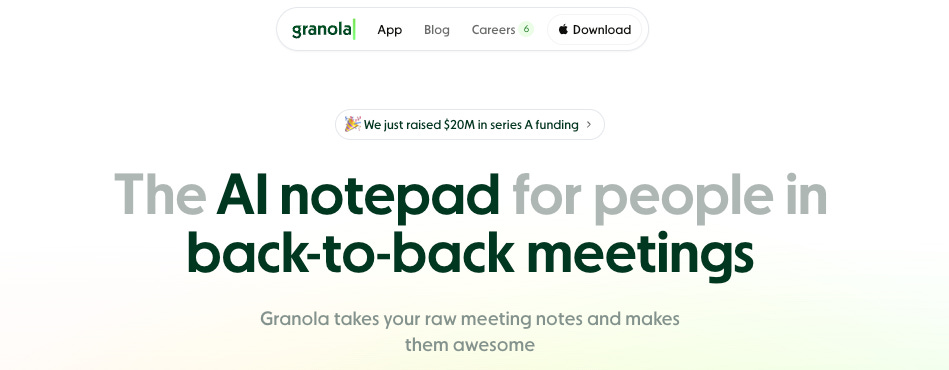
In October 2024, Granola reached 5,000 weekly active users. It also raised a $20M Series A from Spark Capital. The process moved unusually fast: after roughly a dozen investor meetings in a single day, the round closed within a week.
By January 2025, Granola had begun to feel less like a product and more like a habit. VCs spread it to founders, founders brought it to leadership teams, and leadership teams started asking for company-wide licenses.
But the AI note-taking market was becoming fiercely competitive. Otter had reached $100M ARR, Fireflies reportedly received an acquisition offer at a $1B valuation, Read AI raised $50M, and Fathom raised $17M. Plaud was selling about $250M per year of AI hardware pendants.
The question had shifted from "How do we acquire users?" to "How do we retain users in a world where notes themselves are becoming a commodity?"
Closing
Granola's story shows that breakthrough growth is not only about technical excellence. It also depends on deep market and user understanding, plus the courage to make strategic decisions that feel uncomfortable at the time. Its fast iteration in stealth, unusual VC-led distribution strategy, and bold adoption of frontier models to build a quality moat can offer useful lessons to other startups. Granola is not merely a meeting note-taking tool. It acts as a kind of steering wheel for LLMs, helping people stay more present in meetings and collaborate more effectively.