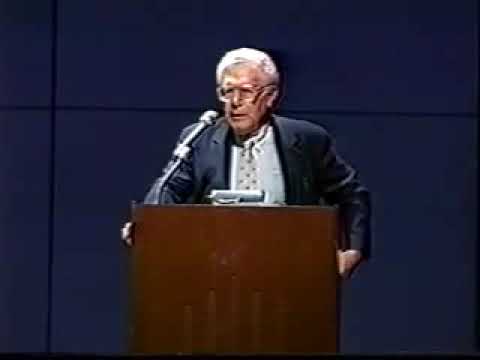
Russell L. Acoff argues that through systems thinking, organizations and education should be viewed as an interacting whole rather than a collection of parts. He criticizes that today's education is focused on conveying information and memorizing answers, which is destroying students' motivation and creativity, and says that the purpose of education is not 'what to teach,' but to learn how to learn on one's own and to make students want to learn. Ultimately, his conclusion is that we should move away from the method of creating departments and departments first and combining them, and design the whole first and then make the parts fit the whole.
1. 시스템은 부품의 합이 아니라 상호작용하는 전체
The lecture begins with an anecdote about a student reading Ackoff's new book and saying, "There's a lot in the book that even the professor doesn't know about." 애코프는 이를 인정하면서도, 자신의 논의가 두 가지 토대 위에 서 있다고 밝힌다. The first foundation is systems and system thinking, and the second is the problem of education that does not distinguish between data, information, knowledge, understanding, and wisdom, which are the contents of the human mind.
According to Ackoff, a system is made up of two or more parts, and each part affects the properties or behavior of the whole. 그러나 각 부분은 따로 떨어져 전체에 독립적으로 영향을 미칠 수 없다. For example, the impact of the heart on the human biological system depends on how the lungs, brain, and other organs function. In other words, all parts of the system are connected, and no matter how they are grouped or divided, the parts affect the whole but do not act independently.
"A system is a whole that cannot be divided into independent parts."
A very important consequence emerges from this definition. The essential nature of a system comes not from what each part does separately, but from how the parts work together. The essential ability of a car is to move people from one place to another, but none of the engine, seats, or body can transport people on their own. 마찬가지로 인간의 '생명'은 어떤 장기 하나가 지닌 성질이 아니라 몸 전체가 지닌 성질이다.
"A car is not the sum of its parts, but the product of their interaction."
Even if you completely disassemble a car and store all the parts in a room, there is no car, just a collection of parts. When the whole is dismantled, the essential properties of the whole disappear, and the functional meaning of each part within the system also changes.
2. Why departmental optimization can ruin the whole
Ackoff criticizes Western management methods for relying too much on the 'divide and conquer' principle. It is assumed that if a company is divided into production, marketing, finance, and human resources departments, and a university is divided into departments, curriculum, and programs, and each is operated as efficiently as possible, the overall situation will improve. 하지만 그는 이 가정이 완전히 잘못되었다고 단언한다.
"Improving the performance of each part of the system does not make the performance of the whole better. In fact, it often becomes worse."
To explain this, he uses an interesting car analogy. Let's say we collect all of the hundreds of cars sold in the U.S. and ask the world's best automotive engineers to select the best engine, best transmission, best fuel injection system, etc. for each. It may seem that the best car will be produced if only the 'best' of all parts are selected and assembled, such as Rolls-Royce engines, Mercedes transmissions, and Volkswagen fuel injection systems, but in reality, there is a high possibility that not even a car will be made.
"부품들이 맞지 않기 때문입니다."
It is not the individual quality of the parts that determines system performance, but how the parts fit together. Nevertheless, universities, companies, and hospitals operate as if improving the performance of each department separately will improve the overall performance. Ackoff believes that this perspective is a way of thinking that must be abandoned when discussing education and organizations.
3. 데이터에서 지혜로: 효율성과 효과성의 차이
The second foundation is the division of the content of the human mind into five stages. 애코프는 다음과 같은 위계를 제시한다.
- Data: Symbols representing the properties of objects or events
- Information: Data processed to be useful
- 지식: '어떻게 하는가'에 답하는 내용, 즉 방법과 기술
- Understanding: An explanation that answers 'Why is that so?'
- Wisdom: The ability to evaluate the purpose itself and decide what to pursue.
He expresses this with an old proverb.
"An ounce of information is worth a pound of data, an ounce of knowledge is worth a pound of information, an ounce of understanding is worth a pound of knowledge, an ounce of wisdom is worth a pound of understanding."
Data represents facts, such as address, age, and number of children. To the question "Where is the event held?" answering "The auditorium" is information. When asking "How do I get to the auditorium?", it is knowledge that gives directions, which in turn creates actual mobility skills, or skills. Understanding is the answer to "Why do you want to go to the event?"
However, wisdom is qualitatively different from the previous four. Data, information, knowledge, and understanding usually allow us to achieve already defined goals more efficiently. Wisdom, on the other hand, asks whether the purpose is right in the first place. Here, Ackoff quotes Peter Drucker.
"There is a big difference between doing things right and doing the right thing."
In other words, efficiency is the ability to perform work 'correctly and well', and effectiveness is the ability to choose the 'right thing'. Ackoff says society is obsessed with doing the wrong thing very efficiently.
"The more we do wrong, the more we go astray."
He cites the healthcare system as an example. Although people call this a "health care system," the way health care providers actually make money is by treating people when they are sick or disabled. Therefore, structurally speaking, this is closer to a system for caring for disease and disability rather than a system for maintaining health.
"They get paid to take care of you when you are sick or disabled. It is not a health care system, it is a disease and disability management system."
He points out that companies often prioritize the comfort of senior management over profit maximization, and universities often prioritize the quality of working life desired by faculty over student education. In particular, there is a sharp satire that lectures at universities are treated as 'costs that professors want to minimize'.
4. A school where learning is more important than teaching
Ackoff makes the paradoxical observation that the better the school, the less lecture time professors have. If you rank American universities from highest to lowest and compare the annual lecture hours of professors, you will find that more prestigious universities have fewer lecture hours and other universities have more lecture hours.
"The ideal school is one where there is no teaching but a lot of learning."
The point of this statement is not that 'there is no need for teachers.' Ackoff argues that one-sided teaching practices, as they are commonly called, can hinder learning. When we learn our first language, learn to walk, or ride a bicycle, we usually do not learn it through formal instruction from someone. In particular, you learn a foreign language much more deeply by going and living in a country where the language is spoken rather than learning it in a classroom.
"Teaching is a big obstacle to learning."
However, paradoxically, Ackoff says that the act of teaching itself is a great learning method. When we think about who learns the most in class, it is often the teacher rather than the students. He said that he has continued to study content that did not exist when he was a student, and emphasizes that educators should be 'professional learners' rather than 'professional teachers'.
"Our job is not to teach, but to promote learning."
He summarizes that the role of a university should be twofold.
- Let students learn how to learn
- Motivating students to want to learn
대학에서 배운 것 중 상당수는 훗날 직업과 무관하거나 빠르게 낡아 버린다. Therefore, success after graduation depends on the ability and willingness to continue learning what is necessary in work and life rather than the amount of knowledge given by school.
"여러분의 미래는 배우는 능력과 배우려는 동기에 달려 있습니다."
5. Education that revives motivation and creativity
애코프는 학교가 학습 동기를 키우기는커녕 일부러 꺾는 듯한 구조를 만들고 있다고 비판한다. By making classes and assignments a 'difficult task that must be done,' students do not want to learn.
그는 필라델피아의 한 흑인 저소득 지역 공동체와 함께 일했던 경험을 소개한다. 당시 그 지역에서는 고등학교를 졸업해도 약 80%가 기능적으로 문맹 상태라는 문제가 제기됐다. At first, we wondered how to solve the literacy problem, but after researching, we discovered that children were not intellectually deficient, but there was a reason they didn't want to read.
About 65% of households in the area had no books, and children rarely saw adults reading. 그 문화는 문자 중심이 아니라 말과 구술 중심의 문화였다. Moreover, in an environment where boys had to belong to a gang to be safe, books were seen as a symbol of submission to the dominant white culture, and carrying books could lead to attacks by members of the same gang.
The solution to this problem was not to force books. Charlie Chaplin's silent films were played all day long in the school auditorium, and any student was allowed to come and watch them without class permission. The children started reading the subtitles because they wanted to know what the movie was about, and by the end of the semester, all the children were able to read.
"The kids wanted to read the subtitles because they couldn't understand what was going on, so they learned."
"누가 가르쳐 준 것이 아닙니다. 동기가 생긴 것입니다."
For Ackoff, the key question in education is not "What do we teach?" but "What excites people and moves them to action?" 그는 역사 속 주요 혁명은 사람을 행동하게 만드는 동원하는 아이디어에서 비롯됐다고 설명한다. 그러나 학교와 대학은 변화를 만들어 내기보다 대체로 현 상태를 유지하는 데 헌신하고 있다고 비판한다.
How testing kills creativity
Referring to the work of Edward de Bono, Ackoff says that young children are naturally very creative, but lose this ability as they grow up. One of the reasons is school exams. When given a test question, students start by asking the next question rather than exploring the question itself.
"What answer does the teacher expect?"
기대되는 답은 이미 알려진 답이므로 창의적일 수 없다. This is because creativity lies in unexpected answers and surprises that deviate from existing expectations.
"창의성이란 놀라움이며, 기대에서 벗어나는 것입니다."
He says students don't even get the opportunity to freely ask questions about important issues in society, such as monogamy, premarital sex, the economic system, and democracy. Students learn not to ask important questions, not to give unexpected answers, and eventually conform to the expectations of society and faculty.
There is also an anecdote where a student cleverly twisted the assignment format instructions and submitted a unique report that was difficult to read but formally followed the instructions. 처음에는 화가 났지만, 애코프는 학생이 자신을 놀라게 하려고 공들였다는 사실을 깨닫고 높은 점수를 줬다.
"He spent time thinking of ways to trick or surprise me. He was creative."
다만 애코프는 다음번에도 똑같이 하면 더는 창의적이지 않을 것이라며 이렇게 덧붙인다.
"다시는 그러지 마세요. 다음번에는 창의적이지 않을 테니까요."
6. A university where students teach and teachers help them learn
Ackoff criticizes that the word 'student' is rarely mentioned even in faculty meetings. It is said that when he attended an engineering professor's meeting for two years and recorded the discussions, the word "student" came up only once. The meetings centered on faculty issues such as faculty well-being, schedules, and academic freedom rather than student learning.
"교수회의는 교수에 관한 회의입니다. 학생에 관한 회의가 아닙니다."
Faculty believe they know what students need to know, but Acoff says that's not true. He gives examples of how many engineering graduates do not work in engineering within five years, and that even those who contributed the most to the development of statistics had never taken a statistics class. Important changes are often created by people looking at the field from the outside rather than existing experts.
"분야의 변화는 전문가들이 아니라, 그 분야 밖에서 바라보는 사람들이 만들어 냅니다."
He even calls computer-assisted instruction "the ultimate insult to human intelligence." The argument is that rather than allowing computers to teach people, students should be allowed to teach things to computers. In fact, we introduce an experiment in which second-grade elementary school students were given the role of teaching arithmetic to computers, and they learned two grades of elementary arithmetic in just one semester. The teacher was not a person who instilled knowledge, but a resource that students utilized when needed.
It also talks about cases where actual community problems were entrusted to student teams. When the students realized that they needed calculus to solve real-world problems such as water supply or highway emergency services, the professor did not teach them directly, but pointed them to a book and said, "You have to learn it."
"You want me to teach you? No, you have to learn."
The students studied calculus on their own, and at the end of the summer program, 95% of participating students passed the math course taken during the first two years of college. When the necessity and purpose become clear, the speed of learning becomes surprisingly fast.
Ackoff also suggested to foreign students who wanted to take a course on development planning for developing countries, "You teach this class, and the professors attend as students." At first, the students found it difficult to understand the professors' knowledge, but in the end, 13 students managed the class, and Acoff said it was the best class he had ever taken. Those who participated in this experience later took on major planning roles in Peru, Brazil, and the World Bank.
"We have turned the university upside down. What matters is not what we think students should be taught. What matters is what students learn how to learn."
7. How academic disciplines split reality
Ackoff believes that the problem lies in the way universities divide reality into disciplines such as physics, chemistry, psychology, economics, and sociology. In reality, separate problems such as physical problems, economic problems, and social problems do not actually exist; it is just that we have different perspectives on the problems.
"There are no such things as physical problems, chemical problems, social problems, or economic problems."
Academic disciplines are not a structure of reality, but are closer to a filing system for organizing and retrieving knowledge. Just as dividing files into 'A' and 'B' files does not mean that the contents within them are essentially different, classification of academic disciplines is merely a classification for convenience of access. He introduces the sentence that Leibniz was probably "the last man who knew everything," and explains that as knowledge expanded and became unmanageable, disciplines became more and more specialized.
"Academic disciplines are not natural entities. They are file systems for storing knowledge."
He gives the example of an elderly woman's death being interpreted differently by different experts. When a woman with heart disease died of a heart attack on the stairs while going home after a hospital checkup, a local medicine professor attributed the medical problem to a lack of doctors who could not make house calls. The economics professor attributed the economic problem to people not having money to call a private doctor due to lack of welfare and medical benefits. The architecture professor believed that it was an architectural problem because the building did not have an elevator. The social welfare professor attributed the problem to her family and social relationships, as she was estranged from her successful son and did not receive help.
"Is it a medical problem, an economic problem, an architectural problem, a social welfare problem? None of that. It is one problem."
Each adjective does not describe the problem, but only describes the person's perspective on the problem. When a company's sales decrease, the marketing manager calls it a 'marketing problem' and tries to adjust only the marketing variables, but the real solution may lie somewhere else entirely, such as production, service, product design, or organizational operation.
Elevator and mirror solution
Complaints were piling up about long wait times for elevators in an old office building in New York. Engineers suggested installing additional elevators, automating them, or introducing computer control, but ultimately concluded that "there was nothing we could do" because the costs were too high or the effects were not sufficient.
However, during the brainstorming session, a young HR manager expressed a different point of view. The problem wasn't that the elevators were slow, but that people were bored because they couldn't do anything for two minutes.
"People are bored standing for two minutes. So how can we keep them entertained while they wait?"
The solution was to install a mirror in the lobby for just $500. People felt that waiting time for themselves and others was less boring, and their dissatisfaction disappeared.
"No one owns the problem. All problems are universal."
The interdisciplinary approach that Ackoff refers to is not about mechanically combining several departments, but about exploring various perspectives surrounding a problem to find the best solution.
8. Design that eliminates problems beyond solving them
Ackoff points out that although education purports to teach 'problem solving,' in reality it mostly gives exercises and questions rather than real problems. Problems, exercises, and questions are different.
Practice problems are designed to intentionally remove important information that the test taker used to construct the problem and force the student to find the answer within limited conditions. Therefore, it is different from training that deals with real problems. He cites the problem of probability of the color of a ball posed by statistician Merrill Flood as an example. Given the premise that there are only white and black balls, the student must calculate. But first Ackoff asks, "How do you know that the balls are only white and black?"
"The moment you give us that premise, it is no longer a problem. It becomes an exercise."
He says that just as learning to box with one hand tied does not teach you how to box with both hands, education that only solves practice problems does not develop real-life problem-solving skills. Even asking "How much is 2 plus 3?" without context is problematic. This is because the answer may vary depending on whether the temperature is in units, logarithmic, or decimal.
"Questions always have context, but we teach questions as if they have absolute context and absolute answers."
He also divides problems into four ways.
- Absolution: Ignoring the problem and hoping it will go away on its own.
- Resolution: A method of finding a 'good enough' answer by referring to past experiences
- Problem Solving: A method of finding the most optimal answer under current conditions.
- Dissolution: A method of redesigning the system itself that creates the problem so that the problem no longer exists.
Ackoff says that the fourth approach, problem solving, is a better approach than the third approach, 'problem solving.' No solution is permanent, and one solution usually creates a new problem.
"The only thing better than solving a problem is to solve it."
The matchbox example shows this. In the past, paper matchboxes had a problem where if you struck a match with the cover open, the flame would transfer to other matches and burn your hands. The company printed "Close the cover before striking the match," but the number of accidents and lawsuits did not decrease. One young man suggested that we move the friction surface of the matchbox to the back rather than the front. Then, you can only strike a match by closing the cover, and the problem of burning your hands structurally disappears.
"He didn't solve the problem, he dissolved it. He redesigned the matchbox so that the problem no longer existed."
9. The whole must be designed first
Ackoff cites architects as a profession that understands design well. When a family tells an architect they want three bedrooms, a living room, a kitchen, a family room, and a garage, a good architect doesn't design each room perfectly and then assemble it later. First, design the shape and structure of the entire house and arrange the rooms within it. Even when you need to change the size or shape of a room, only do so if the change makes the whole house better.
"Parts should be modified only when they make the whole better."
This is the core of systems thinking. Improvements should not be made just because one department or department in a university performs better on its own. It must be demonstrated that the change improves learning and purpose across the university. However, in reality, universities often evaluate only the independent performance of the department itself, rather than the degree to which the department contributes to the whole.
He makes a more fundamental argument here. In fact, a 'problem' is not an object that exists independently in reality, but an abstraction that we separate out to analyze complex reality. Reality is a mass of intertwined problems, that is, a system. If we break reality down into small problems, we lose the essential nature of the whole and the meaning each part has in its interaction.
"Reality is a system of problems. Problems are simply abstractions extracted from reality through analysis."
Ackoff likens this to 'Humpty Dumpty's fallacy.' After the egg is broken, it cannot be restored to its original state even if you gather all the king's horses and servants. Because education has already been broken into pieces called academic disciplines, the true wholeness cannot be restored by later putting the pieces back together under the name of 'interdisciplinary convergence.'
"We must start again from the beginning. Instead of making the parts first and fitting the whole into them, we must deal with the whole first and make the parts to fit into the whole."
He believes that today's universities have become a collection of departments rather than an educational whole. Therefore, if we want to truly change education, we must acknowledge how little we know about reality and education, rather than trying to protect the complacency of those who have invested in the existing education system.
"We are not educated. We are only just beginning to realize how little we know about the nature of reality."
Finish
Ackoff's lecture is not simply a proposal to 'promote convergence education' or 'let's foster creativity.' He criticizes partial optimization, answer-centered tests, professor-centered education, and academic discipline-centered organization, as all methods that incorrectly divide reality. His alternative is clear. Education and organizations should start by asking again the overall purpose, and rather than delivering answers to people, they should ask and learn on their own and develop design skills that can make the problem disappear.