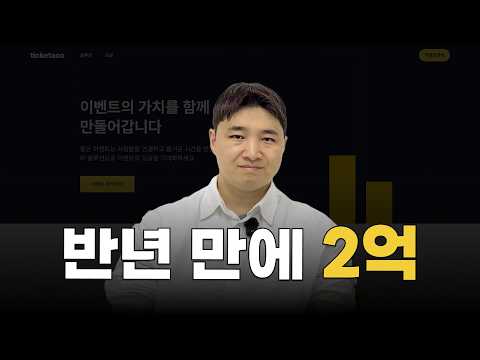
Seungmin Lee built TicketTaco, a ticketing platform for IT community events, as a solo developer using AI tools. His story makes one thing clear: in the age of AI, anyone can build a product — but turning it into a real business is a different challenge entirely. His success came not from superior coding skills but from deep domain knowledge, proactive sales, and the self-motivation to push through uncertainty.
1. TicketTaco: Origin Story 🚀
Seungmin, known online as "Maryang," runs TicketTaco — a platform for discovering, ticketing, and checking in at IT community events. On the surface it resembles existing platforms like Festa or Luma.
The idea traces back to 2016, when Seungmin attended Japanese concerts and was struck by their lottery-based ticketing system. By 2020, the thought had crystallized: "Why not build this myself?" The decisive moment came in 2025 when Festa, a major Korean IT event platform, shut down. He saw the gap, judged that concert venues were too hard to break into but IT events were within reach — and started building immediately.
"Back then I thought, 'why doesn't Korea have lottery ticketing?' Around 2020 this small desire formed — maybe I could just build it... I thought, this position might be mine for the taking."
2. From ChatGPT Copy-Paste to Claude Code 💡
TicketTaco went from idea to launch in three months. In the early days, Seungmin used ChatGPT — copying and pasting code from the web — but found it couldn't understand the broader codebase context, leading to inefficiency.
Today he relies primarily on Claude Code, which he credits with a major productivity jump. Compared to Codex (which tends to suggest overly complex engineering patterns), Claude Code meets him where he is: it adapts to the current codebase and the level of engineering he actually needs. Rather than building elaborate AI agent systems, he prefers to leverage the model's raw intelligence through direct conversation — freeing up his energy for the product itself.
"These days, Claude Code is the best… it feels like it meets me at the level of engineering I actually want right now. It has flexibility. I want to put the energy I'd spend on AI tooling into the product instead."
3. The Power of Sales: Relationships and VoC-Driven Development 🤝
From the start, Seungmin was confident he could sell TicketTaco — because he had spent ten years as a speaker at developer events, building relationships with organizers and deeply understanding the IT event ecosystem.
The confidence also came from a harder experience: in 2014 he built a tablet app for nightclubs and had to go door-to-door selling it to venue owners. That made selling to tech friends feel easy by comparison.
"Back then I was going into nightclubs to pitch to owners directly. Having done that, talking to people I already know now feels really easy — which is why I had confidence."
His early growth strategy: join as an organizer for DroidKnights (an Android conference) and use TicketTaco for the event itself, becoming his own first customer. From there, VoC-driven development took over — he responded to customer feature requests within a week. When someone said "I'd use it if it had X," he replied "I'll build it right now." His most recent example: an HTML mode request, delivered the next morning.
4. Revenue and the SaaS Moat: Sales as Competitive Advantage 💪
Since launching in May 2025, TicketTaco has processed roughly ₩200M (~$145K) in ticket transactions over six months. With a 3.3% fee model, that translates to roughly ₩1M (~$730) in monthly revenue — small, but growing.
His thesis on competitive moat: in the AI era where anyone can clone a product, the defensibility of his ticketing SaaS comes from sales relationships, not technology. Organizations that adopted TicketTaco don't switch easily — B2B switching friction creates a real moat.
"The power here is sales, not technology. In B2B, once you're in, organizations don't move easily. If I can cement the perception that TicketTaco is the standard in this scene, there's a real moat."
He's even tried cold email outreach, with low but non-zero success.
5. Embracing Uncertainty: On Business and Death 🧘♂️
Seungmin connects his entrepreneurship to the idea of mortality. He's anxious every day — TicketTaco could fail tomorrow — but the only thing that defeats that anxiety is intrinsic motivation: knowing that this is something he chose, and that he'd regret not trying far more than any failure.
"I'm anxious every single day. But the only thing that can overcome that anxiety is self-motivation. When I think about what I'd regret on my deathbed — not having tried this is scarier than failing at it."
He sees the AI era as a once-in-a-generation window for people to build things they care about.
6. Advice for the Vibe Coding Era 💰
Making a service is not the same as making a profitable service. Sustaining the long, uncomfortable process of building a business requires working on something you genuinely care about. For Seungmin, TicketTaco emerged naturally from three converging interests: concert ticketing, the IT event community, and the gap Festa left behind — not from a calculated "AI business opportunity."
"AI is an amazing tool — but it was just a means to an end. My path was an extension of what I'd already been doing and loving. It wasn't 'AI is here, let me make money.' It started naturally."
He emphasizes: you don't need to start your own company. Using AI to amplify productivity in your current role is equally valid. If you're too anxious — there's no need to be.
7. The Road Ahead: Fair Ticketing and Anti-Scalping 🎯
Seungmin's long-term vision is fair ticketing — eliminating scalpers and bots, similar to what Ticketmaster does in the US. This is technically difficult territory with patent potential. His current plan: establish dominance in the IT event market, raise investment, and build toward anti-scalping technology with a dedicated team.
Conclusion 🌟
Seungmin's story is a vivid demonstration that in the AI era, technical skill is table stakes — not a moat. What sets successful solo builders apart is deep domain understanding, proactive sales, and the self-motivation to endure uncertainty. AI is a powerful tool for bringing ideas to life; turning those ideas into a real business still takes human effort, domain knowledge, and persistence.