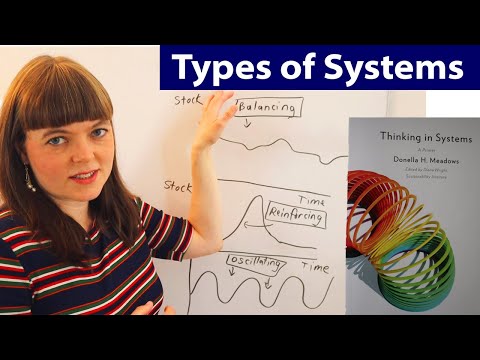
This video explains the key content of Donella H. Meadows' book 'Thinking in Systems', Chapter 2, "A Visit to the Systems Zoo," from an economist's perspective. The author analyzes the characteristics and causes of the different dynamics that the stock of a system exhibits over time: equilibrium systems, exponential growth followed by collapse systems, and oscillation systems, particularly emphasizing how information delays lead to system overreactions.
1. Confusion in system classification seen through the eyes of an economist
While explaining Chapter 2 of Meadows' 'System Thinking', the lecturer honestly admits that the content was somewhat confusing at first. 😟 Chapter 2 seemed to introduce various system types like a 'system zoo', but the clear system categories that the lecturer expected were not presented.
"I was expecting a section title that said, 'Here's this type of system, this is the lion type system, and I'll explain it this way.' So I was actually looking for a classification of about five different systems, and I couldn't find it."
The section titles presented by the author were 'one stock system' and 'two stock system', which was more of an analysis perspective rather than a way to classify the essential types of systems. The instructor realized that the author was classifying systems according to how inventory changes over time.
For example,
- Balancing system: A system that maintains a relatively stable state and naturally returns to its original level despite external shocks.
- Exponential growth and collapse system: A system that grows rapidly and then collapses at a certain point.
- Oscillating system: A system that constantly rises and falls around a stable level.
The author's intention was to understand the system according to the dynamic change pattern of inventory.
2. Why 'inventory' is important: the key to understanding the invisible
The lecturer said he was concerned that Meadows talked too much about 'stock' in Chapter 2. 🤔 This is because in the previous chapter 1, the author emphasized that the essence of the system lies in 'connection' between elements. We believed that it was not the inventory itself that was important, but the dynamics that caused changes in the inventory that were important.
"I was confused as to why we were talking so much about inventory when I thought the dynamics were what was important, not the inventory itself, the things in the system."
But the lecturer soon realized why. Measurability and Visualizability!
"The reality is that inventory is easy to see, easy to visualize, and easy to measure."
When analyzing a system, things like complex connections and incentives between elements are very difficult to analyze because they are invisible. Inventory, on the other hand, is a concrete object that can be measured, visualized, and analyzed. Therefore, the authors attempted to understand the system through how the invisible dynamics of the system affect inventory.
3. Core principles of the system: limitations and reproducibility
One of the key points Meadows makes in this chapter is the limitations of the system. No system can grow forever, and at some point it will reach its limit and forces will act to return the system to its original state.
"Because we can't have a system that grows forever, there has to be a force that brings it back down to earth. There are limits to the universe."
As an economist, the lecturer says he is very familiar with this concept of limits. Meadows also emphasizes that it is very important to distinguish between renewable and non-renewable elements of inventory in the system. This is an essential concept for understanding system sustainability.
4. Types of 'inventory' and complexity of analysis
Meadows explains the importance of inventory using the examples of 'one inventory system' and 'two inventory systems'.
- One Inventory System:
- Room Temperature (Stock: Room Temperature)
- Number of vehicles in used car stores (inventory: vehicles)
- Money supply in the economy (Inventory: Currency)
- Company's capital (inventory: capital)
- Population (Inventory: Population)
- Two inventory systems: When different types of inventory are added to one inventory system and analyzed together. For example, simultaneously analyzing population (first inventory) and food supply (second inventory) to understand the interactions between them.
The lecturer explains that the distinction between 'one inventory' and 'two inventories' is not an essential property of the system, but rather a choice of which elements the person analyzing the system will focus on.
"So one inventory versus two inventory is not really about the intrinsic properties of the system, but about what you are looking at when you analyze the system."
Of course, you can analyze 10 different inventories simultaneously, but as the model becomes more complex, it becomes more difficult to understand. Therefore, it is important to understand the dynamics by reducing model complexity, and sometimes a simple one-inventory model can be more useful than a ten-inventory model. The important thing is to select the appropriate number of stocks based on the purpose of the model. 📈
5. Three main types of systems: equilibrium, collapse, oscillation 🔄
The instructor explains in detail the three inventory change patterns presented by Meadows and provides examples of how these patterns occur.
5.1. Balanced Systems: Towards a Stable Equilibrium
balancing system is a system in which inventory levels remain relatively constant over time. This is because balancing feedback loop comes into play here.
"Inventory is fairly consistent over time... If we sell more than forecast, we'll order more cars next month or week to bring inventory levels back to equilibrium."
Example: Number of vehicles in a used car store 🚗
- If too many cars are sold, the store replenishes inventory by ordering more.
- If too many cars arrive, the store will control inventory by reducing additional orders.
Thanks to this mechanism, the inventory always tries to maintain a certain equilibrium. This is exactly the state economists are always looking for!
5.2. Exponential growth and then collapse system: growth hitting its limits 💥
The exponential growth and collapse system is initiated by a reinforcing feedback loop. Inventories grow rapidly, but eventually the system reaches its limits and collapses rapidly.
"When a rabbit population is introduced to a new environment, they reproduce and the population grows exponentially. But what can cause a collapse in this situation is if the rabbit population eats up all food sources."
Example: Rabbit population 🐰
- When rabbits are introduced to a new environment, their population increases rapidly (exponential growth) due to their high reproductive capacity.
- But at some point, the increased number of rabbits exhausts all food resources.
- Eventually, with nothing to eat, the rabbit population rapidly declines or collapses, reaching a new state of equilibrium (collapse). This new equilibrium may be different from the previous one, and may even be zero.
5.3. Oscillating Systems: Consequences of Delayed Feedback 🎢
An oscillating system is a pattern in which inventory constantly rises and falls around a stable equilibrium point. These oscillations mainly occur when there is a delay in the feedback loop.
"The situation that leads to an oscillating system is when there is a delay in the feedback loop, which tends to overshoot what is needed."
A balanced feedback loop operates to bring the system back to normal, but the phenomenon of overshooting or falling short of the target point is repeated as it takes time to transmit information or react.
Example:
- Meeting Room Temperature: 🌡️
- If the conference room is too hot, lower the temperature.
- However, the adjusted temperature is not reflected immediately, making the room too cold later.
- The temperature is raised again, but the temperature rises excessively and becomes too hot again.
"The reason we couldn't balance the system was because we felt desperate to change the temperature all the time, so we over-regulated it."
- Interest rate adjustment by the Federal Reserve: 💸
- Information about economic conditions (boom or recession) is always delivered delayed.
- By the time the Federal Reserve assesses economic conditions and adjusts interest rates, the real economy may already be in a different state.
- As a result, the Fed tends to overreact relative to the actual state of the economy, which creates an oscillating pattern in which interest rates rise and fall.
"The problem is that there is a delay in information about whether the economy is booming or in recession, so by the time the Fed knows when to act, it may be overreacting given the actual state of the economy."
- Government political orientation: 🗳️
- A government's political orientation (right-wing or left-wing) can also oscillate periodically based on feedback from voters.
6. Next video preview
In this video, we looked at the main types of dynamics in the system. In the next video, the remainder of Chapter 2 will be discussed in greater depth on limiting factors and renewable and non-renewable resources. I'm looking forward to it! ✨
finish
Chapter 2 of Meadows' 'Systems Thinking' provides a new perspective on systems. Understanding the complex dynamics of a system through changes in inventory patterns, and especially the impact of delayed feedback on the system, provides important insights into explaining a variety of phenomena around us. I think it was easier to understand thanks to the analysis from an economist's perspective. 👏