Pogacar's 5 Pre-Ride Exercises and Everything You Need to Know About Cycling Stretches
Pogacar's Warm-Up Routine Isn't Just for Show
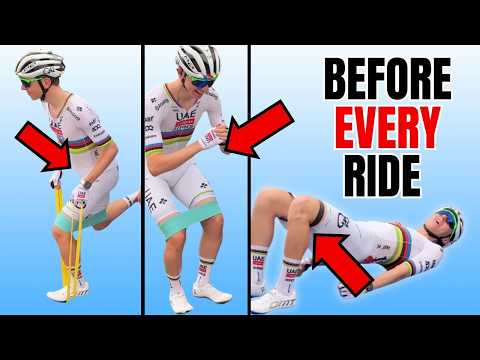
The video opens by emphasizing the importance of the band exercises and activation routine that world-class cyclist Tadej Pogačar always performs before a race. Many people have seen Pogačar next to the team bus, wrapping a band around his legs and doing what looks like a strange crab-walk. If you thought that was just for show, it's made very clear: it absolutely isn't.
"The best professional riders do activation exercises because they work. They know how to wake up their glutes, hips, and core before clipping in."
This kind of routine doesn't just improve performance — it also plays a major role in protecting joints, preventing injury, and aiding recovery after a ride. Yet most recreational riders, especially those over 30, simply hop on the bike without any preparation. Then they wonder why they feel stiff, heavy, and frequently sore.
Why You Need an Activation Routine
The video explains why an activation routine is necessary and why just spinning easy on the bike isn't enough.
- What activation routines do
- They wake up "lazy muscles" — especially the glutes and core — so those muscles are firing properly from the very first pedal stroke.
- Because cycling is so quad-dominant, other muscles tend to get left out.
- Activation exercises recruit glutes, core, and stabilizing muscles that would otherwise stay dormant.
"Activation exercises prime the muscles you're about to use. So instead of relying only on your quads and hamstrings, you start bringing in the other muscles too."
- How activation differs from a basic warm-up
- Riding slowly on a roller or indoor trainer is effective mainly at raising body temperature and increasing blood flow.
- Band exercises and other activation drills directly stimulate weak areas (especially the glutes) and wake up the nervous system.
- Many professional riders treat this kind of routine as mandatory — not just before races, but before training rides too.
"Almost none of the amateurs I know do activation exercises. But every pro does."
The Science Behind It — and the Injury Prevention Benefits
The video emphasizes that the routines used by Pogačar and other World Tour riders aren't just "bro science" — they're backed by research.
- Science-supported benefits of activation routines
- Raised muscle temperature → muscles become more pliable and contract faster.
- Short-term gains in strength, power, and explosiveness.
- Dynamic stretching (moving while stretching) is far more effective before riding than static stretching.
"Studies show that static stretching before a ride can actually reduce peak force and power output. Dynamic warm-ups, on the other hand, improve them."
- Injury prevention
- Research suggests that a structured warm-up routine can reduce injury risk by up to 50%.
- Issues like knee pain and muscle strains in particular can be prevented with proper activation.
"My physiotherapist recommended I do activation exercises before every ride, and consistently doing them has noticeably reduced my knee pain."
5 Minutes Before You Ride: Pogacar's 5 Exercises
Here's the Pogačar-style routine you can complete in 5–10 minutes, with a breakdown of exactly what to do.
- Banded Glute Bridge
- The go-to exercise for waking up the glutes.
- Place the band just above your knees, lift your hips and hold for 2 seconds (10–15 reps).
- Tip: Push your knees outward to prevent them from caving in — this activates the side glutes as well.
"If you're doing these right, your glutes should be on fire by the last few reps."
-
Monster Walk (Banded Side Steps)
- Place the band above your knees and walk sideways.
- Excellent for hip stability and prevents the knees from collapsing inward.
- Just 30 seconds and you'll feel your outer glutes burning!
-
Low Lunge with Rotation ("World's Greatest Stretch")
- Step one leg forward into a lunge, then rotate your upper body toward the opposite side.
- Opens up the hip flexors, quads, and lower back all at once.
- Repeat 2–3 times on each side.
"Cyclists develop extremely tight hip flexors, so loosening them up beforehand noticeably improves both posture and power output."
-
Dead Bug Variation (Heel Taps)
- A core-activation exercise.
- Move slowly and with control — that's what makes it effective.
- If your core starts to shake, you're doing it right!
-
Leg Swings
- Swing each leg forward-and-back, then side-to-side, to dynamically loosen the hamstrings, hips, groin, and outer glutes.
- A perfect way to finish the routine.
"After doing all five of these, your legs will feel much lighter and your body will genuinely feel awake."
After the Ride: The Stretches You Shouldn't Skip, and Why
Once the ride is over, static stretching becomes important. It helps muscles return to their resting length and is essential for maintaining flexibility.
- Why bother?
- During cycling, muscles repeatedly contract without ever fully lengthening — over time, they grow shorter and stiffer.
- Stretching helps keep muscles long and preserves joint range of motion.
"Even a Harvard paper confirmed that stretching is essential for keeping muscles flexible and healthy."
- Does it prevent delayed-onset muscle soreness (DOMS)?
- According to current research, stretching does not reduce muscle soreness.
- DOMS is caused by microscopic muscle damage, so stretching isn't a direct remedy.
"There's very little evidence that stretching reduces muscle soreness. But it absolutely helps with flexibility and long-term movement quality."
6 Recommended Post-Ride Stretches
-
Kneeling Hip Flexor Stretch (Lunge)
- Opens up the hip flexors that have been in a bent position for hours.
- Effective for preventing lower back pain.
-
Glute Stretch
- Releases the glutes and the smaller muscle beneath (piriformis), helping prevent sciatic nerve pain.
-
Hamstring Stretch
- Lengthens shortened hamstrings and reduces strain on the lower back.
-
Chest/Shoulder Stretch
- Gripping the handlebars for extended periods tightens the chest muscles.
- Helps with breathing, posture correction, and opening up the front body.
-
Kitchen Sink Stretch (Back/Lats)
- Lengthens the spine, upper back, and shoulders.
- Relieves the compression that builds up from hours in an aerodynamic position.
-
Calf Stretch
- Releases the calves that tighten from maintaining a fixed ankle position on the pedals.
- Especially recommended after climbing-heavy rides.
"Don't rush through the stretches — hold each position for at least 30 seconds. Put on some Beyoncé if it helps!"
Consistency Is the Secret 🚴♂️
The closing message is simple: consistency matters most.
"When it comes to exercise and stretching, doing a little regularly is far more effective than cramming it all in at once. You won't become a yoga master overnight, but if you stick with it for a month or two, you'll genuinely feel the difference in your flexibility."
The video wraps up by encouraging viewers to put this routine into practice and to share it with any stiff-legged friends they know — ending on a lighthearted note.
"Send this video to a friend and challenge them to touch their toes!"
💡 Key Takeaways
- Activation Routine
- Band Exercises (Glute Bridge, Monster Walk)
- Dynamic Stretching
- Static Stretching
- Injury Prevention, Joint Protection
- Flexibility and Long-Term Mobility
- Consistency Is Everything!
That covers all of it: Pogačar's 5 activation exercises, the science behind pre- and post-ride stretching, how to do them properly, and why showing up consistently makes all the difference. Starting today, invest just 5 minutes — and enjoy healthier, more enjoyable rides. 🚴♀️✨