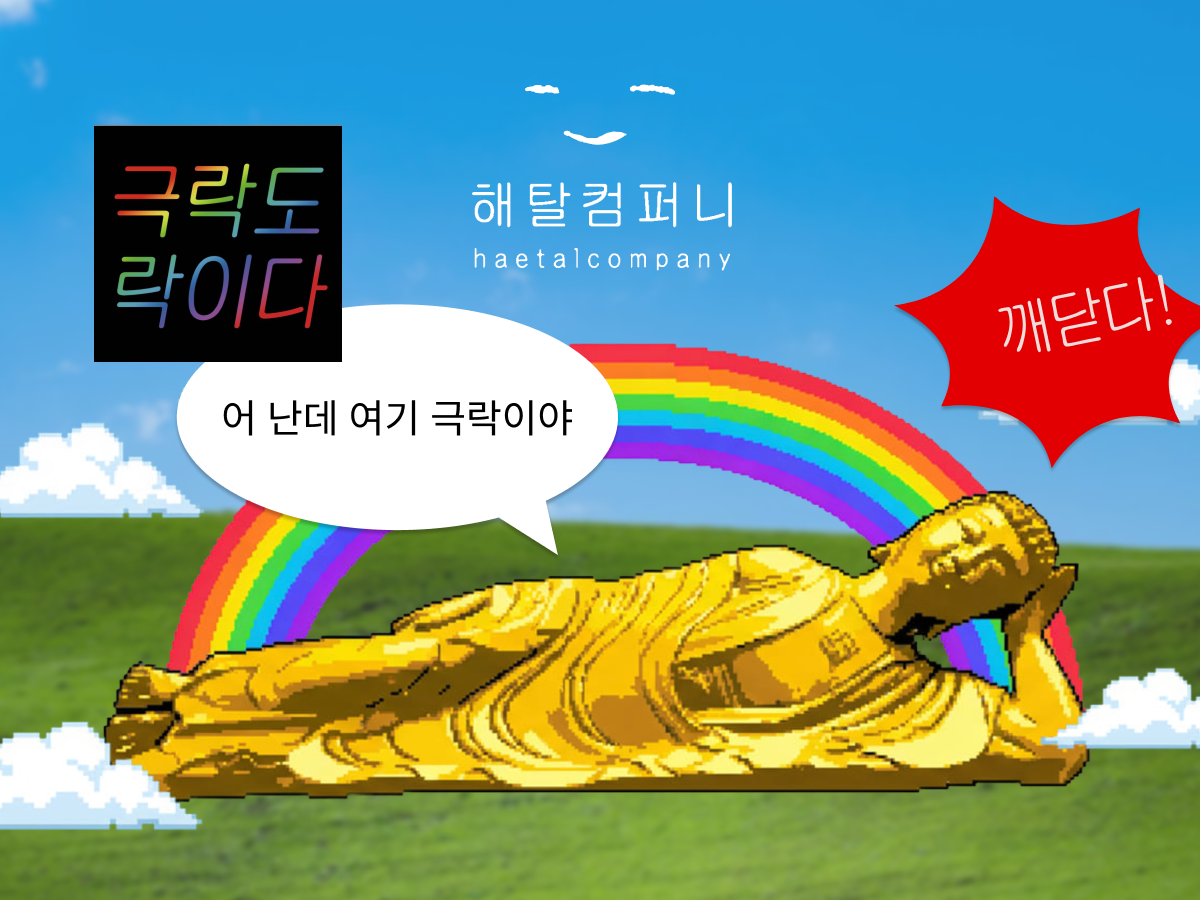
This article explores the success of Haetal Company, a "Buddhist creative collective" that emerged in 2024 and became popular among young people. It focuses on founder Ju Yeo-jin, born in 1995, who grew up learning Buddhism like play from her monk father and later reinterpreted Buddhist culture through playful ideas that resonated with people in their 20s and 30s. Through Buddhist meme goods, Buddhist music, festivals, and pop-ups, Haetal Company communicates the merciful message that "you do not have to be perfect" and is building a new Buddhist culture.
1. The Beginning of Numbness
Haetal Company, a new force in Korean Buddhism, appeared in 2024 as a "Buddhist creative collective." The team tries anything that looks fun around Buddhist themes: Buddhist meme merchandise, a Buddhist music band, festival planning, and more.
At the 2024 Buddhist Expo, their T-shirt with the phrase "Enlightened!" drew a huge reaction. At the April 2026 Buddhist Expo, their denim monk pants even created an "open run" phenomenon, with people lining up early to buy them. Kim Min-ji, CEO of Mind Design, praised Haetal Company as one of the main reasons the Buddhist Expo began to be seen as "hip." To understand why the team has captured so much attention from younger generations, the article meets founder Ju Yeo-jin.
Ju begins the interview with a mischievous smile and a loud, playful greeting. She does not fit the calm image people often associate with devout Buddhists. Her hair is in two braids, and she wears a white Haetal Company T-shirt with this sentence printed on it:
"Dear people who just exist, please do not attach any meaning to life today. Just live and have a fun day."
The line makes you laugh, but on second thought it also translates a Buddhist truth into playful language. It expresses the teaching that life is impermanent, so we should let go of attachment and free ourselves from suffering. Haetal Company's work has this charm: while people laugh and enjoy themselves, they naturally drift into Buddhism.
2. Learning Buddhism as Play From a Father Who Became a Monk
Ju spent her childhood in temples. In elementary and middle school she lived in a small hermitage in Eumseong, North Chungcheong Province. In high school she lived in a house with a small Dharma hall in Wonju, Gangwon Province. The reason was her father, Monk Taehyun.
Her father re-entered monastic life when Ju was eight and her younger brother was six. In Buddhism, "leaving home" means leaving ordinary secular life to walk the path of a practitioner seeking enlightenment. Returning to secular life means leaving the status of a monk and returning to ordinary society.
Monk Taehyun was not a conventional monk. He believed that practicing in the secular world was a way to come closer to enlightenment. So instead of practicing in the mountains, he chose to marry and live with family.
"My father was not an 'ordinary monk.' He believed that practicing in the secular world was a way to get closer to enlightenment. So he did not practice in the mountains; he chose to marry and live with family."
But he did not force the Buddha's teachings on his children. He said the teachings could not be understood through coercion. Instead, Ju learned Buddhism almost like play. Her father turned sutra passages into songs and played them on guitar, and the family often traded jokes using Buddhist terminology.
For example, he explained that maha prajna, or "great wisdom," could be jokingly described in Korean slang as "huge wisdom." When the siblings each had something to do, he would tell them to do it "gagak deungboche," a temple phrase wishing health and peace for each individual being and all other beings.
"My father the monk is a truly cheerful and funny person. He does not usually say heavy things. But when I have a worry, he gives me answers mixed with Buddhist teachings. When he practices, though, he is really fiercely devoted. When he sits in meditation in his room, the whole house becomes quiet. I thought that was cool. Thanks to him, Buddhism felt hip and fun to me from childhood."
Because of her father, Buddhism always had a positive meaning for Ju.
3. Even Doing Nothing Can Be Useful
Life with a "cheerful monk" as a father was not always easy. Ju was often hurt by how others saw her family. People asked, "Why is a monk married?" or "What kind of monk has children?" Because of comments like that, she could not freely call her father "father" outside the home and felt like Hong Gil-dong, who could not call his father father. Once, her father even introduced her as his "foster daughter," which wounded her deeply.
"People would ask, 'Why is a monk married?' or 'What kind of monk has children?' So outside, I could not freely call my father father, and I lived almost like Hong Gil-dong. Once my father introduced me as his 'foster daughter.' Moments like that hurt."
Because of this unusual identity, she became more timid as she grew up and tried hard not to stand out. Even when she had questions in class, she did not ask them. When friends were choosing what to eat, she always gave the choice to someone else.
Around her college graduation in 2019, Ju fell into deep confusion. She had spent so much time watching other people's reactions that she no longer knew what she herself wanted. After graduation she took a six-month contract office job, realized that office work did not fit her at all, quit, and fell into severe lethargy.
"I thought, 'Why can't I live like everyone else?' I became so ashamed that I could not leave my room. I felt like a useless person in the world."
For two years, she mostly "lay in bed and slept." The person who lifted her up again was her father. One day the monk called her a "researcher." When she looked confused, he said, "Did you do a lot of bed research today?"
"One day the monk called me a 'researcher.' I wondered what he meant, and he said, 'Did you do a lot of bed research today?' It was funny, but strangely comforting. I had been blaming myself for becoming a useless person, but he was saying that even this was a kind of 'research.' That changed how I thought."
That one joke changed her thinking. She had felt like a surplus human being, but the idea that she was "researching" something gave her comfort and helped her shift perspective.
Discovering Her Talent Through Buddhist T-Shirts
Because of her father's humorous comfort, Ju began to escape the thought loop she had created for herself. In Buddhism, this kind of release could be called enlightenment. She says this was the first time she experienced enlightenment.
"I actually had perfectionist tendencies. Because I thought I had to do everything perfectly, I could not try anything. I began to let go of the thought that I had to be perfect and instead think, 'Just try anything first.'"
One of the things she tried was planning a booth at the Buddhist Expo. In March 2023, she helped her father participate in the expo as part of the Siddham Script Research Association and planned a booth to introduce the value of Sanskrit letters.
Instead of explaining Sanskrit in words, Ju decided to show it on T-shirts. She learned silk-screen printing in a one-day class and printed hand-drawn Sanskrit characters meaning "wisdom" onto shirts.
"People thought Sanskrit was just 'difficult letters.' But to my eyes it looked like a beautiful pattern. If I printed it on a T-shirt, it might feel like a hip design. Dozens of people bought the shirts I made and found them fascinating. That was the first time I realized there were people who liked what I liked. It felt like I had finally found my home. I thought, 'Maybe this is where I can do well.'"
People bought the Sanskrit shirts with curiosity, and Ju discovered that others could share the things she found beautiful. It felt like finding her talent and her path.
4. Putting "Enlightenment" Into Wordplay and Winning People's Hearts
After realizing that people respond when Buddhist words are shown in a hip way, Ju tried something more radical in April 2024: translating Buddhist teachings into wordplay and putting them on T-shirts.
"I wanted to show that the Buddha's teachings are not only difficult. They can be fun. I thought it would be fun to express them in today's slang."
The representative example is the "Enlightened!" T-shirt. It riffs on the Korean "joyful" meme that became popular around 2018: a red oval with the word "joyful" placed over the face of a boy who does not look joyful. Ju reinterpreted that meme in a Buddhist way.
At first glance it looks casually made, but the details are clever. Instead of an oval, she used a spiky comic-style speech bubble to express the shock of enlightenment. The exclamation mark sticks slightly outside the bubble, showing a figure breaking out of a frame.
"When our fixed ideas break, we can gain enlightenment. We have to move beyond the frame of thought we already have. To express that, I placed the letters slightly off-center instead of in the middle of the speech bubble. I made the exclamation mark jump out. The speech bubble was designed to remind people of the effect you see in comics when something breaks."
She also turned the Buddhist term jungsaeng, or sentient beings, into a meme. Inside a heart shape she wrote "Jungsaeng, I love you," like a fan sign saying "I love you" to a celebrity. The phrase carries Ju's deeper interpretation. In Buddhism, jungsaeng can often be used negatively to mean unenlightened beings.
"If you call older templegoers 'jungsaeng,' they may dislike it. But the word also means all living beings. These days many people hate themselves. I wanted to say that simply because we are sentient beings, we deserve love. Buddhism also teaches that not loving yourself is like taking life."
Those sincere, funny T-shirts became a huge hit at the 2024 Buddhist Expo. On X, people called them "the hip clothes of the Buddhist Expo," and the prepared shirts sold out on the first day. More than 200 people placed preorders.
"I stayed up all night for the four days of the expo to process orders. My body was exhausted, but my heart was full of joy. That was when I realized, 'My aptitude is making people happy.' Buddhism has the doctrine of dependent origination: because this exists, that exists; because this arises, that arises. Everything is connected. When I make others happy, I can also become happy."
Right after the Buddhist Expo, Ju created the brand Haetal Company, meaning both a company that aims for the liberation of sentient beings and a group of colleagues moving together toward liberation. She was 30 years old at the time.
5. Designing Experiences While Imagining a "21st-Century Buddha"
Haetal Company quickly became a center of "hip Buddhism," and Ju worked to weave Buddhism naturally into everyday life. The team released goods such as towels that "wipe away defilements" and keycaps that say "delete defilements."
But if Haetal Company had stayed only as a goods company, it might have shone briefly and disappeared. Ju has kept expanding its energy for three years, and the secret lies in experience design beyond merchandise.
1. Karma Laundry: Showing a Buddhism That Can Embrace Everything
One reason Buddhism is gaining popularity among people in their 20s and 30s is that it feels like a religion capable of embracing the changes of the times. Haetal Company noticed this and connected Buddhist philosophy with social issues that young people care about.
A representative example is the Karma Laundry pop-up store held in July 2024. The event took place in the laundry room of Hongdae Seonwon, a temple-stay-style guesthouse in Hongdae, and used the concept of "washing away the karma accumulated in the climate-crisis era."
Visitors brought clothes they had bought impulsively and no longer wore, then transformed them into Buddhist-core items. They chose patches with phrases such as "practicing," "become Buddha," and "hey, you can become Buddhist too," and attached them to their clothes.
"I think everyone wants to protect the environment. But in reality it is not easy. We inevitably create 'environmental karma' when we buy new clothes. I wanted to wash away that guilt. What if, instead of throwing away clothes we do not wear, we refashion them? In that process, people can also feel that they are building good karma."
By helping people refashion clothes that might otherwise be thrown away, the pop-up gave visitors a sense of doing good and reduced guilt around environmental issues.
2. Pop-Up Store: A Messy Bazaar in the Middle of a Giant Mall
When people think of Buddhism, they often imagine quiet mountain temples, wooden bells, and subtle incense. In January 2026, Haetal Company designed the opposite scene: a noisy, approachable pop-up in Yongsan I'Park Mall, together with the Buddhist brand Amiul.
The venue looked like a messy bazaar. Keychains and stickers were spread across plain white rectangular tables. Towels and T-shirts were placed casually on shelves made from milk crates. Even the price tags were handwritten in marker on spiky paper signs like supermarket discount labels.
The experiential booth where Monk Taehyun drew "2026 good-luck caricatures" was made from discarded delivery boxes. The boxes were connected into a house shape, with a heart-shaped hole in the middle so the monk and visitors could look at each other through it.
The pop-up drew more than 50,000 visitors over eight days. Asked why she made an urban Buddhist pop-up feel like a market, Ju said that was the most Buddhist approach.
"The Buddha who came 2,600 years ago let go of his splendid status as a prince and mixed freely with all kinds of people. I think that is hip. He did not worry about other people's eyes; he went his own way. If we had suddenly tried to look polished just because we were doing a large pop-up, it would have been boring. People who were not interested in Buddhism would not have come in. So we intentionally relaxed the atmosphere and did not make a separate entrance or partitions. We wanted passersby to feel comfortable stopping by even though it was a religious pop-up. People saw that raw sensibility and called it hip."
Just as the Buddha left behind royal status and mingled with all kinds of people, Haetal Company approached people through an unpolished rawness, and that became what people experienced as hip.
6. Why a Buddhist Brand Makes Boundary-Crossing Jokes
Haetal Company plans to keep creating Buddhist experiences people can casually visit and enjoy.
One example is a Buddhist festival planned for May 30, the Buddha's Birthday After Party. At Beomnyunsa Temple in Jongno, Seoul, Buddhist brands and artists will gather for a market and band performances. Visitors will also experience Buddhist rituals such as bathing a baby Buddha statue.
The party's name is the playful "Bul-na-joa Festival." In Korean, the name sounds close to profanity but is reworked into a positive Buddhist pun.
"The first name we considered was 'Buddha, Don't Go Festival,' shortened to 'Bu-ga-fe.' But the Buddha is always beside us, and 'don't go' felt somehow sad. So we tried to think of an exciting, happy name, and Bul-na-joa Festival came out. Everyone has a Buddha inside them. The name means being so happy that the Buddha inside you comes out."
You may wonder how older people in the Buddhist world react to this boundary-crossing humor. Ju reveals that the idea actually began with Monk Taehyun.
"All things are made by the mind. We think according to the language we use. If we transform slang or swear words into something more positive, our mindset may change. The monk suggested that when we want to emphasize something, we could use the word 'bulna.' That is where the idea came from."
Ju goes further and says a Buddhist brand should cross lines.
"If you do not cross the line, nothing new happens. For a message to penetrate other people, you have to cross the implicit line and break the frame. That is how we brought people closer by turning 'serious religion' into memes. In fact, crossing the line is harder than staying inside it. I have to keep breaking my own fixed ideas about the Buddha too. Every time, it is also practice for me."
Crossing lines becomes a way to create change and communication. For Ju, it is also a recurring practice of breaking her own assumptions.
Offering Comfort: "You Do Not Have to Be Perfect"
Ahead of the Bul-na-joa Festival, the Haetal Company team is preparing something else: a Buddhist rock band. Inspired by the spirit of Wonhyo, they named it the "Skull Water Band."
The funny part is that only one of the five members majored in an instrument. Even so, they are bravely preparing to debut on May 30 with a song called "Avalokitesvara," created by an AI bodhisattva that Haetal Company is training.
"Of course we will not be perfect. We will be lacking and full of gaps. But I think there is beauty that comes from imperfection. I hope people can look at us and think, 'They were clumsy, but it was okay. It worked.' Then maybe they will think, 'I can do it too.' I hope people do not become helpless because they are trapped in the idea that they must be perfect. Even if they are awkward, I hope they challenge themselves and accumulate fun time in life. It is exactly what I want to say to my own self in my twenties, when I was too ashamed to leave my room."
Ju hopes people gain courage from seeing imperfection in action. It is the message she most wants to give her younger self.
Closing
At first, Haetal Company may look like a funny, hip brand. But after more than three hours of conversation with Ju Yeo-jin, the word that remains is mercy. Isn't mercy the act of waiting for people even when they are imperfect and telling them they are fine as they are? Perhaps today can be a day to offer that mercy to yourself. And if someone comes to mind, maybe this is a note worth sharing with them.