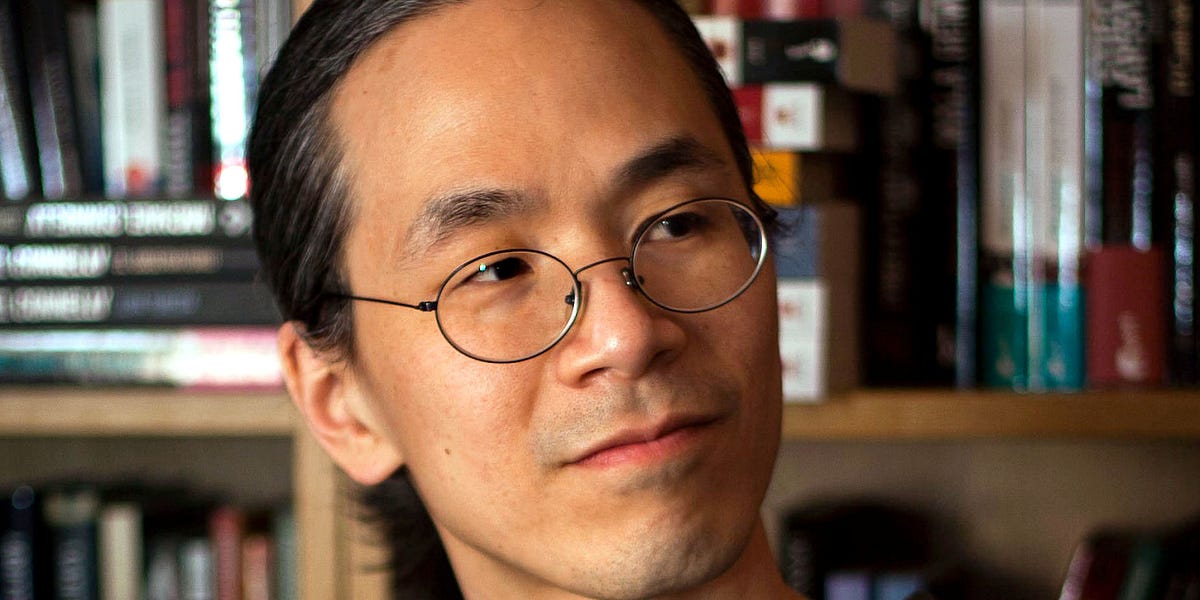
Ted Chiang is widely regarded as the greatest living science fiction short story writer, known for resonating deeply with readers through his original scientific imagination and philosophical depth. This piece examines how he breaks free from conventional SF conventions to construct new worlds grounded in a genuine scientific spirit. It also fairly addresses his perfectionism and its limitations.
1. Praise for Ted Chiang and the Starting Point
The author opens by revealing that they have read all of Ted Chiang's works multiple times, calling him "perhaps the greatest living short story writer." They've read The Merchant and the Alchemist's Gate upwards of seven times -- that's how deeply immersed they are in his stories.
"I've read all of his works at least twice, and I think I've read The Merchant and the Alchemist's Gate about seven times."
However, the author points out that many readers and critics miss one crucial point about his work. This review sets out to uncover that "truly unique aspect."
2. Ted Chiang's Unique SF -- "Genuinely Scientific Fiction"
Traditional SF criticism commonly divides the genre into "hard" and "soft":
- Hard SF: Stories grounded in real physics and science (e.g., Arthur C. Clarke).
- Soft SF: Stories with a scientific veneer but focused more on human relationships and social elements (e.g., Star Wars).
But Ted Chiang's work doesn't fit neatly into either category. His stories feature worlds where "different scientific laws" apply. These worlds are internally consistent, but what makes them unique is that the science itself is fundamentally different.
Key Examples
- "Omphalos": Young Earth creationism is empirically true.
"Scientists discover various independent lines of evidence that all lead to the conclusion of creationism -- because in that world, it IS the truth."
- "Seventy-Two Letters": Technological development originates from Jewish mysticism (Kabbalah).
- "Story of Your Life": The "strong Sapir-Whorf hypothesis" (language determines thought) is actually true in that universe.
In other works, "Division by Zero" features mathematics itself collapsing internally. In "Hell Is the Absence of God," divine intervention is empirically observed and follows certain rules.
"Some critics say the Sapir-Whorf hypothesis is 'unrealistic' or that 'creationism has no basis,' criticizing the science as unrealistic. But Chiang was doing something different. He was creating internally consistent alternate universes to explore philosophical developments and human relationships."
3. Hope for Science and Technology, and Humanity
In contemporary Western "literary" SF, there's a strong tendency to portray technology cynically and pessimistically. The prevailing framework is the "Torment Nexus" approach -- "all new technology = disaster" -- with Black Mirror as the quintessential example.
Ted Chiang boldly goes against this trend. He sees technology not as something that destroys humanity, but as something that brings us closer to our humanity. Quoting Joyce Carol Oates:
"Even if God exists, He is merely part of the world of science and has little interest in humanity. But human curiosity is an engine of nearly divine progress, and its alliance with technological advancement actually elevates humanity." "For Chiang, human curiosity is a driving force of development approaching the divine."
Specifically:
- "The Truth of Fact, the Truth of Feeling": Memory augmentation technology helps people recognize self-deception and forgive their families and themselves.
- "Liking What You See: A Documentary": Technology prompts a rethinking of the nature of beauty.
Technology is portrayed not as the source of horror and catastrophe, but as an occasion for confronting uncomfortable truths. Through that process, people come to understand themselves and the world more deeply.
4. Compatibilism, Time, and Free Will: Narrative as Philosophical Experience
Free Will vs. Determinism
Compatibilism: the position that free will and determinism can coexist.
"Compatibilism holds that when free will is understood as the ability to act according to our desires, we are still free and morally responsible even if everything is determined by prior events."
The author notes that this explanation can feel vague in actual experience. That's why Chiang's fiction makes these philosophical dilemmas feel concrete and visceral.
In "The Merchant and the Alchemist's Gate":
"The journey to the past changed nothing. But what I learned changed everything... The past cannot be erased. There is repentance, atonement, and forgiveness. That is all, but it is enough."
In "Story of Your Life":
- The protagonist learns an alien language and begins experiencing past and future simultaneously, ultimately accepting determinism.
- The process is tragic but beautiful -- there is profound satisfaction and forgiveness in accepting fate.
"This is what compatibilism feels like from the inside. The characters know they cannot change the outcome, yet that knowledge transforms the experience. Forgiveness, acceptance, even joy."
Chiang doesn't discuss these philosophical concepts abstractly; instead, he translates them into an individual's inner, emotional life. The mathematician in "Division by Zero" experiences the collapse of mathematics as if it were the collapse of her own life.
5. A Storyteller Who Crafts "Inevitable Endings" Through Different Paths Every Time
Chiang's works have the charm of feeling completely different on second and third readings.
- His endings don't rely on twists or tricks.
- "The fate was already determined, but the moment of realization transforms the journey itself."
- This is essentially implementing compatibilism as a literary form.
"The ending was always determined, but discovering it still matters. Knowing the destination changes the journey -- it doesn't stop the journey itself."
In this way, Chiang illuminates not mere intellectual amusement, but why human existence and choice are meaningful in a new light.
6. Weaknesses and Limitations: Society-Wide Interaction with Technology
But Ted Chiang is not without flaws.
- He has weaknesses when it comes to depicting society-wide interaction with technology. He excels at exploring the relationship between an individual (usually the protagonist) and technology, or at macro-level explanations (laws of the universe, etc.), but his imagination falls short when it comes to "how an entire society rapidly transforms upon adopting a new technology."
For example, the parallel-universe communication technology (Prism) in "Anxiety Is the Dizziness of Freedom" is revolutionary enough to fundamentally change the world, yet the story focuses primarily on the protagonist's inner struggles and small-scale interpersonal exploration.
"If Prism technology existed in reality, pharmaceutical companies could simultaneously test billion-dollar drugs across multiple universes and exchange data for tremendous research possibilities... Society as a whole would hurtle toward something at incredible speed, but Chiang barely addresses this."
Additionally, outside of stories related to compatibilism, his work can be relatively weaker in philosophical and emotional resonance. His perfectionism and the resulting extreme rarity of new publications are also noted as regrettable.
7. Recommendations and Reader Engagement
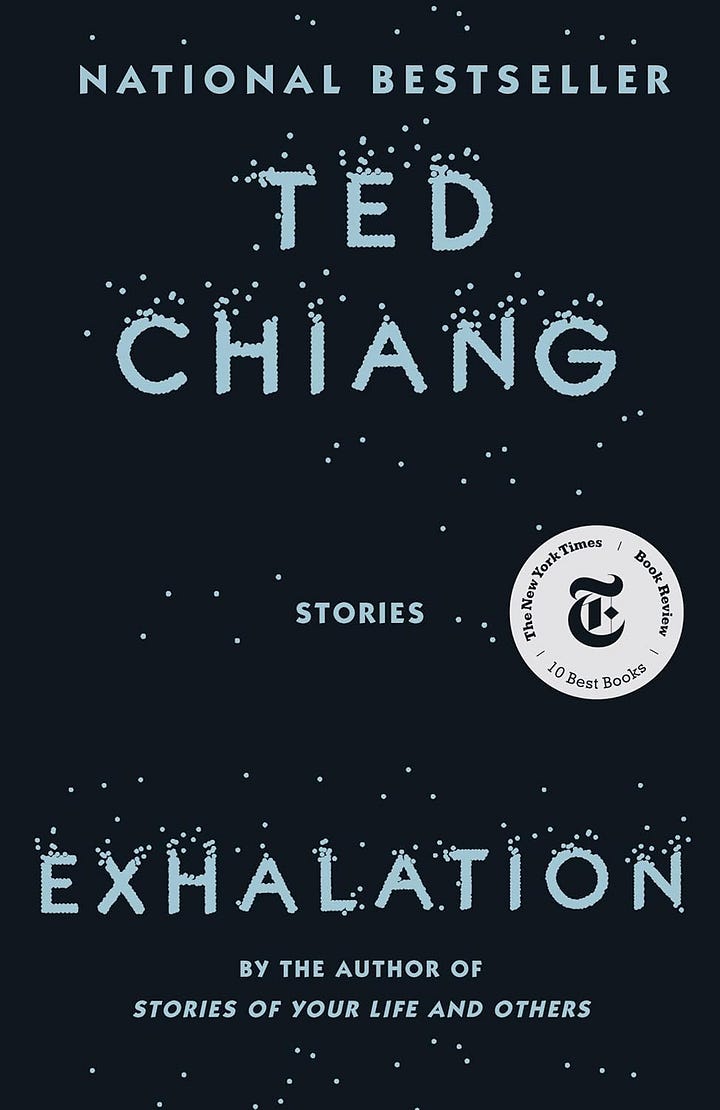
Finally, the author wholeheartedly recommends Ted Chiang's books. "If you can read only one SF book this year, make it Stories of Your Life and Others; if two, add Exhalation."
"If you're planning to read five SF books this year, congratulations! In that case, I'd recommend reading Stories of Your Life and Others twice and Exhalation three times."
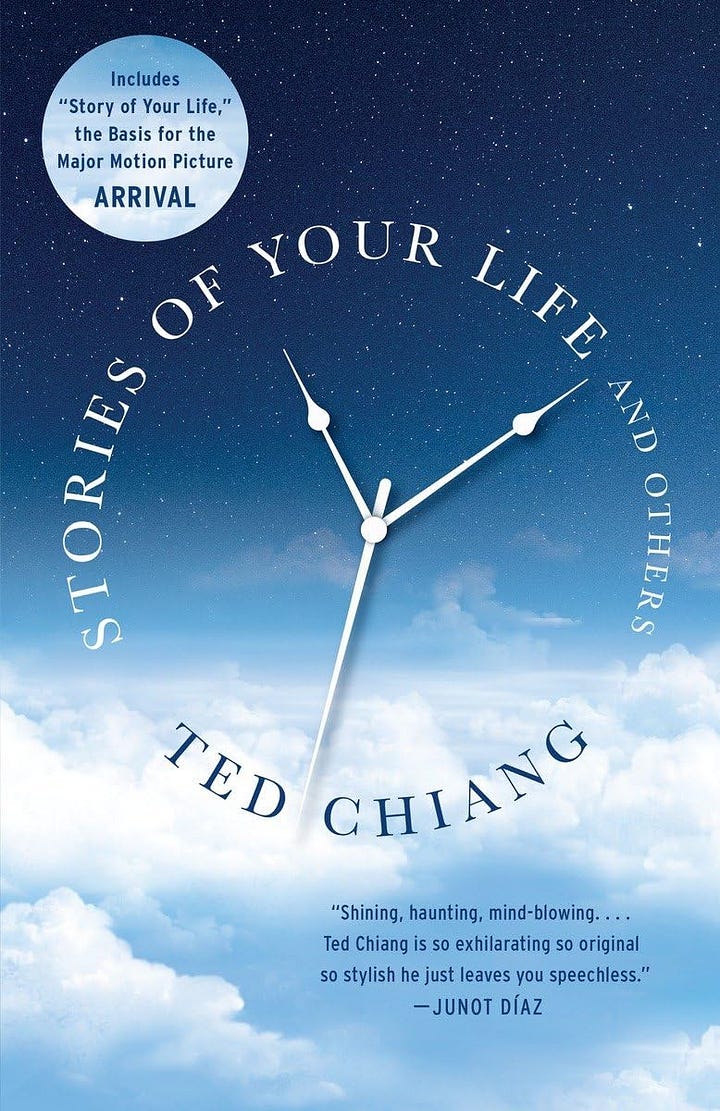
The author also mentions reader engagement, an offline screening event (Arrival, August 25), and subscription thanks.
Closing Thoughts
Ted Chiang transcends the limitations of conventional SF writers by delicately combining an original scientific worldview, deep philosophical contemplation, and warm hope for humanity. His stories compel readers to look anew at themselves, the world, and what it means to be human.
"The past cannot be erased, but there is repentance and forgiveness. That is all, but it is enough."
The worlds Ted Chiang shows us may offer a new way of experiencing and accepting the world through different eyes.