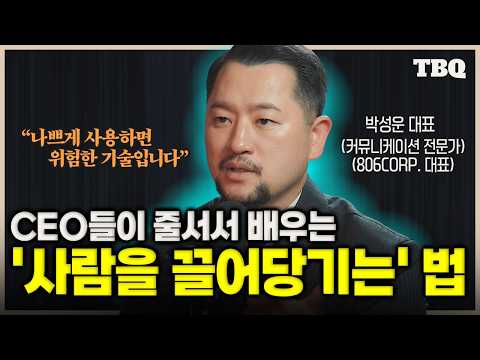
In this talk, leadership and communication expert Park Sung-woon explores the art of influence that draws people in and how to become a confident leader. Drawing especially on his experience in VIP protocol, he explains in detail the problem-solving skills he gained, the image created by dress and behavior, and the communication methods that build genuine leadership and charisma. The talk is rich with practical advice for personal growth and business success.
1. Lessons and Insights from VIP Protocol Work ✨
Park Sung-woon opens his story by introducing his past work as a protocol and interpretation coordinator for head-of-state-level VIPs — including the President of Bosnia, the King of Lesotho, and the Prime Minister of Cambodia. He emphasized that through this work he came to deeply understand the essence of communication and the importance of problem-solving ability.
"International events are events that involve a great many people from many different organizations. The Ministry of Foreign Affairs, the police, the hotel, the organizers — many institutions are mixed together. So the person called the coordinator in the middle of all this has to know all of this information and play the role of a gear that meshes everything together well."
Using as an example a tricky situation during the Cambodian Prime Minister's visit, when there was no interpretation booth, he explains that the key to solving a problem is figuring out what the other person truly wants. The point was that it wasn't about simply bringing in an interpretation booth, but about addressing the underlying need — "our boss can't speak English." This insight carried over into his own business: when selling spaces, he succeeded by addressing the customer's budget concerns or by emphasizing that the space would make the person in charge look good.
"What does this person really want? When I looked into that desire, I realized — ah, this person doesn't need an interpretation booth right now; their boss can't speak English, so they need interpretation that lets him hear it in his own language."
He added that when you run into a problem, it's important to recall the question, "What does the other person really want?" Even in conflict situations, he emphasized the need to ask "Why is this happening?" in order to grasp the other person's real problem, and to make the effort to understand their background and circumstances.
2. Wit and Coping in a Crisis 💡
Park Sung-woon shares a nerve-wracking episode that occurred during the visit of the King of Lesotho. The Korean restaurant he had reserved had a narrow entrance and required taking off your shoes, which made the VIPs increasingly unhappy — but he says he overcame the situation through storytelling.
"Eating jellyfish salad is good for your skin." "Red symbolizes wealth in the East."
Through this experience of turning the mood around by adding stories about K-beauty or Eastern symbolism to the food, he says that when a problem arises, it's important to make people quickly forget the bad memory. Just like the saying "only those who live in the present are happy," he argues that rather than persuading people, providing new fun to get them focused on the present is the effective way to cope. He emphasizes that this kind of improvisational ability is not innate but can be fully cultivated through practice.
3. A Career Journey That Began in a Tiny Boarding House 🚀
Park Sung-woon candidly confesses that behind his current success lay hard times that began in a one-pyeong (roughly 35-square-foot) goshiwon (boarding house). After a falling-out with his father, he left home and made a living in Busan working various part-time jobs at PC cafés, bubble tea cafés, and izakayas.
"The place I stayed at back then was a one-pyeong goshiwon. I had about 800,000 won in my bank account at the time, so I got a goshiwon that cost 250,000 won a month, got a new phone, changed my number entirely, got a new phone, and worked day and night like that."
Even back then, he prepared for the future by keeping the habit of writing his business plans on the wall and taking notes, and he began building his career when, by chance, he took over a friend's place doing protocol work at an international event. As an English Literature major who taught himself English and Japanese, his language ability was so strong that he entered university as a foreign-language specialist. He learned the importance of protocol while attending to VIPs through interpretation work, but ultimately, driven by the thought that he wanted to "tell my own story" rather than "speak someone else's words," he began producing communication content such as leadership skills from 2018, which led him to the path he walks today.
4. A Dignified Image and Manners: How to Become a Gentleman 🎩
Park Sung-woon emphasizes the importance of dress and manners that he learned directly from VIPs. In particular, he stressed the importance of shoe care and clothing fit.
"There's a difference between wearing 100,000-won shoes and wearing 2-million-won shoes. It's keeping your shoes well polished. ... Most people, when they look, are unlikely to be able to tell whether they're truly top-grade 2-million- or 5-million-won shoes or 100,000-won shoes. And people don't even look at shoes that much. But they do notice this: clean shoes versus dirty shoes."
- Shoes: Rather than expensive shoes, keeping them clean is what matters, and he recommends using shoe trees.
- Dress:
- Fit: Wearing clothes that fit your body is most important. For jackets, you need to mind the shoulder line; for trousers, the waist and length.
- Material: Rather than cheap clothes, it's better to buy clothes made of good material and wear them for a long time.
- Color: You should follow basic color-matching rules, such as choosing socks to match the color of your shoes. With a formal look, sports socks or white socks are a fatal mistake to avoid.
- Tidiness: Tuck your shirt into your underwear, secure your tie with a clip, and avoid bulging your pockets with a wallet or phone. He added that it's best not to wear a short-sleeved shirt under a jacket.
- Grooming: For a clean impression, he emphasizes consistently keeping up facial hair grooming (hair, eyebrows, nose hair, beard) and skincare.
But he says that what matters more than these external elements is mindset and behavior. He defines a true man as someone who knows love and someone who takes responsibility for what he wants to protect.
"A real man is someone who loves. A man who has never loved finds it very hard to become a real man. ... Because he knows love, he wants to take responsibility, to protect, to look good to that person, to show the best version of himself."
He also advises that a mature man should possess humility, and that it's important to "speak less and act more."
5. Why Modern Men Grow Weak, and a Philosophy of Raising Children 👨👦
Park Sung-woon cites "too safe a society" as the reason modern men are less mature than in the past. In a social atmosphere where danger and challenge have disappeared and everything is tolerated, men no longer feel the need to become strong.
"It's too safe. We've become too safe a society. ... Life was originally wild, and war doesn't only exist in the military. Life is a war every day."
He says that because of the responsibility — that if he doesn't make himself strong he can't protect his family and his company — he works out and makes the effort, and he stresses having a sense of crisis and responsibility. When raising his son, he says he shares information with an attitude of "Dad is just like you" and gives him opportunities to fail. By showing the hardships his father goes through and the process of overcoming them, he helps his child judge and grow on his own.
"I'm just like you. So even Dad has things he doesn't know, and I get stressed too, and yeah, I have hard times too. That's why I try hard to share a lot of information." "It's okay to make mistakes. As long as you know it even while goofing around — I say a lot of things like that."
6. Dealing with Rude People and Building an Aura and Charisma 🛡️
When dealing with a rude person, he says it's first important to check yourself to see whether you did something that warranted such treatment. And when you are treated rudely, he advises you to "Squirm!" — recommending that, rather than evaluating the other person, you honestly express your own feelings, such as "I'm uncomfortable" or "that's unpleasant for me."
"I think that remark was a bit too much. It makes me a little uncomfortable. Just saying that alone can make this person hesitate."
He says that a rude person you meet only once is like feces, so the best policy is to let them flow past quickly, and he advises against bothering to waste energy trying to fight them.
He explains that aura and presence are created through the speed of your actions. Rather than quick, small movements like a rabbit, moving slowly like a lion, slowing the pace of your speech, and sometimes staying silent adds weight and gravitas.
"Just by controlling the speed of your actions, you can dramatically raise a person's aura."
He emphasizes that charisma comes from a proactive demeanor, and that it's important to put grounds and logic into your words. He says that if you cultivate the habit of speaking clearly by following the "conclusion–reason–evidence" principle, you can convey trust and come across as a charismatic person.
"There are a great many cases where people speak well by following this principle of conclusion, reason, evidence. ... When people use that way of speaking, we feel — wow, this person speaks crisply. This person is really articulate. So this person is very trustworthy, a charismatic person — that's how we come to feel."
7. Self-Esteem, Self-Confidence, and the Art of Conversation 🗣️
Park Sung-woon clearly explains the difference between self-esteem and self-confidence.
- Self-confidence: The ability to believe "I can do it" based on past experiences of success (it comes from the past)
- Self-esteem: The ability to respect your present self just as you are (it starts in the present)
He points out that people with low self-esteem habitually use negative speech patterns in conversation and tend to put their deficiencies and shortcomings front and center. Expressions like "I won't be able to do it" or "Someone like me..." are typical examples. He emphasized that honestly revealing your feelings and tearing down your self-esteem are two different things.
"The characteristic of how people with low self-esteem talk is this: a negative form is laid down as the foundation. I won't be able to do it. How could I do it? Someone like me."
As a way to quickly get close to others, he cites visual setup and specific compliments. It's effective to pinpoint and compliment the part the other person put effort into, and sometimes to show an earnest attitude that seems to touch the pride of an expert. He explains that even when ordering a cocktail, the secret to getting good service is to tell the bartender your mood and the taste you want, and hand over the choice to them.
At a networking party, he advises you to act like a lion.
- Observe and secure your own territory: Don't rush; observe people and choose a group to join in conversation.
- Connect deeply with just one person: He emphasizes that properly building a relationship with one person leads to a genuine network, more so than knowing many people shallowly.
- Ask 5W1H questions: When starting a conversation, keep it going by asking questions that show interest in the other person, such as "How did you come to be here?" or "What kind of work do you do?"
- Mirroring technique and honest self-disclosure: Repeat the other person's words to mine for conversation topics, and mix in your own honest stories here and there to avoid feeling like an interview.
8. How to Judge Good People and Spot Gaslighting 🧐
As criteria for judging a good person, Park Sung-woon offers two.
- Three lights: Read the person's state and energy through their eyes (eye-light), complexion (face-light), and body presence (body-light).
- Attitude toward three beings: You can know a person's character by watching how they behave toward children, animals, and the elderly.
He also says that to know whether someone is sincere with you, you can look at whether they remember the small things. A person who is interested in you remembers all the details without even trying to memorize them.
He explains that gaslighting is psychological violence characterized by information control, stripping of self-esteem, maximizing fear, and fostering dependency. Words and behaviors like "What do you know?", "What does someone like you think you can do?", and "Who's going to take responsibility if you fail?" are typical examples. He emphasizes that to avoid being gaslit, it's important to share information and to give the other person opportunities to fail.
9. Public Speaking Tips and the Essence of Leadership 🎤
For tips on speaking well in public, Park Sung-woon advises the following.
- Overwhelming experience: Real-world experience matters most, and it's good to practice with actual people seated in front of you.
- Self-review: Watch a recorded video with the sound off and check whether the message comes across through your facial expressions and gestures alone. Public speaking requires exaggerated gestures and expressions.
- Form one-on-one relationships: Find someone in the audience who is friendly toward you, make eye contact, and proceed as if having a one-on-one conversation.
- Keyword-based understanding: Instead of memorizing a script, understand it around key keywords so you can speak flexibly.
- Voice control: Use the three elements of volume, speed, and silence to create a dynamic voice.
- Matching gestures: Use hand gestures that support the content of your words to boost the message's impact.
When you suddenly have to give a speech you're not prepared for, he says to use the FEET formula.
- Feeling: "Looking back on this past year, it was a truly joyful year."
- Episode: "I remember last summer, sweating buckets while sorting things out in the warehouse."
- Extract (lesson): "At that moment, sharing the ups and downs together, I felt that we were truly one team."
- Thank You: "Thank you for all your hard work, and I look forward to working well together next year too."
He says that high-level clients such as CEOs, professionals, and second-generation business heirs mostly come to him for the ability to convey their thoughts well in front of many people. For them, coaching is done not just for speech technique but together with mental management, communication, and an understanding of their life background. He emphasizes that overcoming trauma is about covering it over with experiences of success, and that anxiety and fear can disappear through knowing.
He explains that leadership education is ultimately communication education, and that it focuses on the influence that moves people's hearts to advance toward a shared goal.
10. Good Influence and a Vision for the Future 🌟
Park Sung-woon defines good influence as ultimately "the propagation of goodness." Just as sunlight makes plants grow, his vision is to exert good influence to create even better people and benefit the world.
"I think it's the propagation of goodness. Through good influence, creating even more good people." "Exerting influence — in the good sense, when you exert influence in a good way — lets you cultivate even more good people and grow even better things, so I think of it as the propagation of goodness."
His company, 806, aims at developing talent. He explains that all of the company's business activities — in space, fashion, media, and education — are focused on nurturing better leaders and helping them contribute to the world.
"What does our company exist for? We do everything for the sake of developing talent."
Finally, he closes the talk by emphasizing the importance of a positive mindset — embracing the ups and downs of life not as something shabby but as variety and beauty — and steady effort.
In Closing
Park Sung-woon's talk went beyond mere speaking technique to offer deep insights into how a person can grow and exert a positive influence on others. His sincere experiences and practical advice spanned a wide range of topics — from the importance of self-management to the essence of human relationships and the meaning of true leadership — gifting us the wisdom we need to live better lives. It was a time to once again realize that learning and practicing steadily is the surest path by which we can all grow and develop. 😊