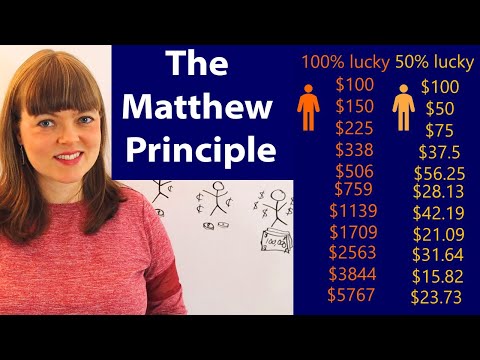
This video explains the 'Matthew Effect' and shows how inequality in the economic system deepens when more is given to those who already have a lot, and what is taken away from those who do not. In particular, it explains in an easy-to-understand manner how inequality accelerates over time through luck-based simulations and various examples from real society.
1. What is the Matthew Effect?
In economics, the Matthew Principle refers to the phenomenon in which more power is given to those who already have a lot, that is, powerful people, and more money is given to those who have money. 💰 This term originated from Matthew 25:29 in the Bible, and it is said that the name was taken from the following verse:
"For to everyone who has, more will be given, and he will have an abundance; but from him who does not have, even what he has will be taken away."
This principle is not simply limited to economic systems, but also appears in various fields such as ecological systems and power-based systems. However, this video mainly focuses on the economic system. The best way to understand this principle is to think of the game Monopoly. Those who are lucky at the beginning of the game accumulate more and more wealth, while those who are unlucky lose what they have and eventually hand over all their resources to the lucky ones.
Of course, real-life income distribution is not simply determined by luck. Along with luck, many factors come into play, including effort, talent, and the ability to meet the demands of the economy. But the important thing is that once you fall behind, it becomes increasingly difficult to move forward, while when you get ahead, you have the resources to further expand your wealth and economic stability. 💪
2. Luck-based economic simulation: Accelerating inequality 🎲
To understand the Matthew Effect in more detail, the video presents a simple luck-based economic simulation.
- Initial Setup: Everyone starts with $100.
- Game Rules: Each round, you play a coin toss game, risking half of your money.
- Win: You get back the money you bet and it is doubled. (Example: If you bet $50 and win, you will receive $50 back for a total of $150)
- Losing: You lose the bet. (Example: If you bet $50 and lose, you only have $50 left)
This system is a Zero growth economy where there is no overall wealth growth, but money is redistributed to the winners.
2.1. Comparison of results after 10 rounds
Here, let's compare 100% lucky people and 90% lucky people.
- 100% lucky person: The person who continues to win throughout 10 rounds
- After 10 rounds, you will have $5,766.
- 90% lucky person: A person who wins the first 9 rounds but loses the last 1 round.
- After 10 rounds, you will have $1,922.
Amazingly, people who are 100% lucky become 3 times richer than people who are 90% lucky! 😮 Even 90% of the time, it is said that the result is the same regardless of which round the lucky person loses.
So what happens to the 50% lucky, that is, the person who wins half and loses half?
- 50% lucky person:
- After 10 rounds, only $23.73 remains. (I started with $100, but it actually went down!)
The results of this simulation may come as quite a surprise to many people. It's just 50% luck, and you end up with a lot less money than the $100 you started with.
2.2. Results after 20 rounds: Inequality deepens 😱
What if we run this simulation for 10 more rounds, for a total of 20 rounds?
- A person who is 100% lucky will accumulate 9 times more wealth than a person who is 90% lucky.
- 50% lucky will have less than $6.
- The two unluckiest groups of people end up with less than 1 cent left over.
In this way, the Matthew Effect deepens inequality over time, showing that small differences in initial conditions can create huge disparities. 📉
3. Expanding the Matthew Effect: Effort, Talent, and Systems
How about changing the word 'luck' in this simulation to 'effort' or 'talent'?
- If we do the same simulation based on 'effort', someone putting in 50% effort could lose a lot of money in this system.
- Of course, in reality, effort can increase the size of the overall pie (wealth) by creating more goods and services, but the distribution of that pie is still likely to follow a power law distribution.
The video also addresses ways to slow this acceleration of inequality. For example, if you change the rules so that instead of betting half your money, you only bet 10% and get a 10% profit or loss, you could slow down the progression of inequality. But if you go through enough rounds, you'll eventually reach a similarly unequal outcome. In other words, it is only a matter of how quickly the system moves towards this unequal income distribution, and the direction itself does not change.
4. Matthew effect in non-monetary areas 📱
The Matthew Effect doesn't just apply to money and economic systems. The same appears in **non-financial areas.
4.1. Attention Inequality
Think about the algorithms of platforms like YouTube. 🎥 We tend to send more viewers to YouTubers' videos that already have a lot of views. This focuses viewers' attention on content that is already popular, making it difficult for YouTubers who are just starting out or content with few views to receive attention. This also applies to podcasters and musicians. Because the platform algorithm works in a "if a lot of people enjoyed it, this person will enjoy it too", popular content is recommended more, viewed more, and ultimately perceived as more 'watchable'. This is the **power law distribution of interest**.
4.2. The Google Scholar effect in academics 🎓
In the academic field, the Google Scholar effect is a representative example. The more cited a paper is, the higher it appears at the top of Google Scholar search results, making it easier for other researchers to discover and cite the paper. In the end, the algorithm serves to widen the gap by highlighting papers in the top rankings and keeping papers that are not ranked in the bottom rankings.
4.3. Metcalfe's Law and Network Effects 🌐
Metcalfe's Law is the theory that the value of a network is proportional to the square of the number of users. In other words, as the number of users in the network increases, the number of possible connections increases exponentially. If one platform has 10% more users than another platform, its network power and agility becomes much more valuable than simply 10 times. This is one of the important causes of the Matthew effect, where 'those in power are given more power' even in online platforms.
Conclusion
In conclusion, the Matthew Effect shows that over time, the system tends to give more to those in power and less to those without power. 📉 Especially once you fall behind, it becomes very difficult to build stability in your life through education, technology, resources, etc. In this way, the Matthew Effect provides important insights into understanding the fundamental mechanisms by which inequality deepens not only in the economy but also in various areas of society.