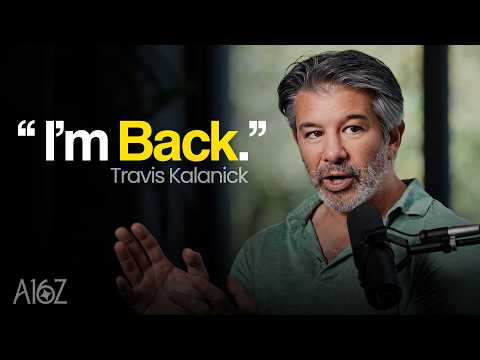
This conversation looks back on Uber's initial investment failure, the crisis of 2017, and the vision of Atoms that Travis Kalanick built privately over the course of eight years. The key is digitization of the physical world, which goes beyond software and combines manufacturing, real estate, logistics, robotics, mining, and food production. Travis emphasizes that rather than a good idea, it is the founder and team's ability to push it through to the end and solve new problems while creating them that makes a great company.
1. Missed investment opportunity in Uber Series B
The conversation begins with a joking introduction to the relationship between Travis Kalanick, Ben Horowitz, and Mark Andreessen. The host describes this as "the return of the king" or "the return of Travis," and emphasizes that the reunion of Travis and Ben is a restoration of a relationship that was lost in past Uber investment discussions.
Travis brings up the story of Uber's Series B investment attraction in 2011. Uber started in June 2010, and at that time, Travis had already completed Series A and was attracting larger investment. Because he went through such a difficult time in the process of starting a business in the past, he recalled that even when Uber was doing well, he worked extremely hard, "as if I wouldn't be able to eat tomorrow."
"Even though things were going well at Uber, I was still acting like I wouldn't have anything to eat tomorrow."
Travis attracted investment through a competitive bidding method rather than a general negotiation method. The structure was to first select a major investor, and when that investor presented a price, other investors followed. Instead of telling investors the exact target amount right away, he continued to raise the lower limit of the price by saying, "It's at least this much."
"We think this deal will be one of the hottest deals in Silicon Valley this year. We don't know where the price will go, but it will be at least double the previous round."
They told one investor it was double the previous round, then told the next investor it was triple the amount, and so on. As a result of such competition, Andreessen Horowitz rose to the level of offering Uber investment terms based on a corporate value of approximately $375 million. Another investor, Yuri, tried to offer almost $400 million but eventually gave up, and Travis thought he had a done deal with Andreessen Horowitz.
"The deal was settled at $375 million, and Andreessen Horowitz won."
But then I got a call from Mark Andreessen asking me to have dinner with him. Travis responded by asking him to send the investment terms first, but Mark kept asking to meet in person. When we met at a sushi restaurant in San Francisco, Mark said that the investment conditions had changed.
"We took it to the partnership, and they didn't think $375 million was the right number. The best we could do was $210 million."
From Travis's perspective, the deal suddenly fell apart after he had already completed competitive bidding and confirmed the highest price in the market. He had to contact the other investors again and explain, "Now the new price is $210 million." It was a very embarrassing situation where both trust and negotiating power were shaken.
"The deal peaked and then bottomed out. We had to call everyone again and say, '$210 million is the new number.'"
Eventually, Menello Park Ventures, led by Shervin Pishevar, came in as an investor. As Shervin continued to raise the terms without any other competitors, Travis actually told him to stop negotiating.
"Bro, you won. It's okay now. You don't have to keep raising the price by yourself."
But the situation Ben Horowitz remembers was a little different. Ben remembered that Travis came alone to explain investments without any team members. At the time, it was very rare for a founder to appear alone in a transaction of that size, but Travis' presentation was powerful.
Ben says he had already read a lot of Travis' articles and thought, "I definitely want to get this deal." However, at the time, Ben was not an expert in the consumer Internet field, and he already held close to 16 board positions. So the deal was passed on to Mark Andreessen and John O'Farrell.
The key issue Ben remembers was the negotiation regarding the employee stock option pool. He thought he had a deal going, but the next thing he knew, Sherbin had taken it.
"I thought we were working on a deal, but the next moment I realized that Scherbin had taken it. I thought, 'Oh my gosh, we lost the deal.'"
Ben says he regretted this for a long time. Afterwards, Scott Weiss of Andreessen Horowitz invested in competitor Lyft, and Ben joined the board of directors to help the company when Lyft was struggling. While Travis achieved great success with Uber, Ben had to deal with a difficult situation at Lyft, and the two developed a relationship that was both respectful and tense.
"Travis kept winning, and there was no way he wouldn't let me hear about it."
The two compare their relationship to basketball's Larry Bird and Magic Johnson.
"We had a relationship where we hated each other, but at the same time, we wanted the other person to be on our team."
2. Uber's 2017 crisis and 'the moment pirates become navies'
The host refers to the situation Uber went through in 2017 and says things would have been different if Ben or Mark had been on Uber's board of directors. Ben immediately agrees.
"Uber's 2017 wouldn't have gone the way it did if Ben or Mark were on the board."
Ben admits that it's his fault they missed this opportunity. They say that if Uber had received the help of the two men at the time, it would likely have become a much larger and more important company than it is now. In particular, I think Uber would have dominated the food delivery market and become a leader in the autonomous driving field.
"Uber would be a much bigger, more important, more central company than it is now."
Travis also recalls that Uber's competitiveness was enormous at the time. At the time he left the company, DoorDash had a market share of only about 5%, and Uber treated even a small drop in market share as a serious crisis.
"If our market share dropped by just 0.1% in a week, we didn't think about going home for the weekend."
However, Ben says that the past cannot be evaluated simply as "what if." In the end, what matters is actual performance, and DoorDash founder Tony Xu persevered and grew the company even in difficult circumstances.
"The most important thing is not the assumptions, but the actual record. He ended up doing something."
Travis looks back on his time at Uber and says that although 2017 was a very difficult year, he still loved his relationship with the company. He likens Uber to a lover.
"When you fall in love again, you don't think about your ex as much, and you can just say, 'It was a good time. I just got a little crazy at the end.'"
The conversation then continues with the topic that as a startup grows, the way the founder behaves must also change. Travis explains that in the early days of Uber, he behaved like a "pirate," a small, aggressive challenger. However, as a company grows and becomes a market leader, the same actions are interpreted completely differently.
"It's okay to act rough when you're a small challenger. But it's not okay to act like that even after you become the biggest company."
Ben describes this phenomenon as "the moment pirates become navies". When you are a small company, breaking rules and challenging the existing order is an advantage, but when you become a large company, social influence and responsibility change. Travis admits that he didn't learn enough about the implications of these changes as Uber grew.
A representative example is the internal program created to attract Lyft drivers to Uber. Uber called this "Shoplifting." Travis thought it was an aggressive competitive strategy at the time, but David Drummond, a former Google executive, pointed out that the name itself was inappropriate.
"Travis, that's not a name you can use. You need to change it."
The legal team advised that the project name should be appropriate enough for a children's basketball team to use it. So 'Shoplifting' was changed to the absurdly polite name NACS, North American Championship Series.
"We have started a big plan to make sure we win the North American Championship Series."
This anecdote clearly shows that as Uber changed from a small startup to a huge company, the standards for words and actions also changed.
3. After leaving Uber, I met Cloud Kitchens.
Travis says he was dogged by lawsuits and investigations for about seven to eight months after leaving Uber. He still supports the decisions made at Uber, but he also acknowledges that he pushed too close to the edge of the rules.
"I still think all the decisions were right, but I would say we went too close to the border."
He was able to prove that his actions were not completely wrong legally, but the evidence was so subtle that it could only be seen under a microscope.
"You could show that there were no chalk marks on the shoes, but you would have to have an electromagnetic scanning microscope to see them."
The problem Travis experienced stemmed from the gap between the aggressive culture of a small startup and the responsibility of a large corporation. He thought that the methods that created success at a small company would remain the same once the company grew, but he realized too late that social rules and expectations were completely different as the company grew.
Meanwhile, Travis connected with his friend Diego, who had a great sense of real estate. Diego was looking for an opportunity to combine technology and real estate, and was interested in the dark kitchen concept that emerged during the early stages of Uber Eats.
Around 2015, Uber discovered that commercial kitchens, rather than regular restaurants, were registered with Uber Eats in Melbourne, Australia. These were kitchens that only did delivery without a restaurant hall.
Diego envisioned a model of incorporating multiple small kitchens into one property. The plan was to build about 30 kitchens in one building and lease each one to a restaurant specializing in delivery.
"We're building 30 kitchens on one property, each about 200 square feet, and renting them out as delivery-only spaces."
Travis felt that the scale was too small when Diego said, "I will make a few more."
"How many more are you making? How many thousand are you talking about?"
Eventually, Travis joined the business, took over the company, and expanded it in earnest. From this experience, he says that entrepreneurship opportunities come in two ways. You can come up with an idea yourself, but sometimes ideas come to you.
"Sometimes I create the ideas, and sometimes the ideas come to me."
Travis explains that when he finds a business that suits him, he jumps into it like he's falling in love rather than thinking about it for a long time. It is said that the more complex and seemingly unappealing a problem is, the more interested it becomes.
"There are times when I see something fascinating that people don't understand yet. The most fun feeling is, 'You can't see it yet, but I guess I'm seeing it.'"
Cloud Kitchens was not just a food delivery company. We had to convince them to buy real estate, renovate buildings, attract restaurants, and expand delivery-only branches. Here, we tried to combine software and robot technology.
"We wanted to buy real estate, build construction, open a restaurant, install software, and even start robotics at the same time."
The ultimate question he considered important was as follows.
"Can the cost of preparing and delivering a good quality meal be reduced to something close to the cost of going to the grocery store?"
If possible, it could transform kitchens like Uber transformed the automobile industry.
"That would be doing to your kitchen what Uber did to your car."
4. 'Computer of the physical world' started with food
Travis explains that to properly implement online food delivery, an Amazon-style warehouse is needed. However, unlike regular warehouses, they must not only store and deliver food, but also produce it on site.
In other words, the following functions must exist together in one facility:
- Real Estate: Space for kitchen and logistics facilities
- Manufacturing: Kitchen where food is actually cooked
- Logistics: System for sorting and delivering orders
- Automation: Food cooking robot
- Autonomous driving: Robotic delivery vehicle that carries food
Travis calls this structure the "Internet food court."
"High-quality food made in every way imaginable and delivered to your door at a price close to the cost of going to the grocery store. I call it the 'Internet Food Court.'"
He asks whether people will still cook their own food in 20 years or whether robots will create higher quality food. Most people readily agree that robots will make our food. Then the question changes from "is it possible" to "when is it possible?"
"Will people still be cooking for themselves on a regular basis in 20 years? Will robots be making better food than we can? Most would say of course they will."
If you narrow the time to 10, 7, or 5 years, the future will be pulled toward the present. Travis describes this as bending reality.
"If everyone agrees it's going to happen, the only question is when it's going to happen and who's going to do it. That's when you say, 'Let's go.'"
Cloud Kitchens started off a bit early, but over time, each element of the business really started to come together. Hundreds of facilities have been built in several countries, and the survival rate of restaurants has been increased by ensuring a stable order volume for restaurants.
It is predicted that food production costs can be reduced by about 50% if robot production progresses, and if robot delivery becomes a reality, delivery costs can be lowered from $12 per meal to 50 cents to $1. This can significantly lower the overall price of food, real estate, and labor costs.
"Robotic delivery could reduce the cost of a meal from about $12 to 50 cents or $1."
Ultimately, the calculation is that a system can be created where food worth about $6 to $10 can be delivered to people's homes. When the host jokes, "Then you can't take away the robot delivery man," Travis laughs again, acknowledging that the expression 'Shoplifting' is inappropriate.
5. 8 years of stealth operation
Travis ran a company related to Cloud Kitchens privately for about 8 years. He explains that after resigning from Uber, he received nearly 150 negative articles a day, and he did not want to bring that negativity into his new venture.
"After I left Uber, there were 150 negative articles a day. I didn't want to bring that negativity into the new organization."
He wanted his team to work without worrying about what the New York Times would write the next day. However, stealth operations were very difficult. The company name could not be properly disclosed in job postings, and it was difficult to explain what the company does when meeting customers.
"Even though we were a company with thousands of employees, we had to hire people while only listing 'stealth company' on LinkedIn. It was a really difficult method."
As the matter remained private for a long period of time, media reporting became difficult. This is because there is too big a gap between the past story and the present. From a reporter's perspective, it was difficult to explain the gap of several years, and even if someone leaked information, it was difficult to know where to connect it.
"Over time, stealth becomes self-reinforcing. If someone leaks something, the media doesn't know what to do with it."
The company used different names in each country. In the United States, it was known as Cloud Kitchens, but in Latin America it went by several other names: Casino, Korea, Kitchen Valley, and China. Names such as Food Stars in London and Kitchen Park were used in the Middle East.
Because the company's traces were dispersed in this way, it was difficult for the outside world to connect different businesses into one company.
6. Atoms and 'Computers for the Physical World'
Travis' bigger vision started with Uber. Uber was a service that called and moved physical resources such as cars through smartphones. In the past, it seemed like science fiction for a car to come to a real location and pick up people, but now it has become very natural.
"Everyone's first experience with Uber was a magical moment: I could press the screen, a car would come to me, and I could see it moving on a map."
He maps the basic structure of computers to the physical world.
- Just as the CPU processes bits, manufacturing processes materials.
- Just as a storage device stores bits, real estate stores materials and production facilities.
- Just as a network moves bits, transportation/logistics moves materials.
"CPUs process bits. So what processes atoms? Manufacturing. Storage stores bits. Storing atoms is real estate. If networks move bits, then what moves atoms is transportation and logistics."
Travis calls this structure Atoms-based computer, that is, an atom-based computer. If we compare a food facility to a semiconductor or computer system, multiple kitchens become processor cores, and the passage through which food moves becomes a data bus. Refrigerated and frozen storage space functions like a cache that stores pre-calculated data. Delivery workers and delivery robots are like network packets.
"A facility with 30 kitchens is like a 30-core processor. The path through which food moves is like a network bus, and delivery robots are like TCP packets."
This metaphor is not just a play on words; it is an argument that software algorithms and data structures can be applied to the physical world. In fact, the company explains that it uses a concept similar to TCP to distribute orders based on kitchen capacity and reliability.
Once Uber has digitized the network of the physical world, the next step is to digitize the CPU and storage of the physical world. In other words, it remains to innovate manufacturing and real estate with software and AI.
"Uber was the network of the physical world. Now what's left is the CPU and storage of the physical world: digitized manufacturing and real estate."
7. Bringing together food, autonomous driving, and mining
Atoms' vision does not stop at just the food business. Travis determined that manufacturing facilities, automated production, and autonomous logistics would all be needed to automate the physical world.
He describes the delivery robot of the future with the expression 'self-driving burrito.'
"There will come a time when four-wheeled self-driving robots carrying boxes of food that maintain the temperature will come to your home. Twenty years from now, this will be something that everyone will take for granted."
To this end, Travis looked into autonomous driving and robotics companies, and eventually created an autonomous driving company separate from the food business. This is because rather than developing large-scale autonomous driving technology within one food company, it was judged appropriate to separate it into a specialized technology company and attract investment and talent.
In the process, Eric Myhofer, who led Uber's autonomous driving business, took charge of the food robotics division, and Pronto, led by Anthony Lewandowski, who was in charge of autonomous driving at Uber, was acquired. Pronto was a company specialized in off-road autonomous driving, especially mining sites.
Travis emphasizes that mining automation can simultaneously improve productivity and safety. Mine sites are places where human life and safety are greatly threatened, and self-driving equipment can replace dangerous work.
"There are safety issues in mines where serious accidents can occur every day. Automating certain tasks not only increases productivity but also significantly improves human safety."
Pronto's goal is not simply to move vehicles. It is about understanding what tasks should be performed in what order in the special environment of a mine.
"In mining, what matters is not simply 'does this machine move?' It matters in what context, for what task, and how it moves."
When Pronto's autonomous driving system surpassed human productivity, its business began to grow rapidly. Customers demanded more equipment and faster deployment, forcing the company to install equipment in hard-to-reach areas such as the Amazon or near the Saudi Arabian border.
Travis describes the company as the process of growing from a lean startup to a muscular organization.
"We've been a lean startup for a long time. Now we have to go lean."
This does not mean making the organization unnecessarily large. This means having the necessary processes and manufacturing and supply chain capabilities, but not losing speed and agility.
8. Reasons for integrating several companies into Atoms
Travis originally could have run food, mining, and transportation businesses respectively. However, Ben Horowitz saw Travis trying to receive investment in several businesses separately and said he wanted to invest in the entire structure rather than choosing just one of each business.
At the time, Travis compared himself to a person who takes out several watches and shows them off.
"I was like the person who hid about 20 watches under my trench coat and asked, 'Which watch do you want?'"
Ben's answer was clear.
"I don't want just one watch, I want the whole trench coat. I want to be your partner in everything you do."
This was the opportunity to consolidate several businesses into one holding company structure, Atoms. Each business has a separate corporation and operating organization, but overall shares a single shareholding structure and direction. This provides employees with better compensation and a sense of belonging, and reduces the burden on Travis of having to manage multiple companies separately.
9. Great companies start with great founders
Ben Horowitz points out that the way a company's success is explained is too much centered around ideas. Facebook, Google, Tesla, and Amazon are all described as "successful because they came up with a good idea," but in reality, there were countless people with similar ideas.
"There are many people with good ideas, but very few people actually build companies from those ideas."
In the case of Tesla, there were many people who spoke about the need for electric vehicles, but the person who actually changed the industry by overcoming resistance from the automobile industry, large corporations, and the government was Elon Musk.
"Why was there only one person who could have built Tesla? Because there was only one very rare person in the equation who could have done it."
Ben sees Amazon's AWS as a similar case. Amazon, which started out as an online bookstore, created cloud computing not simply because it came up with the "idea of the cloud." Amazon had experience operating large-scale systems and a direct understanding of customer problems, and Jeff Bezos had the management ability to expand that knowledge to other industries.
"Amazon's success was not just because of the idea of an online bookstore. It was because of the knowledge of operating the system on a large scale and the management ability to expand it."
Travis also started out with ride-hailing at Uber and then expanded into food delivery, autonomous driving, freight transportation, and AI research. If one base is successful, the founder's imagination and the organization's capabilities can expand into new areas.
"The starting point is important, but what is more important is how far you can expand the knowledge and management capabilities gained from that starting point."
Travis explains why he started back at a small company even after he made his fortune. He says he prefers fighting in the arena to living comfortably.
"I like fighting in the arena."
The last general meeting I held at Uber had 20,000 attendees, but when I first joined Cloud Kitchens, the company had only six employees. He stood in front of a small conference room and encouraged the team just like he did in his Uber days.
"At the last Uber general meeting there were 20,000 people. At the next company general meeting there were only six people. I stood at the front and said, 'Let's go, guys. Let's do it.'"
The employees were confused because they couldn't understand how the Uber founder had suddenly become their CEO, but for Travis, building from scratch came naturally.
Ben says many entrepreneurs want to try new things after success, but refuse to go back to the bottom and start with a small team.
"People want to start at the top, but they don't want to build from the ground up. You can't start that way."
10. Stealth culture and the dangers of external recognition
Stealth operations forced the company to focus on solving internal problems rather than external evaluations. Rather than working to become famous or get media attention, employees found satisfaction in solving real problems with the people they worked with every day.
"When a company begins to seek external positions, it becomes a risky and unstable situation."
Travis refers to this as a culture that makes decisions based on internal accuracy rather than external approval.
"Decisions should be made based on internal righteousness, not external recognition. That is the advantage of stealth."
However, stealth also had a price. Everyone wants their family and society to be proud of the work they do, but such recognition is not sufficiently provided in private organizations.
"Stealth robs people of the opportunity to be proud of what they do."
Travis believes that this lack actually fostered strong emotional intelligence and internal solidarity in the organization. Now that Atoms has been revealed to the public, a new challenge has become how to balance external attention with internal direction.
11. More important than the starting point is 'why you start'
The host says that just as books were the starting point for Amazon, food was the starting point for Atoms. Travis explains that food was not just his first business, but an appropriate starting point for him to experiment with his vision of digital manufacturing and digital real estate.
The company's official name was City Storage Systems for a time. To maintain stealth, they deliberately chose a boring and ambiguous name.
"The name City Storage Systems was intentionally boring, because people would forget the name in 20 minutes."
But for Travis, this company was not just about making restaurant kitchens. It was an experiment using physical storage space and manufacturing facilities like computers.
"What I saw was digitized manufacturing and real estate, a storage device for the physical world, a food computer."
He admits that he did not perfectly predict the entire future from the beginning. When I started my business, I didn't even know 1% what problems would arise in the future.
"When you first start, you have almost no idea what problems you will face."
What is important is the ability to apply the knowledge gained while conducting business to other problems. A good entrepreneur does not confine his or her experience to just one field, but expands it to many fields.
"The best entrepreneurs take what they have learned, expand its application, and continually create new possibilities."
So, for Travis, "why you start" is more important than "where you start."
"It's not all about where you start. It's why you start that matters."
12. From a problem solver to a problem creator
Atoms can expand into more industries in the future, including food, mining, and transportation. However, Travis does not increase his business recklessly. First, they say that the current business must be sufficiently stable and the organization must have the capacity to solve most problems.
"First you have to find a beachhead, make it thrive, and build the management capacity to solve 98% of the problems. Then there is room to do new things."
He describes himself as a problem solver and problem creator. Starting a new business is intentionally creating new problems. For example, the decision to "bring Uber to China" creates a huge problem.
"I am a person who constantly creates problems. The moment you say, 'Let's do Uber in China,' a huge problem arises."
However, if the speed at which problems are created is faster than the speed at which they are solved, the organization becomes overwhelmed. Travis expresses this like a formula.
"The rate of increase in problem creation must be less than or equal to the rate of increase in problem solving."
If you create too many problems, your organization will be underwater. At this time, you need to stop new business and solve existing problems to come to the surface. Once you have some leeway, you can create new problems again.
"If you create too many problems, you will sink. In that case, you should come to the surface first instead of creating more problems."
What is important here is not only the capabilities of the entire organization, but also Travis's individual capabilities. In order for an entrepreneur to immerse himself in a new business, the existing business must be able to operate without him.
"If you create a new big problem, the existing business should run without paying as much attention to detail as before."
13. Industrial AI and the return of the Second Industrial Revolution
Travis calls the new field that Atoms belongs to Industrial AI. This does not mean just software or humanoid robots. It combines software, sensors, robots, machinery, real estate, and logistics into one system to automate an entire specific industry.
"Industrial AI is a stack that combines software, sensors, robotics, and machines to automate an industry."
He tries to approach each industry in order to apply the philosophical concept of 'physical AI' to actual industries. Although food, mining, and transportation are each independent industries, they all have a common structure for making, storing, and moving materials.
"We want to pick industries one by one, automate them, and completely change the industry itself."
This process resembles the Second Industrial Revolution of the past. Industrialists such as Carnegie, Rockefeller, Frick, and Ford changed society by producing steel, oil, and automobiles on a large scale. They encountered tremendous political and social resistance, and at times even their personal safety was threatened.
Ben tells the story of steel industrialist Frick, who was shot in his office, but went back to work after stitching up his neck. Although the exact facts need to be confirmed, it is presented as a story that shows the level of risk and hostility that industrialists were exposed to at the time.
Likewise, conflicts surrounding data centers and manufacturing facilities are growing today. People have been worried for a long time about the loss of manufacturing jobs, but now that manufacturing is coming back, they are now opposing the construction of data centers and factories.
"Everyone has been saying for years that manufacturing jobs are disappearing, and now that they are coming back, they say they don't want them."
Travis explains this as resistance to change. The more valuable unknown truths are discovered, the faster the change, and the faster the change, the more resistant the existing order is.
"Change occurs when we are good at discovering valuable unknown truths. The faster the change, the naturally greater the resistance."
Therefore, companies need to build trust and increase supporters while pushing innovation.
"We must overcome resistance to change with great progress, but we must also build as much trust as possible so that we have more supporters than enemies."
14. The next step in starting a business is people and teams.
At the end of the conversation, Travis says that Atoms deals with three huge industries simultaneously: food, mining, and transportation. With each of these being trillion-dollar opportunities, attracting top talent is now paramount.
The talent he is looking for is not simply a manager who performs work. He is an entrepreneurial leader who can build teams, inspire people, and lead complex businesses.
"No matter what stage of business you are in, securing talent is ultimately the key to the game."
He says he's looking for someone like Emile Michael, his right-hand man at Uber, who can drive strategic deals and business development and build great teams. It also explains that a legal officer, mining business CEO, and technology leader in autonomous driving and advanced robotics are also needed.
But just attracting great talent is not enough. It is important to give autonomy to various entrepreneurial leaders, but align them with the overall company strategy and culture.
"Empowerment begins with alignment."
The key to running an organization according to Travis is as follows.
"It's about aligning at the front and holding people accountable at the back. We need to let builders create."
Autonomy must be granted to the leaders of each business, but goals, strategies, and culture must be consistent. Giving autonomy should not divide the overall company culture.
"Culture should not be diluted just because autonomy is given."
He points out that simply acquiring companies is not enough for Uber to expand into multiple countries. When you acquire another company, that company's culture and reputation come with it. Because technology and products are also influenced by the culture, integrating different organizations is very difficult.
"Products and technologies are a reflection of culture. When companies with different cultures come together, products and technologies must also fuse together, and that is a very difficult task."
Ultimately, the criteria for Atoms to enter new industries in the future are bridgehead and management capabilities. The strategy is to first stabilize the existing business, enable the organization to solve problems on its own, and then use the surplus to advance into a new field.
Finish
In this conversation, Travis Kalanick explains why he started from scratch after Uber and built Cloud Kitchens and Atoms. The next era he sees is not an era of software alone, but an era in which AI, robots, manufacturing, real estate, and logistics combine to automate the entire physical world.
There are three key points that he repeatedly emphasized.
- Why you start is more important than where you start.
- More important than a good idea is the founder and team that make it a reality.
- You can create new problems, but you have to be able to solve them faster.
Ultimately, Atoms' goal is not simply to run a food or mining business. Travis seeks to change the entire industry by connecting manufacturing, logistics, real estate, and robotics like a single computer.
"We want to automate industries one by one and completely transform them."