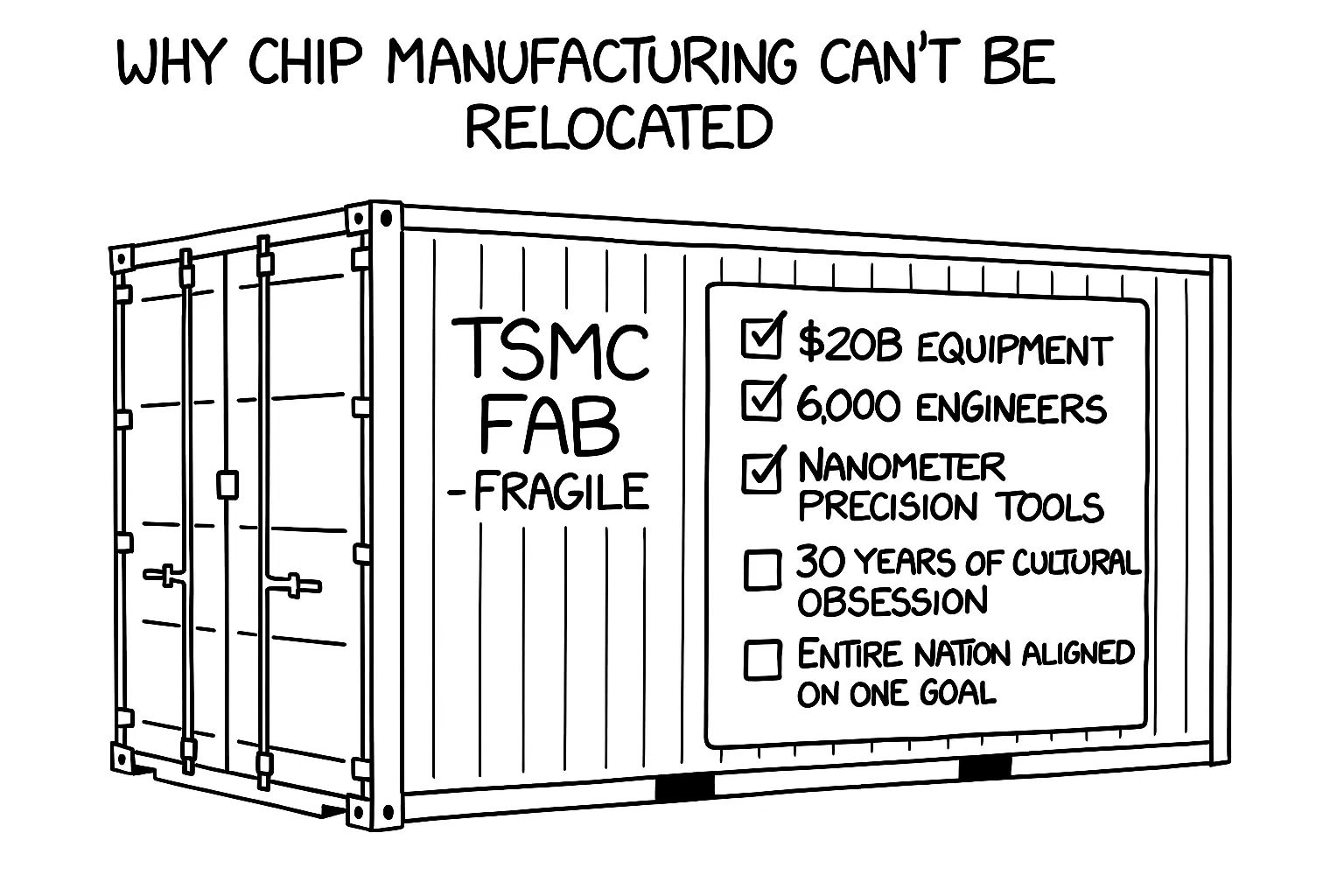
This article examines the background behind TSMC's $440 million loss at its Arizona factory and how Taiwan came to stand at the center of the semiconductor myth. The key was not production facilities or technology, but differences rooted in national and organizational culture. It chronologically traces Taiwan's collective dedication and the management philosophy that drove TSMC.
1. TSMC's Failure in America and the "Alien" Culture Clash
TSMC built a massive factory in Arizona, but the result was a shocking $440 million loss. American engineers at the factory described the work environment as follows:
"Rigid, brutal, prison-like."
Meanwhile, Taiwanese managers expressed their frustrations with American employees:
"Lack of dedication and obedience."
Both sides experienced major clashes in work style and attitude. In Arizona, engineers would clock out right at the end of their shift, whereas at TSMC in Taiwan, engineers were described as
"sleeping in the fab" -- that's how dedicated they were.
The decisive difference was revealed in attitudes toward work. In America,
"Here, it's just a job." But in Taiwan, "It's service to the nation." -- that difference in atmosphere was emphasized.
2. Founder Morris Chang's Foresight and Criticism of U.S. Semiconductor Policy
TSMC's founder, Morris Chang, foresaw these results. He had long said the following about America's massive capital investment in semiconductor development policy:
"A very expensive exercise in futility."
Morris Chang founded TSMC at the age of 55, having already internalized the lesson that the semiconductor industry could never grow without complete national 'alignment'.
3. Taiwan's Semiconductor Myth: Collective Alignment That Money and Laws Cannot Replicate
What enabled Taiwan to emerge as a global semiconductor superpower was collective culture and societal dedication that went far beyond mere 'business.' TSMC's formula for success can be summarized by the following principles.
3.1. Going All-In for Survival
In 2010, when Apple demanded a chip that seemed 'impossible,'
"Losing Apple would be like losing Taiwan's future." With that conviction, Morris Chang invested $9 billion -- half of TSMC's cash reserves. 6,000 employees worked day and night for 11 months to make it happen.
3.2. Never Compete with Your Customers
While Intel tried to control everything, TSMC adhered to the principle:
"We will never compete with our customers." When NVIDIA provides TSMC with a 5-year roadmap, thousands of TSMC employees protect it like state secrets.
3.3. Competitors Share One Factory
Even 'rivals' like NVIDIA and AMD share the same TSMC production lines. What matters is the shared understanding that
"Every customer's success is Taiwan's success."
3.4. Precision as Daily DNA
TSMC's latest equipment delivers 50,000 tin droplets per second with pinpoint accuracy. This level of precision has
"permeated into emails, meetings, weekends -- not as policy, but as culture."
3.5. The Power of 30 Years of Compounding
Every supplier and even university curricula have grown tailored to TSMC, and
"This kind of focus and dedication can never be replicated through subsidies or legislation." That was Morris Chang's conviction.
4. The Decisive Fork Between TSMC and America: Choices That Bet on the Future
In the late 1990s, when Qualcomm turned away from IBM and chose TSMC, Morris Chang
sensed that "IBM is finished." Intel built walls, and TSMC built bridges.
Especially in 2007, when Intel decided
"iPhone chips have low margins, so we won't make them," this ultimately led to losing both the mobile and AI eras.
The real problem revealed through this process was
"the arrogant belief that one company can do everything." TSMC was the complete opposite.
5. In the End, Culture Decided Everything
As of 2025,
"Every ChatGPT query, every iPhone, every NVIDIA chip is made at TSMC."
TSMC came to lead in technology not because it had the best engineers, but because
"Taiwan made 'engineering excellence' itself a cultural value."
The decisive conclusion is this:
"You can replicate a factory, but you cannot replicate a culture."
In Closing
What ultimately distinguished TSMC's failures and successes was culture. Collective dedication and national consensus -- beyond capital, policy, or technology -- placed Taiwan's semiconductor industry at the top of the world. The core message is that today, every path in AI, mobile, and advanced IT runs through Taiwan's culture and TSMC.