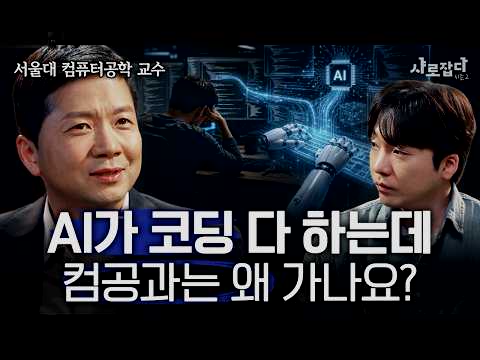
AI is rapidly automating the tasks of writing code and completing programs, but the ability to define what problem to solve and judge a good solution is still important for humans. Professor Lee Jae-wook of the Department of Computer Engineering at Seoul National University explains that computer engineering in the AI era must go beyond simple coding education and foster problem definition, algorithmic thinking, data-based thinking, critical review, and design skills. In addition, because AI is a new technology for everyone, it is emphasized that both majors and non-majors should develop their own senses by directly using AI starting from small projects.
1. AI is changing the coding and development field
The video begins with the question, "Will humans no longer need to code with their fingers in the future?" The host says that AI goes beyond simply assisting code and can now create something in a short period of time without human intervention. Therefore, it is explained that an environment in which programs can be created by instructing AI in natural language is being opened, to the extent that there is even a saying, "English is the best programming language."
"Writing program code can be almost, perhaps even completely, automated."
Amid this change, Professor Jaewook Lee, a professor in the Department of Computer Science and Engineering at Seoul National University and head of the AI research institute, is invited. Professor Lee is a researcher who mainly conducts infrastructure research in the AI field and is actually continuously exposed to coding in research and education fields.
He says that recently, as AI has become very good at coding, it has become a situation where computer science education itself needs to be reconsidered. In the past, if you gave students programming assignments based on textbooks, they would think and write code themselves to learn, but now they can easily solve assignments using AI tools.
"Assignments that were previously given can now be easily solved by students using AI tools. So, I was very concerned about how to redesign the assignments."
The professor's own research methods have also changed. In the past, a lot of time was spent writing papers, code, and presentation materials, but now it is said that time to read, review, and criticize AI-generated results has become more important than time to write articles and code directly. Drafting ideas and writing things has become easier thanks to AI, but it requires humans to read and analyze the content carefully to determine if the results are truly valid.
"I used to spend a lot of energy writing, but now I spend most of my time reading and critiquing."
Therefore, it is emphasized that in the AI era, not only the ability to create something directly, but also the ability to read and judge critically will become more important.
2. Will there come a time when humans no longer need to code themselves?
The host asks a slightly more extreme question. In the future, humans will no longer need to write code themselves. Professor Lee believes that the amount of automation in the code writing process continues to increase, and that there is a possibility that it will approach 100% in the long term.
"The coding part continues to be automated, and I think it could go to almost 100%."
However, this does not mean that the role of humans disappears. The core task that people still need to do is decide and define what to implement and what to achieve through coding. Even if AI creates code, you cannot get the right results if you do not know the problem to be solved.
Professor Lee compares working with AI to a kind of team management. In the future, developers may assign various tasks to AI agents and play a role in coordinating the entire work. However, he explains that just as it is difficult to become a good manager without proper engineering experience, it is difficult for someone with no coding experience to instruct AI well.
"Working with AI is similar to managing a team: you lead and manage agents, but it's difficult to be a good engineering manager without engineering experience."
The important things that remain for humans are as follows:
- Identify what problem needs to be solved
- Specifically define the problem to be solved
- Divide multiple tasks and allocate roles
- Determine whether the results produced by AI are appropriate
- Correct and improve direction when necessary
On the other hand, after the problem and goal are clearly defined, implementation and iterative improvement work is likely to be largely taken over by AI.
It also explains why there is a prediction that AI will replace developers first. Many of the first people to actively use AI were software developers, and vast amounts of code data were accumulated on the Internet. Because the code has a logical structure, it was relatively easy for AI to learn.
"There is a huge amount of code data on the Internet, and the code has a logical structure. I think these are the reasons that made AI good at software and coding in the first place."
3. Possibilities and fatal limitations of vibe coding
Recently, a method called Vibe Coding has been attracting attention. This is a method where developers describe the desired function in natural language and have AI create the code, rather than writing code line by line. The number of people who have created products or services using tools such as Claude Code or Codex is increasing.
Professor Lee evaluates Vibe coding as very useful for quickly creating basic prototypes. As an actual example, we introduce how a public official at Gwangjin-gu Office created a chatbot-type system using AI to easily find complex administrative regulations. A system that compares various laws and regulations and answers questions was created using Vibe coding, and it was said to be quite effective in solving specific problems in the field.
"Vibe coding is useful enough to have an impact on real-world work. You can make basic prototypes pretty well."
However, there is a difference between a prototype and highly completed software. Even if the code works properly in 95% of situations, if an error occurs in the remaining 5%, it is often virtually unusable in actual service. Even 99% accuracy may not be enough, especially in fields such as finance or security where even small errors can lead to major damage.
"Even if something works 95% of the time, if it doesn't work 5% of the time, it doesn't really work."
If a 1% error occurs in a service used by 10 billion people, 100 million people may receive incorrect results. Therefore, the fact that the code created by AI is executed is not enough; exceptions, security vulnerabilities, performance issues, and data errors must also be reviewed.
Another problem with Vibe coding is that users may evaluate their skills higher than they actually are. When AI produces results quickly, users may feel like they created a good program, but they may not know why the code works, when it fails, or how to fix it.
Professor Lee explains the phenomenon in which an AI model's capabilities develop faster than the user's learning speed with the concept of 'capability overhang' or capability overhang. AI functions are increasing rapidly, but people's ability to use them is not growing as fast, so the productivity gap may widen between people who use AI well and average users.
To utilize AI well, you need to know two things in particular.
- Understanding what kinds of tasks can be done with AI
- Know what AI is not good at and what its limitations are
"Using AI well means understanding both the scope of what it can do and the limits of what it cannot do."
In the end, how well users understand the nature of the problem and the limitations of AI is more important than the performance of the AI tool itself. If this difference is not properly understood, the gap between those who are good at using AI and those who are not may grow wider.
4. Challenges and computer engineering education in the AI era
In a situation where AI can almost completely solve tasks, existing educational methods are being called for major changes. In the past, problems were created based on information in textbooks and students had to solve them themselves. However, if there is enough data on the Internet and AI learns from it, AI can solve these problems with high accuracy.
"Problems that were previously based on textbook content can now be solved by AI with 100% accuracy. Such problems may no longer be good learning tools."
Professor Lee is concerned about a situation where students become mere intermediaries in the learning process. The professor poses a problem, the student inputs the problem into the AI, the AI creates an answer, and the student only has the role of delivering the result.
"When the professor poses a problem and the AI solves it, the student becomes a kind of high-end delivery driver."
It is difficult for real learning to occur in this way. Real learning occurs in two main places. One is the process of defining what problem to solve, and the other is the process of actually solving that problem. If AI takes over most of the solving process, students should at least actively participate in the process of defining the problem and verifying the results.
Just because we have calculators doesn't mean we don't teach basic arithmetic and multiplication. This is because you need to know the basic concepts to check whether the calculation results are correct and to interpret what the results mean. Professor Lee explains this basic knowledge as the threshold of knowledge.
"Just because you have a calculator doesn't mean you don't teach basic arithmetic and multiplication. You need basic knowledge to understand, interpret and evaluate results."
Teaching methods can change as follows:
- Use tests and quizzes to check if you understand basic concepts
- Let students define the problem themselves
- Design-type assignments where there is no single correct answer
- Present only the minimum conditions and let the student create a solution
- Present the results and have them critically review them
For example, rather than deciding on a detailed problem in advance, a professor can present only the minimum constraints to students and have them consider "what kind of problem should we design under these conditions?" By creating and solving problems that do not have a set answer, students can develop problem definition skills and creative design skills.
5. Why you should still learn computer engineering
The host asks, "If AI takes over coding, is there a need to study computer engineering?" Professor Lee answers that the essence of computer engineering is not simply writing code.
"Computer engineering is a field that deals with various problems and learns how to solve them efficiently and effectively using computers as tools."
Computer engineering teaches a way of thinking that converts complex problems into a form that computers can solve and divides them into systematic procedures. He specifically points out two ways of thinking as key.
Algorithmic thinking
It is a method of solving complex problems by dividing them into simpler steps rather than trying to solve them all at once. Even if AI generates the code, it is still up to humans to decide which steps to divide the problem into.
Data-Driven Thinking
It is a method of analyzing the distribution of data and obtaining meaningful insights from the data. Even though AI's ability to handle data is advancing, humans still need to decide what data to use, what it means, and whether the results can be trusted.
"Algorithmic thinking and data-driven thinking are skills that will continue to be needed even as technology advances."
Therefore, even if the number of hands-on coding decreases, the value of computer engineering does not disappear. Rather, the ability to abstract complex problems and transform them into solvable structures may become more important in the AI era.
6. Realistic prospects for the future and employment of developers
There are two perspectives on whether AI will eliminate all developer jobs. One is the outlook related to Jevons' Paradox. The argument is that if coding becomes easier thanks to AI, more services and projects that require coding will be created, and as a result, the size of the overall market will increase.
Conversely, there is also a prediction that if coding is almost entirely automated, there will be no need for human developers. Professor Lee believes that reality is probably somewhere in the middle.
"If AI makes coding easier, the pie for the entire industry may increase, or conversely, the demand for human coding may decrease. The reality is likely to be somewhere in the middle."
He gives an example of when ATMs were introduced to banks in the past. At the time, there were concerns that all bank tellers would lose their jobs, but in reality, employees moved into new roles such as customer service, strategy work, and investment-related work. Technology can reduce existing tasks, but it can also create new tasks and markets.
AI can also increase the total amount of work that developers can handle and expand the possibilities of new products and services. As developers and engineers use AI to solve bigger problems, the size of the entire industry can grow.
However, they point out that in reality it is becoming more difficult for new and entry-level developers to enter. This is because AI quickly handles simple implementation tasks previously handled by junior developers.
"The reality we face now is that it is becoming more difficult for entry-level developers to break into the industry."
It is explained that this problem is difficult to solve through individual efforts alone, and is a task that educational institutions, companies, and society must address together.
Nevertheless, when Professor Lee is currently 20 years old and is a freshman at Seoul National University's Department of Computer Engineering in 2026, when asked whether he would choose computer engineering again, he answers yes without hesitation. Because AI is a new technology for everyone, the starting line gap between experienced and freshmen has been relatively reduced.
"Changes in AI are new to both experienced people and those just starting out. Anyone with a good idea can lead innovation."
He says that now is a time when the space for innovation has expanded, and it can be a very exciting time for people with new ideas.
7. Competencies needed for future developers
Even in the AI era, the ability to write good code is still necessary. However, its value may be somewhat lower than in the past. Even if writing code directly is automated with AI, developers must understand how computer systems, software, and hardware work so that they can entrust AI with accurate tasks.
What is especially important is acquiring basic skills and core concepts. Professor Lee emphasizes that most good engineering managers have extensive practical engineering experience.
"If you don't understand coding, it's difficult to properly assign tasks to AI."
In the future, developers will not be people who simply ask AI to "make something," but rather they will be people who distribute tasks to multiple AI tools and agents and are responsible for the overall results. For this, the following competencies are important:
- Understand the basic principles of software and hardware
- Practical experience with coding and core technologies
- Ability to define what problem needs to be solved
- Judgment to distinguish between good and bad solutions
- Ability to critically review AI-generated results
- Ability to understand actual user needs and industrial sites
Professor Lee says that in order to develop a sense of recognizing good solutions, you need to create many things yourself and sometimes boldly throw away the results. This is because only by experiencing what is not a good result can you gain eye and taste, or 'sense', to distinguish between good solutions.
"You have to make a lot of things and throw away a lot of them. In the process of realizing that it was not a good solution, you gain discernment and sense."
8. AI native education and new developer award
Professor Lee says that the computer engineering curriculum should also change to AI native direction. This means that the curriculum should be redesigned based on the premise of using AI tools in all subjects, rather than restricting the use of AI to only some classes.
Using AI, projects can be performed at a much higher level than before. Therefore, students should experience more of the following activities rather than simply writing code.
- Define the problem and set the scope
- Designing the structure of a product or service
- Complete and release an actual project
- Critically review AI-generated code and design
- Compare with other students' results and find areas for improvement
- Creating creative solutions within minimal conditions
"AI tools allow us to tackle challenges at a much higher level than before, so we need to focus more on design and problem setting."
In the past, a relatively hierarchical structure in which planners passed tasks to developers was common. However, thanks to AI, it has become much easier for one person to handle everything from planning to development. Professor Lee describes such people as 'product manager-developer hybrids' and explains that this is an important developer image for the future.
"Determining what problem to solve is becoming more and more important. I think the combination of planners and developers is the way forward."
Looking at the winners of recent AI competitions, it is said that they often have a deeper understanding of a specific industry or job than simply being good at handling technology, and have well defined problems actually needed in the field. Ultimately, the combination of domain knowledge and technology utilization will become important in the future.
"The ability to understand a specific industry or job and define and solve problems based on actual needs is important."
9. How should non-majors use AI?
For those who have not majored in computer engineering, I advise that it is more important to have the experience of solving small, realistic projects with AI rather than studying grandiose things.
Among the problems or tasks you are currently experiencing, think "Couldn't this also be solved with AI?" and try using AI tools yourself. There is no need to create a huge service from scratch. You can start with tasks that are realistically necessary, such as small automation tasks, document organization, data analysis, and simple web page creation.
"Start with the very small, realistic projects you have now and use AI tools to solve them."
After trying several times, you will get a sense of which tasks the AI is strong at and which tasks it is weak at, how to ask questions to get good results, and how to modify the results. This sense is much more important than simply memorizing how to use it.
- Solve small problems with AI
- Find out why the results came out well or why they failed
- Understand AI's limitations and error types
- Try the same problem again in a different way
- Gain experience and create your own methods of use
They say that if this process is repeated, even people who have not formally majored in computer engineering can use AI as a tool to solve more problems.
10. A new starting line open to everyone
Lastly, Professor Lee says that the current AI change is a very big turning point for humanity. Quoting a person visiting Seoul National University who described AI as 'The Great Equalizer', he explains that since AI is a new technology for everyone, it provides a similar starting line to some extent.
"Changes in AI are new to everyone, creating a new starting point for both those with experience and those just starting out."
Of course, AI does not eliminate all gaps. New gaps may arise depending on how AI is used, what problems it discovers, and how well the results are verified. However, I think this is a very exciting time because anyone with new ideas has the opportunity to lead innovation, regardless of experience or existing position.
He emphasizes that rather than passively resisting change, we must actively embrace AI and create human-centered technology that is actually helpful to humans.
"We need to actively embrace these changes and think about whether we can create human-centered technologies that help us."
In the end, the Department of Computer Engineering is not just a department that teaches coding. It is a study that trains thinking skills to abstract complex problems, convert them into a solvable form, and solve problems efficiently.
"Computer engineering is not just a department that teaches coding, but a department that teaches problem solving methods that abstract complex problems and turn them into solvable ways."
Therefore, Professor Lee's conclusion is that in a future where there is less coding, the value of computer engineering will not decrease, but rather may become more important as a discipline that fosters a framework for thinking about looking at, structuring, and solving problems.
"It may seem that the value of computer engineering is diminishing because today we do less coding than before. However, the ultimate value of this department lies in developing a framework for thinking and practicing applying it to other problems. So, it may actually become a more important department in the future."