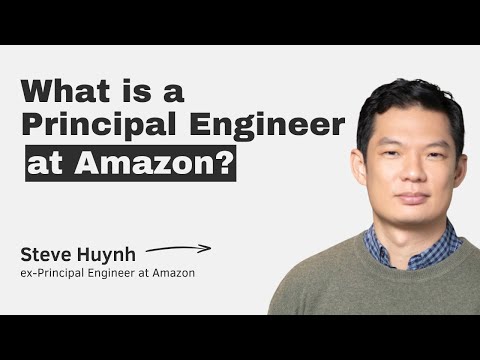
Quick Summary: Steve Huynh, who spent 17 years at Amazon including 4 years as a Principal Engineer (L7), shares the reality of the Principal Engineer role, the internal culture, and the unique challenges and growth opportunities that come with the position. He provides a candid look behind the scenes at Amazon's high standards, technical challenges, internal community, and leadership principles -- covering the many facets of an engineering career and organizational culture. In particular, he offers deep insight into why the promotion from Senior to Principal is considered the hardest in the industry, and the distinctive engineering culture and growth strategies at Amazon.
1. Career at Amazon and Diverse Team Experiences
Steve Huynh's career at Amazon is remarkable. Over 17 years and 6 months, he worked on a variety of projects, building a career that felt like holding five or six different jobs.
"I started with a project called Search Inside the Book, and I was part of the early Kindle launch. Then I worked on what would become Prime Video, then payments, Amazon Local, Amazon Restaurants, Amazon Tickets, and for the last five years, I was on Prime Video's live sports streaming team."
This kind of movement between teams was possible thanks to Amazon's unique "freedom of movement" policy. There was a time when a manager could block transfers, but after this policy was introduced, managers became more responsible for improving their team environments, and engineers gained the freedom to seek better opportunities internally.
"Transferring internally is much easier than interviewing externally. You already know the culture, and you're already a proven talent."
2. Engineering at Amazon's Enormous Scale
Amazon's technical scale is beyond imagination. The infinite scroll gateways on Prime Video and retail pages translate a single request into hundreds or thousands of internal microservice calls.
"A single request generates 10K, 100K or more traffic hits on the backend. A single microservice can handle hundreds of thousands of requests per second."
The problem is that in these intricate dependency chains, subtle performance degradation or partial failures -- known as "brownouts" -- can cascade across the entire service like dominoes.
"This isn't just a theoretical problem. When 100,000 requests come in at once and one service goes down, three other services start experiencing brownouts in a chain reaction."
In payment systems or live sports streaming, where transaction reliability and real-time performance are essential, a single failure can lead to enormous revenue losses.
3. Amazon's Obsession with Latency and the Reasons Behind Its Technical Evolution
Amazon is obsessively focused on latency optimization.
"Someone measured the correlation between website response time and revenue, and found that the faster the page loads, the more revenue increases linearly. Faster means more money. I think this is closer to causation than mere correlation."
Because of this, performance improvements don't start from "cutting latency by 50%" but instead aim for conceptual limits like 1ms or 10ms from the very beginning. In its early days, everything ran on a single massive monolithic system.
But due to hardware and software constraints (like the 4GB binary size limit for 32-bit systems), Amazon gradually transitioned to a service-oriented, microservices architecture. In this process, the trade-off between the simplicity of a monolith and the scalability and team autonomy of microservices became a critical consideration.
"I think startups should absolutely start with a monolith. Amazon did too. The problems only start showing up when the engineering team grows."
4. Principal Engineer: The Industry's Most Brutal Promotion
Amazon's engineering levels generally progress from Junior to Mid to Senior to Principal (L7). However, the jump from Senior (L6) to Principal (L7) is not just one level -- it's practically a "2.5-level jump" in difficulty.
"At other companies, you go Staff to Senior Staff to Principal in a natural progression. But Amazon doesn't have a Staff level, so you have to jump straight from Senior to Principal. Because of this, even some of the best engineers in the industry couldn't clear that bar and left for Meta, Facebook, or other companies."
Internally, Amazon has hundreds of open Principal Engineer positions at any given time, with thousands of Senior Engineers competing for them, yet the actual promotion rate is extremely low. The expectations and required capabilities are immense.
5. The Principal Engineer Community and Internal Culture
Once promoted to Principal Engineer, a special community awaits.
"There were internal offsites with hundreds of people, Slack channels, and smaller org-level offsites. The community members all had something special -- deep technical expertise, business impact, or industry leadership. Put just five of them in a room and the level of conversation is incredible."
Amazon allocates company resources to cultivating level-specific communities, and its internal knowledge-sharing culture -- including the 20-year-old "Principals of Amazon" series -- is highly active.
"Every Amazon employee can access 20 years' worth of Principal Engineer presentations. They're not public, but internally they provide an enormous learning opportunity."
The COE (Correction of Error) culture for sharing and learning from mistakes, along with a blameless failure culture, also serves as an important learning platform.
"Just subscribing to COE emails gives you realistic insights from the countless outages and recovery stories that happen every day."
6. The Real Day-to-Day and Challenges of a Principal Engineer
A Principal Engineer requires more than just technical leadership -- it demands complex capabilities spanning organizational strategy, decision-making, communication, prioritization, and mentoring.
Key Challenges and Paradoxes
-
The Belonging Paradox: You're involved in every team's work, yet you don't truly belong to any team.
"You're not embedded in a team. You get dropped into projects short-term and then move on. It feels like being a stranger."
-
Freedom vs. Accountability: Senior leadership only sets the direction; the specific execution falls entirely on the Principal Engineer.
"When leadership said 'improve live sports availability,' how to solve it was completely up to me."
-
Work Overload: Endless team meeting requests and a calendar triple- or quadruple-booked. Work piles up unless you actively decline.
"Looking at my calendar, a single day has three or four weeks' worth of meetings. The art of saying no becomes essential."
-
The Struggle to Truly Focus: Your attention is pulled across multiple projects and meetings simultaneously.
"If you don't build a system for focusing only on truly important priorities and ruthlessly ignoring the rest, you can't survive."
-
Role Overlap: Technical leadership, project management, multi-team coordination -- you end up doing manager-level work as well.
"In practice, the manager and senior engineer roles are blended. I don't write performance reviews directly, but during review season, I actively participate in large org-level review meetings."
7. Amazon's Success DNA: Principled Thinking, Customer Obsession, and Writing Culture
The Amazon culture Steve Huynh values most highly is "Principled Thinking."
"Individual leadership principle slogans matter, but the real differentiator is treating them as immutable axioms that don't change easily regardless of the situation."
Key principles include Customer Obsession, Bias for Action, and Ownership, internalized by everyone from the most senior executives to interns.
"If an intern raises a concern in a meeting saying 'the customer experience isn't good,' the meeting stops and the discussion happens right then."
Another striking characteristic is Amazon's document-driven (6-page memo) writing and discussion culture.
"As a Principal Engineer, I spend an average of 1 to 4 hours a day reading or writing documents. Strategy, system design, and new project proposals are all written as 6-page memos, and meetings always begin only after everyone has read the document."
This documentation-centric culture drives not only knowledge sharing but also patent filings, internal IP protection, and organizational learning.
8. Secrets to Growth, Career Advice, and Personal Reflections
Meta-learning Is Key!
"Rather than focusing on specific technologies, focus on how to learn faster. 'Learning how to learn quickly' is the key to an unshakeable career."
Technology Trends, Reading, and Community
When it comes to programming language preferences (Perl, Rust, etc.), Steve recommended Cal Newport's "So Good They Can't Ignore You" and practical learning books like "Designing Data-Intensive Applications (DDIA)" as his top picks.
Looking back on his 17 years at Amazon, he described the principled thinking, constant technological change, and exceptional internal community as "things I miss deeply."
Conclusion
The Amazon Principal Engineer role has the highest difficulty in the industry, a unique impact, and significant trade-offs even after you're in it. Yet the strong community built internally, the meaningful learning environment, and the principle-driven performance culture and colleagues make growth and personal fulfillment the greatest rewards. Ultimately, the very reason this role is so challenging is what makes Amazon competitive, and this depth transcends the company level to serve as a model for the entire tech industry.
"As a Principal Engineer, you think about Amazon's overall technical direction beyond team boundaries, broaden your network with colleagues, and experience true principled thinking and customer-centric culture firsthand."
"Never forget that the ability to learn quickly, and a commitment to your own principles, are the keys to career growth."