
This article collects practical advice about startup marketing. It emphasizes that founders often think they have not "started marketing" yet, when in fact marketing is already hidden inside the things they are doing. Early on, rather than trying many channels at once, the better approach is to focus on one or two things that are already showing traction and go deeper. The article also gives practical guidance on defining whether marketing experiments are working, handling attribution problems intelligently, and knowing when and how to hire an agency or first marketer.
1. Marketing Has Already Started
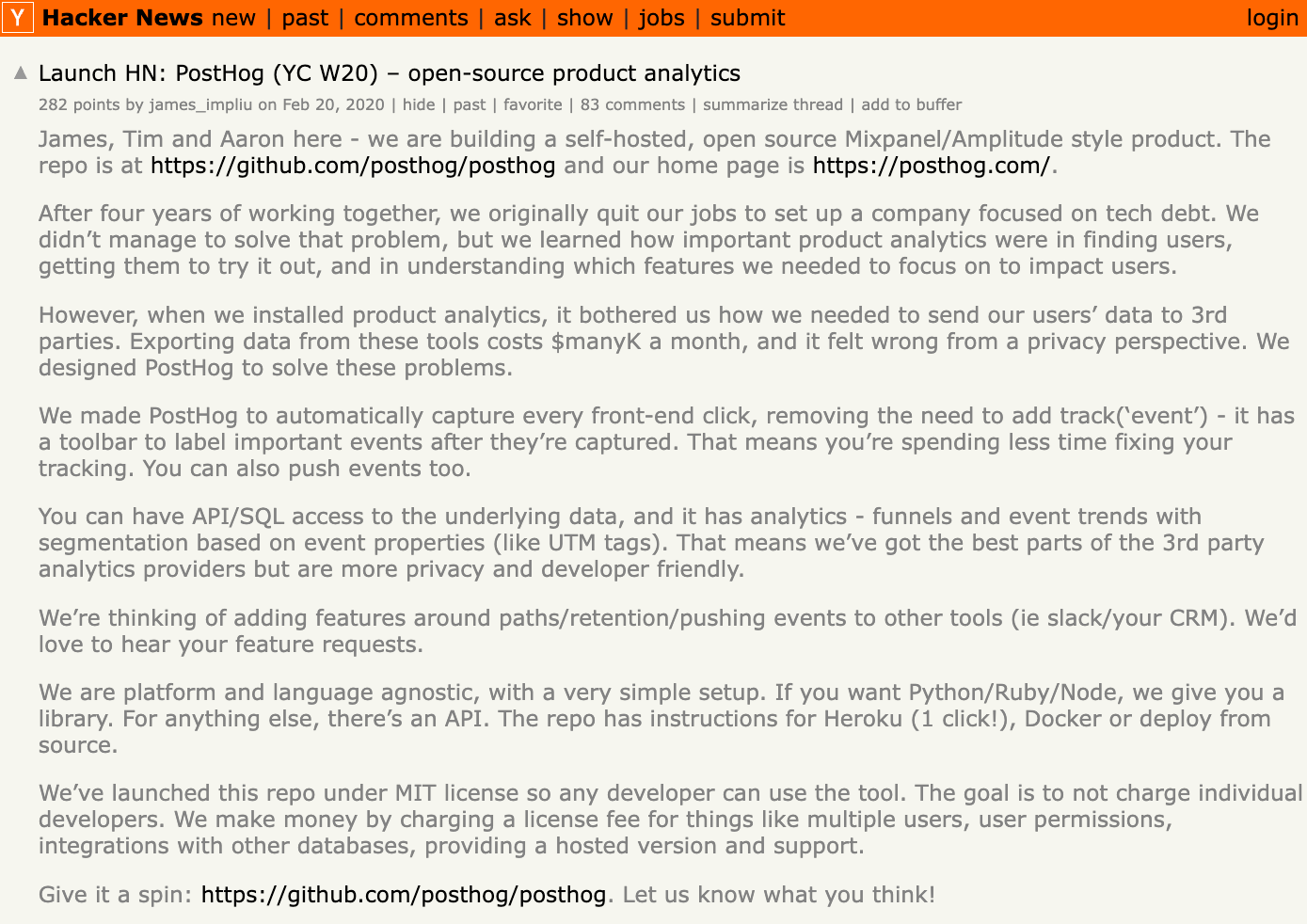
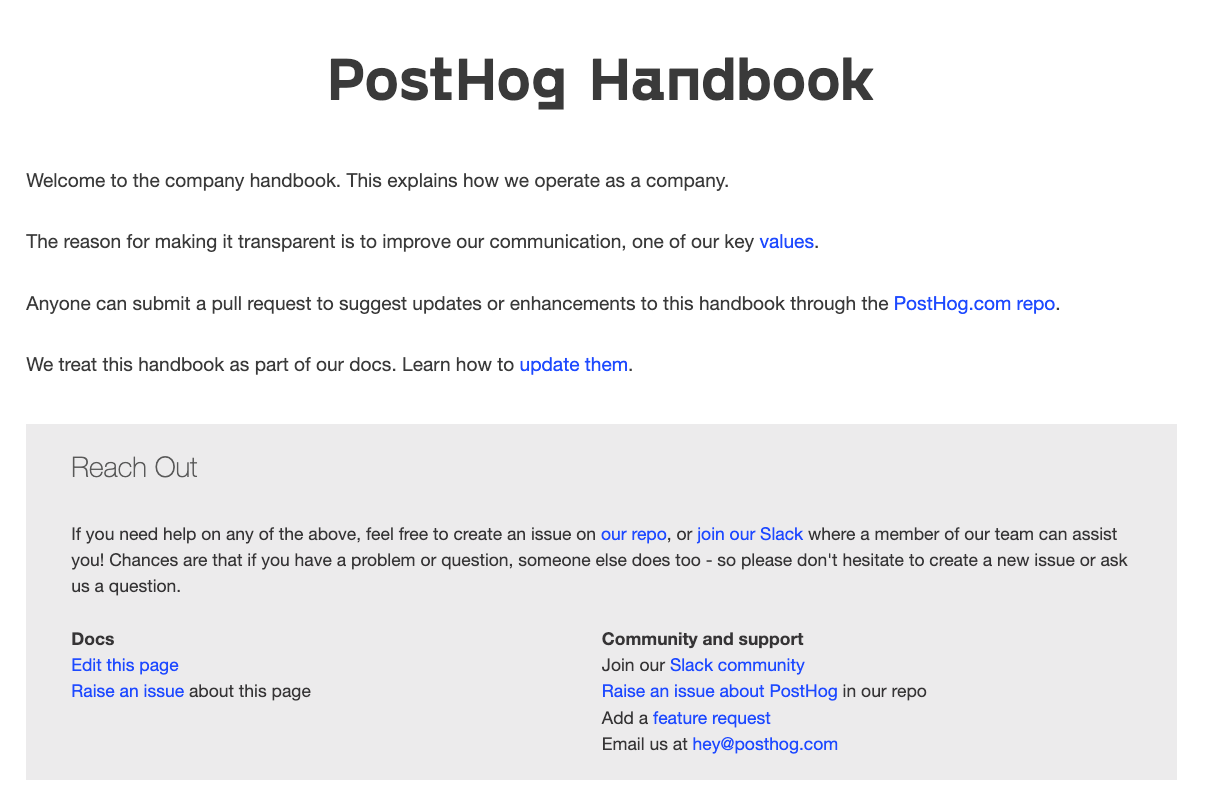
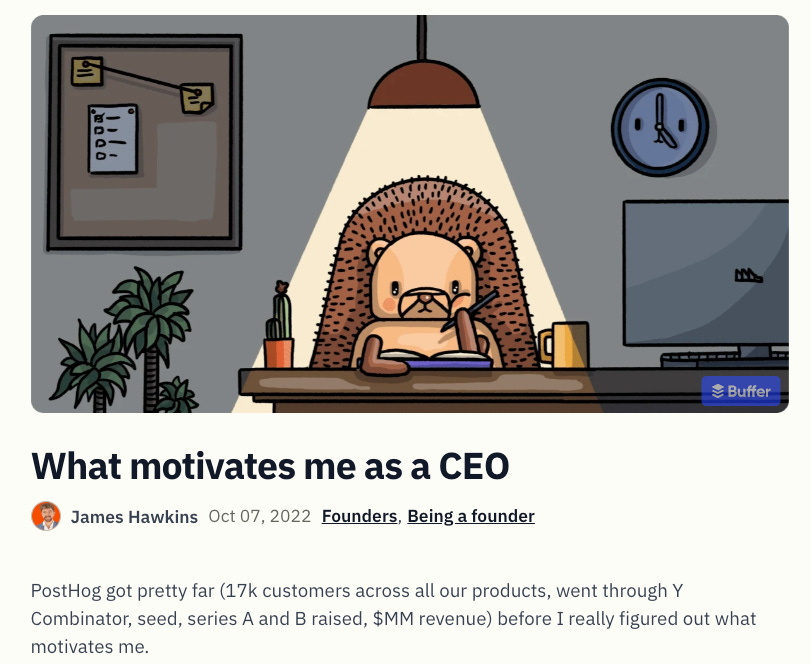
Founders often ask, "How do we get started with marketing?" But marketing usually exists much earlier, and in more forms, than people think. In PostHog's case, the company was already doing marketing through activities such as:
-
A launch post on Hacker News:
-
An unusually detailed employee handbook:
-
A founder blog that honestly documented company life:
Marketing is simply the work of narrowing the gap between what you are building and the people who might care about it. You do not immediately need a grand strategy, brand guidelines, content calendar, or paid budget. It is enough to figure out what potential customers would find interesting and talk about it. Approached this way, the brand feels far more authentic.
2. Go Deep, Not Wide
When early success begins to appear, many startups try 5-10 different channels at once. Six months later, this often leaves them with nothing working properly. A far better method is to focus on one or two things that already seem to work and go deeper.
For example, if LinkedIn is getting a good response, post there consistently every day. If podcast appearances are converting, pitch other podcasts. PostHog used this kind of approach early on to acquire its first 1,000 users. After its Hacker News launch worked, the founders kept publishing blog posts that shared the company's behind-the-scenes story.
- A retrospective on why the Hacker News launch worked and how they used the momentum
- A detailed explanation of how they raised a $3 million seed round as an open-source company
- The story of six failed product ideas before pivoting to open-source product analytics
When you focus deeply on a niche, you can develop something distinctive that other companies cannot easily copy. A large company could not create the same kind of transparent and candid founder blog that PostHog did. It was possible because PostHog was small and relatively unknown. So instead of trying many things shallowly, the smarter strategy is focus and depth.
3. Choosing the Right First Channel: PLG vs. Sales-Led
Which channel you should prioritize depends on whether your business is product-led growth (PLG) or sales-led. If you are not sure which model you have, first define your ideal customer profile (ICP). That is the map you need to turn potential users into paying customers.
3.1 For a PLG Model
If your business is PLG, early success will likely come from places where users already spend time:
- Hacker News
- X
- Developer communities
- Tutorials
- Documentation
In this case, the goal is to widen the top of the funnel. Branding, advertising, and word-of-mouth growth can also help. If done well, customers will come to you. PLG can be a very efficient way to build a business, so if you see early signs of success, keep pushing.
3.2 For a Sales-Led Model
If your business is sales-led, early success usually comes from a more targeted approach. You need to go directly to customers.
- Direct outreach
- Industry events
- Partnerships
- The founder's network
- Appearing on podcasts your potential customers listen to
- Attending major events such as AWS re:Invent
Important: No matter which model you have, do not put too much energy into SEO too early. SEO takes time and specialized knowledge. There is effectively no such thing as "vibe SEO." The same applies to app store optimization.
4. Set Clear Success Criteria for Marketing Experiments
Like product launches, marketing should be approached with an experimental mindset. Before starting something new, clearly predict what success would look like. A simple yes/no question is enough:
"Did more people who look like our ICP sign up, use the product, and become enthusiastic advocates?"
At this stage, avoid setting specific numeric targets. If you have not done the thing before, any number is only a guess. What matters is defining the goal so that success or failure is not ambiguous.
An experiment period of about six weeks is usually enough. If something has run longer than six weeks and still has not improved, it rarely becomes magically better. If a clear signal appears earlier, you can stop the experiment sooner.
If six weeks pass and you cannot clearly say, "This worked," then either the experiment was poorly designed or it simply failed. But that is still a useful result, because now you know what not to do again. The worst marketing outcome is the feeling of "we're not sure." That kind of result leads to a pile of mediocre content that nobody can later shut down.
This approach keeps teams from spreading energy across too many things at once and helps them make deep progress. For example, when PostHog started paid ads, it did not launch across every ad platform at once. Instead, it ran two or three small experiments step by step.
- First experiment: Check whether targeting was working. Were people who looked like the ICP clicking? If not, adjust audiences, keywords, and placements until targeting worked.
- Next step: Once targeting worked on a channel, focus on optimization, such as better ad copy and lower customer acquisition cost.
PostHog started experiments on new platforms only when the previous channel was stable enough to enter maintenance mode.
5. Attribution Is Only a 7/10 Problem
If you think about marketing as experimentation, you will inevitably run into attribution problems. Suppose someone sees your viral tweet on X, searches for your company, then clicks a Google ad and signs up. Your analytics tool may attribute the user to Google ads, but the tweet was the real starting point.
If you fall into this trap, you draw the wrong conclusions from data and spend money in the wrong places. Many teams waste paid-ad budgets in exactly this way.
Accept that attribution is not a problem you can solve perfectly. It is enough to solve it 70% of the way. You do not need to build or buy fancy multi-touch attribution software with complex models.
What you really need is a free-response field in signup that asks, "Where did you hear about us?" This is some of the most powerful marketing data you can get, and it costs nothing. Even if optional, 5-10% of people will answer. Read those answers every week.
Adding this field was critical to PostHog's early growth. Through these answers and follow-up conversations, the team learned that developers hated feeling "sold to," but were interested in PostHog's startup journey itself.
Remember two simple principles for dealing with the mirage of attribution:
- Trust attribution when the signal is overwhelming. When it is ambiguous, ignore it.
- If the "Where did you hear about us?" answers and attribution data match, trust them. If they do not match, trust the answers in the box.
6. When Should You Hire an Agency or Your First Marketer?
Another common founder question is, "Should we hire a marketing agency and hand some of this off?" The answer here is no, not yet.
6.1 Marketing Agencies: Not Early On
Agencies cannot build your positioning, understand your users, or define what "good" means for your brand. That is your job, and until you have done it yourself, you cannot delegate it.
The process of figuring out what marketing works for your target customers also improves product decisions. It is an extension of talking directly with users. If you outsource early marketing to an agency, the result will likely be average, feedback loops will slow down, and you will learn nothing.
Use agencies only for things you truly cannot do internally. For example, PostHog later outsourced paid ads to an agency because it was time-consuming, required less unique PostHog context, and rewarded long-term specialized experience. Outsourcing it for $5,000 per month made sense.
Never use an agency expecting it to think through the parts you have not yet thought through.
6.2 Hiring the First Marketer at the Right Time
Founders often want to hire a marketer as soon as they have budget. But before hiring the first marketer, the following conditions should be true:
- You have users who actually use the product
- You have users who enthusiastically recommend it to others
- You have users who are willing to pay
- You have users willing to do all of the above even when the product is still rough
When those conditions are in place, hire a generalist as the first marketer.
The title does not matter. They may be called a content marketer, product marketer, or growth marketer, but what you actually want is someone who can:
- Write well
- Think in funnels
- Talk to users
- Solve problems without a fixed playbook
You need someone who can cover multiple areas because you do not yet know which channel matters. Specialists tend to rely more on playbooks.
PostHog's first marketer was Joe, who had experience across journalism, content marketing, copywriting, and product marketing. Because the team could not give him clear instructions, he spent as much time talking to engineers as writing copy. His job was to figure out what was actually needed.
The first marketer should also be fairly experienced, because you will not be able to provide a long-term strategy. The most you can give them is context about what has worked so far; the rest they need to figure out independently.
Closing
Startup marketing can feel like unknown territory, but in reality it is often already hidden inside your daily work. Through deep exploration and disciplined experiments, you can find a path that works. Rather than obsessing over perfect attribution, listen to customers. Rather than handing everything to outside experts, have the courage to find the answers yourself. This guide is meant to help, even in a small way, on that journey.