A summary and detailed breakdown of Dan Hockenmaier's analysis
1. Three Perspectives on DoorDash's Success
There are three broad ways to view DoorDash's success:
-
The business school perspective: DoorDash chose the right strategy, entered the right market, secured the right restaurants, and designed its marketplace well.
-
The Silicon Valley hustle perspective: "They executed faster than everyone else. They built a better product, more selection, and more reliable delivery—quickly."
-
The financial markets perspective: "They got lucky. Grubhub and Uber were hobbled as public companies at critical moments."
Key takeaway: In reality, all three perspectives must work together for success to happen. "Today, winning in any competitive market requires the right strategy, fast execution, and luck—all at once."
2. DoorDash's Three Decisive Strategic Bets
2-1. Recognizing the Importance of Owning Delivery
- Most restaurants couldn't afford to run their own delivery operations.
- Grubhub's model was purely order-connecting, and that approach was bound to hit a ceiling.
- DoorDash introduced a model that took direct responsibility for delivery from day one. (Uber Eats started with a model of loading bulk-cooked food into cars for fast delivery; Postmates originally focused on package delivery, not food.)
Tony Xu (CEO) on the final slide of YC Demo Day 2013: "We knew from the beginning that logistics was the core."
2-2. Starting in the Suburbs, Not the City
- Conventional wisdom for logistics businesses is to start in dense urban areas, where high order volume drives network efficiency.
- But DoorDash targeted the suburbs instead.
- Suburbs had almost no delivery alternatives, wealthier customers, and higher average order values.
- With little competition, DoorDash could establish market dominance early.
Sarah Tavel's "Marketplace Hierarchy" principle: "To become number one in a market, you can't just be number one—you have to be the overwhelmingly dominant number one." "Once you get there, demand flows to you, which attracts more supply (restaurants), creating a virtuous cycle."
2-3. Prioritizing Restaurant Selection Above All
- DoorDash treated variety of restaurant options as its top priority.
- It recognized that "is the restaurant I want available?" mattered more than delivery speed or price.
- It understood that once delivery arrives within 40 minutes, incremental speed gains make little difference.
- Uber, obsessed with faster delivery, ended up choosing the wrong model.
- DoorDash initially charged consumers more while cutting fees for key restaurants to get them on the platform.
3. Crisis and Execution: DoorDash's Survival Story
3-1. Early Growth and Cash Crunches
- Raised a Series A from Sequoia in 2014; in 2015, legendary investor John Doerr led a Series B at a $600M valuation.
- But cash ran out, and for six months in 2016, DoorDash couldn't find investors. Sequoia eventually led a Series C—a down round—at $700M.
- By late 2017, cash was nearly gone again; a $60M bridge round barely kept the company alive.
3-2. Outgunned by Competitors
- Uber and Grubhub had far more capital.
- DoorDash had no choice but to survive on sheer execution.
3-3. The "AND" Culture and Execution
- Tony Xu and the leadership team (Prabir Adarkar, Keith Yandell, Jessica Lachs, and others) were tenacious, data-driven, and hands-on to the last detail.
- They learned to do multiple things simultaneously.
Keith Yandell on the Crucible Moments podcast: "People would come to us and ask, 'Are you going to focus on growth or profitability?' We quickly realized: to survive, we had to do both at the same time. That became a core value. It's 'AND,' not 'OR.' You can't choose. We have to grow, and we have to become more profitable."
3-4. Improving the Customer Experience
- More reliable service: "It was just more dependable." (Better delivery speed, lower error rates, improved restaurant and dasher quality management.)
- A better app experience: "The app was just better." (Larger photos, easier menu navigation, faster checkout, reorder functionality, real-time driver tracking, etc.)
Features like real-time driver tracking launched in 2017 (DashPass, Chase Sapphire partnership, and others were also introduced before competitors.)
4. Luck and Market Shifts
4-1. 2018–2019: The Decisive Period
- Where each company stood during this period set the foundation for explosive pandemic-era growth.
- Grubhub: "Food delivery is a bad business—always has been, always will be." (CEO Matt Maloney) → Chose not to shift to DoorDash's model; instead pursued asset-light (no direct delivery) profitability.
- Uber: Dealt with the #DeleteUber crisis, a CEO change, and post-IPO cost-cutting mode in 2019.
4-2. DoorDash's Aggressive Investment
- Raised $535M from SoftBank in 2018, another $250M later that year, and two additional $1B+ rounds in 2019.
- Lost $475M in 2019 alone (−54% EBITDA margin).
- Expanded to 5× more markets, launched massive marketing and branding campaigns. (Spent over $3B on marketing and sales from 2019 to 2021.)
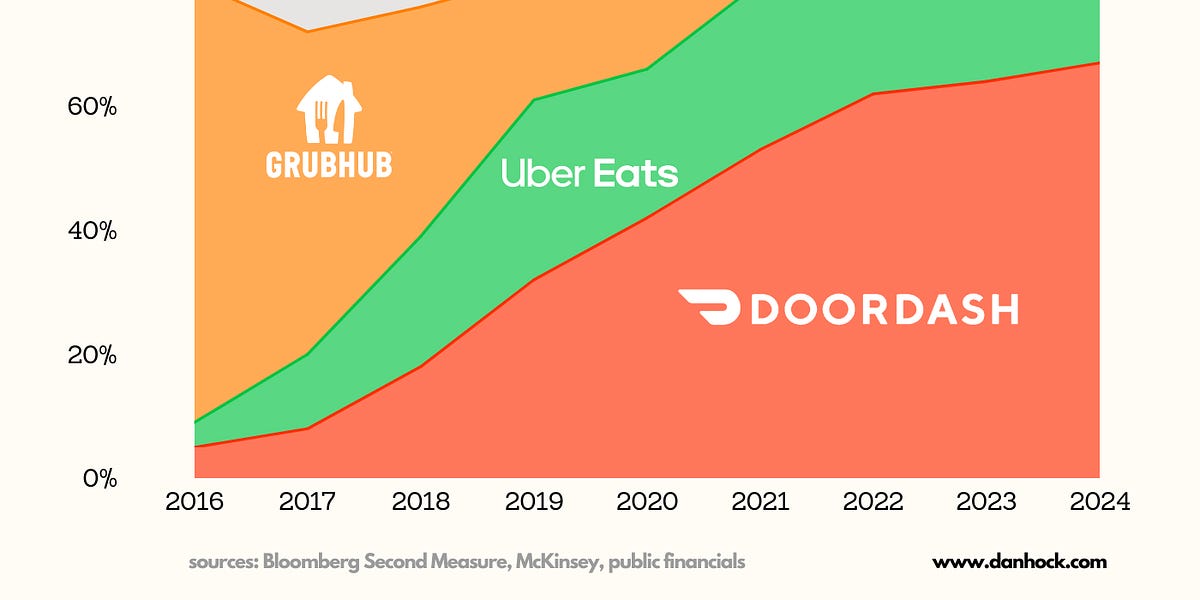
From third place in 2017 to first place in 2019! When the pandemic hit, DoorDash was already the market leader. "The moment the world stopped and food delivery became essential infrastructure, DoorDash was perfectly positioned to seize the opportunity."
4-3. The Counterfactual
- If Uber had successfully acquired Grubhub in 2021, the outcome might have been different—but Just Eat outbid them, and ultimately sold Grubhub at a loss in 2024.
5. The Formula for DoorDash's Success
"DoorDash had the right strategy, fast execution, and the right timing—all at once."
- Success formula:
Success = (Strategy) ^ (Execution Speed) × Luck- Strategy: No amount of speed matters if you're heading in the wrong direction.
- Execution speed: Moving fast lets you validate and improve your strategy. Moving slow means getting beaten by competitors.
- Luck: Good luck amplifies outcomes; bad luck can kill a company.
"Twenty years ago, two out of three might have been enough. But today, every market is full of competitors with abundant capital, information, and execution ability. To win, you need the right timing, the right idea, and extraordinary execution—all together." 🚀
6. Key Terms and Concepts
- Strategy
- Execution
- Luck
- Own Delivery
- Suburbs
- Selection
- Network Effects (Flywheel)
- Customer Experience
- Shipping Fast
- AND Culture (AND, not OR)
- Pandemic
- Marketing/Sales Spend
- Market Leadership
- Competitors (Grubhub, Uber Eats, Postmates)
- Real-Time Driver Tracking
- DashPass, Partnership Programs
7. Closing Thoughts
DoorDash's success wasn't the result of any single factor. It came from strategy, execution, and luck all falling into place—and along the way, navigating countless crises and decisions, relentless execution, and continuous improvement of the customer experience.
"Today, only those who combine the right strategy, fast execution, and a measure of luck can become true winners in a fiercely competitive market." 🌟
References (See the reference list at the bottom of the original article.)