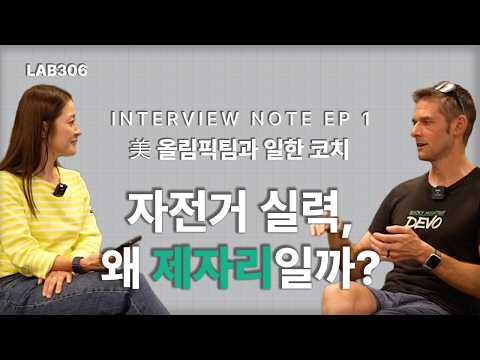
This video is an interview with Ryan Koller, a coach and exercise physiologist who has worked for the U.S. Olympic team and USA Cycling, to address concerns that amateur cyclists often have. The key is to be clear about training intensity, recovery, nutrition, strength, and the purpose of each workout, rather than just riding a lot. Ryan emphasizes, "When your skills plateau, the answer may not be more training but rest," and says that if you want to enjoy cycling for a long time, you need to train flexibly and in a balanced way to suit your goals.
1. If you ride a lot, you will eventually stagnate.
Ryan Koller runs a business called Rocky Mountain Devo in Colorado where he coaches athletes and provides physiological testing. It is introduced that the test items include VO₂max, lactic acid threshold, and metabolic ability.
At first, your skills will improve simply by riding your bike a lot. In particular, it is possible to develop naturally up to a certain level without using data. However, at some point, there comes a plateau where your records or performance no longer improve even if you keep riding in the same way.
"Just riding more and not using data gets a lot of cyclists up to a point, but at some point you hit a plateau and then nothing changes."
Of course, not everyone wants a higher record. As long as it's enough to enjoy the ride at the current level, stagnation itself is not a problem. But if you want to progress further, you need to check what is going on inside your body. Physiological tests help you identify your individual strengths and weaknesses, such as VO₂max or lactate threshold, and find where progress is blocked.
"We can answer a lot of questions just by looking at what's happening metabolically in the body."
In other words, when breaking a plateau, rather than unconditionally increasing the amount of training, you should first check what you are good at and what you are lacking.
2. In Zone 2, the slower the better, you must use a range that suits your purpose.
Meaning of Zone 2
Zone 2 training is low-intensity aerobic training that can be continued for long periods of time. However, after learning about Zone 2, many riders make the mistake of trying to only stick to the highest point of the range.
Ryan explains that if you know Zone 2 accurately, you can find the appropriate intensity needed for long rides. Many amateur riders tend to ride harder than they think, so every workout ends up being "medium hard riding."
"If we don't know Zone 2, we usually ride too hard and all our training gets condensed into a vaguely hard medium intensity."
Using Zone 2, you can avoid riding too hard when training long distances, and you can also configure separate high-intensity training to stimulate different metabolic systems as needed.
However, the exact intensity of Zone 2 varies depending on the training amount of the day and the surrounding training situation. Even for riders like world-class athlete Tadej Pogačar, even the upper intensity of Zone 2 can be too high on days when he spends very long time in the saddle.
"You don't always have to ride at the top of Zone 2. You have to adjust your range depending on how long you ride that day and what you train before and after."
Therefore, it is important to understand Zone 2 as the entire range that can be used depending on the situation rather than a single fixed number. Don't just focus on the edge, but make sure to use enough intensity to suit your condition and training purpose.
3. FTP number is not a goal, but a standard for understanding training
FTP is an indicator of sustainable power that can be maintained over a relatively long period of time. But just because FTP is expressed as one number doesn't mean all of your training should be geared toward that number.
"FTP is a performance indicator that tells us what we can do over a relatively long period of time, but that one number doesn't tell the whole story."
There are several ranges of intensity around FTP. Riding at an intensity slightly below FTP allows you to train a specific aerobic energy system, while riding at an intensity slightly above FTP stimulates other energy systems as well. You can use the lower part of the FTP for long intervals, and the upper part for short, intense intervals.
What is important is not the FTP number itself, but for what purpose you apply that number.
"Just because you find your FTP doesn't mean you always have to train at that point. Whether you do it a little above or below depends on what energy system you want to train at the time."
In the end, FTP is not a report card or an absolute goal point, but more of a reference standard for determining training intensity and understanding your condition.
4. The sweet spot is effective, but if you do it too often, you'll burn out.
Sweet spot training is training typically performed at an intensity of approximately 88-92% of FTP. Ryan says the sweet spot itself is a very useful and favorite exercise. However, if you only perform this intensity at the upper 92% level every time, a problem arises.
In the past, many riders in Colorado also followed sweet spot training as a trend. The problem is that we always focus on the highest intensity without utilizing the full range of the sweet spot. I continued to push my body by training at an intensity near 92% several times a week, such as Tuesdays, Wednesdays, Fridays, and Saturdays.
"People said they did their sweet spot, but they always rode at 92% of their FTP. They never used the lower end, and they trained like that three or four times a week and ended up burning out."
If you combine this with lack of nutrition, you will collapse even more easily. If the amount of exercise increases but the amount of food eaten decreases, the body will not be able to recover and ultimately will not be able to continue training.
"If consumption increases and intake decreases, you will eventually burn out."
Therefore, Sweet Spot is a tool that must be used strictly. To be effective, you need to control intensity and frequency, eat enough, and mix it with rest and other low-intensity training.
5. If your skills are limited, check your weaknesses, not your strengths
In order to break a plateau, rather than continuing to repeat what you are already good at, you need to find areas you are not good at. Ryan explains that checking your power profile in an analysis tool like WKO5 can help you identify your strengths and weaknesses.
For example, there may be a rider who has strong endurance power that lasts for 30, 60, or 90 minutes or more, but has weak 5-, 10-, or 20-second sprint power. In this case, even if the rider participates in a gravel race, it is not efficient to continue training only for long-distance endurance.
"If you've already done a lot of long endurance training and that's your strength, you need to look at what's blocking your progress. It could be your VO₂max, or it could be your anaerobic capacity."
In other words, if you want to break the 'ceiling' of your skills, you should approach it not by doing more of what you are good at, but by complementing the relatively lacking energy system.
6. To lose weight, you need to eat enough
The most common problem for amateur riders is low fuel conditions
Surprisingly, the first thing Ryan recommends to amateur cyclists is not more training, but adequate nutrition. Many amateurs say they don't eat as much as they should, both on and off the bike.
In particular, if you restrict carbohydrates or train on an empty stomach while overemphasizing Zone 2 or fat burning, you will not be able to provide enough energy for actual exercise.
"Amateur cyclists generally do not put enough fuel on their bikes, both when riding and when not riding."
This doesn't mean you have to eat 100 to 120 grams of carbohydrates an hour like a professional athlete. Rather, it can be difficult for amateurs to consistently consume 40 to 60 g of carbohydrates per hour during long rides. It is common for people to eat well at first but forget to eat after about two hours.
Therefore, it is important to understand your exercise amount and energy consumption and consistently maintain an appropriate intake amount.
"The biggest barrier is just eating enough. You have to figure out how much energy you use and figure out how much you can sustainably consume."
Rather than reducing carbohydrates, you should increase your digestive ability
Even if you want to improve your ability to burn fat better, the basic order is train first. They say that carbohydrate restriction is only a secondary factor and that there is no need to worry about it until the foundation for training at the right intensity is established.
"If you want to increase your fat-burning ability, you have to train first. Carbohydrate restriction is just a small addition."
Carbohydrates are an important fuel for performance on a bicycle. Ryan advises that you first check if you can consume about 60g per hour, and then gradually increase to 70g or 80g once you get used to it. However, there is no need to force it to the point where it puts a strain on the stomach.
"Find the upper limit of what you can eat. If you can't eat more, that's your current limit."
If the limit is 60-80g, during intense training, eat about 70g and control it by not exceeding 80g. If you need more carbohydrates, you should gut train by increasing your intake little by little over a long period of time.
"We need to train our gut too, finding the limits and giving the body time to adapt by consistently adding fuel."
7. Even if you are anxious about taking a day off, you cannot become stronger without recovery.
There are two aspects to recovery. One is physical recovery of the muscles and body, and the other is mental recovery, regaining motivation and enjoyment of training.
When you train, your body becomes temporarily damaged and fatigued. You need time to recover so your body can adapt and become stronger. If you continue to train, your body will gradually break down, and your performance will not come back unless you recover.
"If you don't recover, your body won't be able to adapt. If you keep training, you'll just break your body down, and your performance won't come back until you start recovering."
A complete rest day and a very light recovery ride play different roles. If you've trained hard enough, taking a day off isn't a bad thing; it's actually a good option. As you get older, you may need to take two days off a week, such as Mondays and Fridays.
"It's important to take recovery days as seriously as training days. It's recovery days that actually make your body stronger."
Mental recovery is also important. Ryan introduces the case of an athlete who, after training for two years in preparation for an Ironman, was unable to ride a bicycle for three months due to burnout. To prevent this, intensive training is usually conducted for 8 to 12 weeks, or at the most 2 to 3 months, followed by a transition period of about a week. During that period, I take a break from training or only do very light riding, such as going to a cafe.
"It's a time to remember why I love cycling."
Professional athletes also have more rest days than you might think. In fact, there are many cases where amateurs continue to ride without stopping.
"When performance plateaus, the answer is usually rest, not more training."
Additionally, every session included in your training plan must have a purpose. Shortly after starting coaching, Ryan said he kept hearing this question while having his training plans reviewed by senior coaches.
"Why are you doing this training? Why are you doing it on this day? If you can't explain why, you should skip that session."
The core principle he emphasizes is simple.
"Everything must have a purpose."
If you can't explain the purpose of your training, it's better to take that day off.
8. Strength training and bike torque training cannot replace each other.
When asked whether high-torque/low-cadence training, which involves stepping heavily on large gears, can replace strength training, Ryan answers that both types of training are valuable, but their roles are different.
The force generated when stepping on a large gear on a bicycle is relatively small compared to the force generated during weight training. Therefore, if you are a rider who is not yet doing strength training, just lifting weights twice a week can greatly help improve your performance.
"If you have stagnating skills, try starting strength training. Just doing weight training two days a week will definitely help."
After first building basic strength with weight training, adding torque training on the bike will help you apply that strength to pedaling. In other words, strength training builds the base, and big gear training connects that power to the cycling movement.
9. Do not endure knee pain and continue riding, but check the cause.
When you have pain, you need to determine whether the pain goes away when you get off the bike or whether it persists even when you stop riding the bike.
If the pain goes away as soon as you get off the bike, it may be due to bike fitting or biomechanical problems. It is necessary to check the connection between the bike and the body, including saddle height, cleat position, and pedaling posture. On the other hand, if the pain persists even when you are not riding your bike, it may be a more general physical problem.
"Pain that disappears immediately after getting off the bicycle must be viewed differently from pain that remains even after getting off the bicycle."
If you are in pain, the first thing to do is rest. Afterwards, you should be evaluated by a physical therapist or specialist to check for weak areas or movement problems. It is also explained that cyclists often overuse their quadriceps and underuse their glutes.
"You need to rest, get assessed, and then come back gradually."
If the cause is weak muscles, you may need strength training, and you may need to change your cycling position, frequency, or total training amount. The important thing is not to force the pain, but to figure out where the problem originates.
10. High-intensity exercise is possible even as you age, but you must know your limits.
Even people who are older or have cardiovascular disease do not necessarily have to avoid high-intensity training. Exercise has a positive effect on cardiovascular health, and many studies have shown that appropriately performed high-intensity exercise is helpful even for people with heart disease.
"Exercise is really like medicine."
However, an important premise is to know your own condition and limitations. Young, healthy athletes can push their bodies quite hard and still recover to some degree, but as they get older, it's harder to keep pushing them in the same way.
"As you get older, you can't keep pushing your body to the floor like you used to. You have to be much more aware of your limits."
Therefore, rather than completely giving up on high-intensity training, it is advisable to practice it in small amounts as needed and not overdo it.
11. Don't just ride a bike, you should also engage in various types of exercise
It is easy for cyclists to get used to a life of only riding a bicycle, but a variety of movements are necessary in terms of bone health and overall physical strength. Activities that load the bones in a different way than cycling, such as running, hiking, or strength training, can be helpful.
"For bone health, you need a different type of load. You need to give your bones new stimulation, like running, hiking, or strength training."
Some professional cyclists also box in the off-season. The explanation is that because riding a bicycle only repeats certain types of stimulation to the lower body, spine, and pelvis, boxing can also apply stress to the bones of the upper body.
"Multiple activities should almost always be part of an overall training program. Cross-training is very important."
Of course, this doesn't mean that everyone should do a variety of exercises every day. You can change your training structure depending on your long-term goals. If your goal is to age healthily, this could consist of cycling three times a week, strength training once, and hiking or running once a week. Conversely, in the period leading up to a specific gran fondo or competition, you can increase the number of cycles to five and maintain one or two strength training sessions.
After the competition is over, we switch back to reducing the proportion of cycling and increasing other activities.
"Amateurs have this flexibility: they can choose what works best for them."
12. If you can only ride three times a week, split it between intensity and distance.
If you can only ride your bike three times a week, Ryan recommends using different stimuli rather than similar rides all three times.
The first session consists of a Long Zone 2 ride on the weekend. Long-term riding is responsible for long-term endurance adaptation and training volume.
The second session is set to high-intensity intervals in Zone 4 to Zone 5. Increases performance at high intensities through short, strong stimulation.
The third session consists of a moderate intensity level of tempo or subthreshold. This way, you can experience long distances, high intensity, and moderate intensity.
"You can create a good range by placing a long ride, a sufficiently high intensity stimulus, and a tempo or subthreshold."
You must rest sufficiently on different days to complete these three training sessions. For time-limited amateurs, three purposeful sessions with ample recovery may be more effective than riding a little each day.
13. For group rides, you must decide on a purpose and participate.
In a group ride, when someone else takes the lead, you instinctively want to follow. Just as in Zwift, when someone passes you, you immediately increase your speed to catch up, in a real group ride, you continue to increase the intensity without even realizing it.
"When I see the first person passing me, I immediately want to follow them. The same thing happens on group rides."
First, you need to choose a group that suits your level. If there is only one group, it is a good idea to check your legs and breathing and avoid staying too far forward and using too much force. And you have to keep thinking, "Why did I go on a group ride today?"
If you just want to enjoy a group ride, you can ride as hard as you like. However, if you want to use it as training, it is better to stay at the back and follow the wheel, and even if you go to the front of the pace line, get out right away and come back down again.
"It is important to set the purpose of the group ride and stick to that purpose until the end."
If you give your best every time on a group ride, you will end up riding at an intensity that exceeds your sweet spot every time, which can eventually lead to burnout. On the other hand, if the goal is 'fun', then that is a good enough ride. The important thing is to distinguish between training and socializing and fun.
14. American amateur cycling has a very high level of competition
Ryan introduces that the level of amateur cycling in Colorado is very high. Although he was a competitive player in Pennsylvania, he said he felt like he was automatically at a lower level after moving to Colorado.
"When I came to Colorado, I almost felt like I was automatically taken down a level. The amateur competition was so incredibly fierce."
It is said that there are cases where amateur athletes with jobs and families cross the finish line with professional athletes in Category 1 and 2 open competitions. He explains that the foundation for general sports is also strong, with people in their 70s and 80s hiking the Colorado Trail.
There are especially many criterium matches in Colorado. Competitions range from fast and fun games on wide, simple oval courses to very technical courses with 11 corners.
However, accidents often occur in the beginner category because there is a large difference in physical strength and skills. A person who has excellent physical strength but lacks road driving experience may drive in front and collide with another person at a corner. Conversely, the higher the category, the more stable the participants' skills and skills are, leading to fewer accidents.
15. To reduce drops, learn spatial awareness on the track and in groups.
You can't completely avoid falls, but you can practice safe bicycle handling skills. Ryan picks track riding as a particularly good method.
On the track, you ride a fixed-gear bike without brakes and pedal continuously, which reduces the habit of sudden changes in speed or sudden braking. In the process, you can naturally learn the spacing between other riders, your own space, and the flow around you.
"If you learn to ride on the track, you learn to control space without the brakes, which makes you much more comfortable on group rides."
If you don't have access to a track, it's helpful to get familiar with the surrounding space on a group ride. Instead of just staring at the rear wheels of the person in front of you, look up and see if two or three people are slowing down in front of you.
"Don't just look at the person in front of you, look at two or three people in front of you. If you see the speed decreasing in front, you can control the flow in advance to come towards you."
It is said that Ryan himself had the experience of falling with several people during track training and suffering serious road abrasions. The risk of falling cannot be completely eliminated in cycling, and you must decide for yourself how much risk you are willing to take.
"You can only progress if you are willing to take the risk of falling. If you don't want to take that risk, you shouldn't push that hard."
However, this does not mean that you should take excessive risks. You should only take on challenges within the range of risk you can accept.
16. Ryan's coaching philosophy is 'making it possible for you to do it yourself'
Ryan does not apply the same program to all players. For beginners, we provide the necessary tools and basic understanding at that level, and for experienced riders, we check their current knowledge and habits and help them refine the details.
"Everyone starts at a different point. I try to start with each person where they are."
In his opinion, the ultimate goal of good coaching is not to make players depend on their coaches forever. It helps you learn enough and make your own decisions.
"If one day a player says, 'Now that I've learned enough, I think I can coach on my own,' then I think I've done my job."
He also emphasizes that enjoying cycling is as important as achieving goals. This is because cycling is not a sport that ends with short-term results, but an activity that can be continued for a lifetime.
"Cycling is a sport you can do for the rest of your life. It should help you reach your goals, but also help you find fun in the process."
17. The biggest driving force that keeps me riding a bike is fun
At the end of the interview, a carnation is given to Ryan in celebration of Korea's Teacher's Day. The host introduces Ryan as his teacher and gives him flowers as a thank you for his knowledge and advice. Ryan happily accepts it, saying it has been a while since he received flowers. 🌸
Finally, Ryan says it's not just records or numbers that keep him cycling. You have to find what you like about riding a bike, and whether it's an easy ride or a hard workout, you have to find moments that make you smile.
"Find out what you love about cycling. Let that be your drive and motivation."
"Find something that makes you smile on the bike. Whether you ride easy or hard, if you enjoy it, you'll keep improving."
Finish
The message this video conveys is riding more and harder is not always the answer. If your skills have stagnated, you should first check your weaknesses and training goals, and make sure you get enough carbohydrates, rest, and strength training.
Principles especially worth remembering are:
- Zone 2 uses the entire area rather than just focusing on the edges.
- FTP is not an absolute goal, but a standard for understanding training.
- The sweet spot is effective, but if done frequently and vigorously, it can lead to burnout.
- If your skills plateau, consider taking a break before training further.
- Do not overly restrict carbohydrates, and ensure a steady supply of fuel on long rides.
- In addition to cycling, add various movements such as strength training, running, and hiking.
- All training must have a clear purpose.
- Above all, if you want to ride for a long time, you must make cycling an enjoyable activity.
In the end, what is more important than growing quickly is finding a way to ride steadily for a long time without breaking down your body and mind.