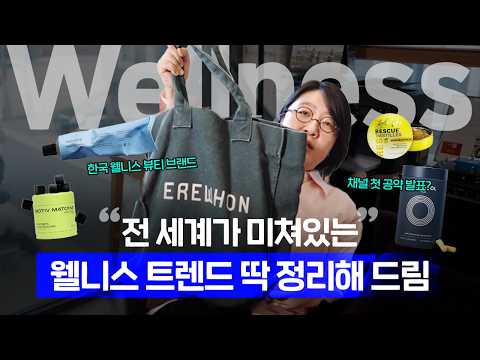
This video analyzes why wellness is emerging as an important consumption trend precisely as AI technology makes the world faster and more efficient. It explains that wellness is more than health management—it is a lifestyle and a shift in how people consume—and compares popular wellness examples such as matcha, saunas, and Pilates, along with the differences in wellness consumption between the US and Korea. The speaker also shares the experience of getting ahead of the wellness trend and applying it successfully to a business, and personally introduces a line of wellness beauty products.
1. Wellness: From the Privilege of the Wealthy to Everyone's Aspiration
In the past, wellness was seen as a life reserved for the rich—those who had physical, mental, and social health all at once. But now it has become a way of life that anyone can aspire to. Personal training and Pilates, once hard to imagine, are now taken for granted despite being expensive services, and we live in an age where people admire those who lead such a life.
"Physical health, mental health, social health—it's exactly the kind of life only the rich could have. But this is a life that every human being wants."
2. Why Wellness Matters Even More in the AI Era
The advance of AI technology is accelerating an age of speed, efficiency, and dopamine. In a society where everything changes quickly and stimulating information overflows, people instead feel a thirst for a slow, healthy life in which they care for themselves. This is why the wellness trend grows stronger as AI develops, forming a paradoxical relationship in which dopamine and wellness boost each other.
"AI ultimately comes down to issues of speed and efficiency, and dopamine. I think the stronger it gets, the more the wellness trend will be pulled upward."
3. The Spread of Popular Wellness Trends: Matcha, Saunas, Pilates
Recent wellness trends are appearing around us in various forms.
- The popularity of matcha: Instead of coffee, matcha is rising as a smart and hip form of consumption with less caffeine. This is a form of wellness that has evolved beyond simple beverage consumption into a cultural consumption that considers health.
- Hip sauna culture: Old bathhouses and saunas are being reborn as sophisticated spaces like "Othership" and "Bathhouse," gaining attention as hip wellness activities. This is a case of traditional health-management methods combining with a modern sensibility to come back into fashion.
- The lasting value of wellness: Wellness is not merely a passing fad. Because it helps people move in a healthy, positive direction, the speaker predicts it will ultimately survive even if some bubble forms around it.
"I think matcha is the result of that cultural consumption moving toward a slightly smarter, hipper consumption with less caffeine—and that, too, is a kind of wellness." "In the end it's moving toward people's health and in a good direction, so it's fine even if there's a bit of a bubble."
4. Characteristics and Cases of the US Wellness Market
The US wellness market is developing with a different background and pattern than Korea's.
-
Advertising and products: In the US, wellness products are sold using bold words like immunity, stress, and detox.
-
Bio-functional trends: Wellness is expanding beyond a mere lifestyle into bio-functional solutions.
- Hims (Forhims): A healthcare startup that solves specific health problems such as male hair loss, erectile dysfunction, and acne in a hip and innovative way. Using the COVID-19 pandemic as a catalyst, it expanded into diagnostic services and showed the essence of wellness.
- Equinox: A fitness center for the wealthy that even owns hotels, offering an overall wellness lifestyle including natural food, social networking, and sleep rooms.
-
High medical costs and a prevention-centered culture: Because medical costs are very high in the US, disease prevention is essential, and wellness is considered not a choice but a "must." In Korea, by contrast, the medical system is well-established, so wellness tends to be used as a marketing element.
"The reason wellness can only end up as marketing for Koreans is that, fundamentally, hospitals are too cheap. But in the US, a single ambulance ride costs you at least 6 million won."
5. The Insight to Read the Wellness Trend, and the Business Opportunity
The speaker started a business three years ago by getting ahead of the keyword "wellness beauty." At the time it was an unfamiliar concept, but now many brands emphasize wellness beauty.
- A dilemma and a choice: So that wellness beauty would provide genuine value rather than ending up as mere dopamine-generating marketing, the speaker chose to export to the US market, where the market is large and wellness is a "must."
- A shift in platforms: There are now more and more platforms that value "what kind of value a brand holds" and "how wellness-oriented it is" rather than a brand's sales or fame.
- The experience of being stocked at Happier Grocery: Happier Grocery, a US wellness organic market, came directly to the speaker's brand and proposed stocking it. In particular, they required a full-ingredient chart, valuing the essential worth of the product.
"I was the very first to use the keyword 'wellness beauty.' And I deliberately put out a press release. When I said I was launching wellness beauty, even my own employees objected." "While running the wellness beauty business, there was a store that recognized the choice I'd made because I truly wanted to prove myself to consumers in the end."
6. US Wellness Products and the Importance of Storytelling
The speaker introduced the Erewhon market, which leads the wellness trend in the US, along with various wellness products.
- Erewhon market: A premium wellness market a tier above Whole Foods, it carefully curates and stocks organic and small-scale brands that carry a philosophy. The speaker set a goal four years ago to get stocked at Erewhon, buying its iconic shopping bag to steel that resolve. The speaker's brand is currently in the process of registering as an Erewhon vendor.
"Erewhon is the market brand that currently shows the most iconic wellness play in the US." "When I go to a buyer meeting at Erewhon later, I want to carry it in and show them: I've been supporting you from South Korea for four years."
- Various wellness products:
- Matcha energy gum: The taste may be somewhat unfamiliar, but it's a product that combines energy and wellness.
- Hair-loss vitamins: Products that help relieve hair-loss symptoms using specific ingredients like saw palmetto. Due to medical regulations they are hard to release in Korea, but the high medical costs in the US create a large market.
- Stress-relief products: Many products sold on the concept of naturally relieving stress.
- The power of storytelling: Wellness products add value through storytelling beyond mere efficacy. The speaker explains that, just as "making a powder from cassia seed tea turns it into a brightening tea that clears your eyes," she can introduce cassia seed tea—drunk since our grandmothers' generation—to the US market and win empathy with the story "It clears your eyes!"
7. Introducing the Wellness Beauty Brand "Lits"
The speaker introduced her own wellness beauty brand, "Lits." Lits product packaging carries the phrase "Wellness From Seoul." This embodies a determination to promote Korean wellness beauty in the US market, where wellness is a key survival keyword. The speaker closed the video with a pledge to gift products to 100 subscribers if she succeeds in getting stocked at Erewhon.
"Our brand got stocked at a US wellness organic market called Happier Grocery, so when you set up exports, you absolutely have to include a wellness element." "We write 'Wellness From Seoul.'"
Closing
This was a video that analyzed in depth the phenomenon of wellness trends becoming even more important in the AI era. The value of wellness—encompassing not just health but an entire lifestyle—and the speaker's insight in connecting it to a business opportunity stood out. In particular, by examining the differences in wellness consumption between the US and Korea, it helped deepen an essential understanding of the market, and by emphasizing concrete product cases and the importance of storytelling, it gave viewers a great deal of inspiration.