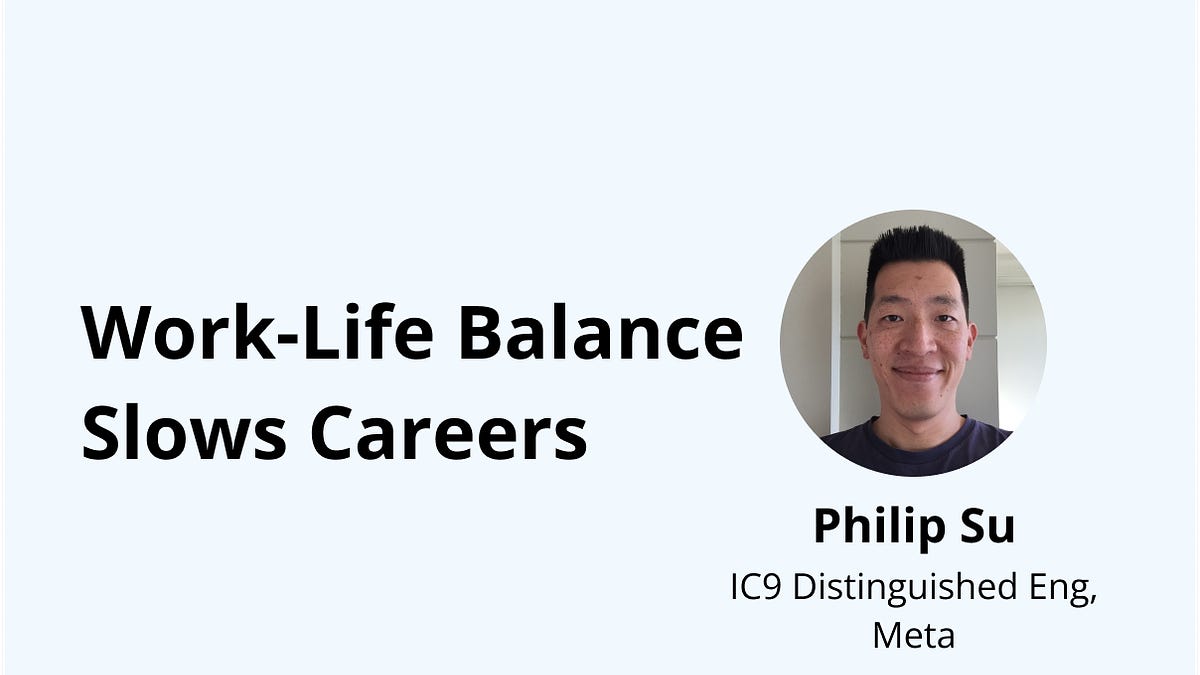
This is an essay by Philip Su, a former Meta E9 Distinguished Engineer, arguing that fast promotions and career growth ultimately require effort and sacrifice. He acknowledges the influence of luck and talent, but contends that the factors you can actually control are diligence and time invested, and that to grow faster than your peers you have to work longer or more efficiently. At the same time, he candidly admits that his rapid rise came at a clear price: lost time with his family.
1. Special Guest Philip Su and the Question the Essay Raises
To celebrate reaching 3,000 subscribers, the newsletter Path to Staff introduces Philip Su as a special guest contributor. Philip was an E9 engineer at Meta, and he is also known for spending $57,000 to buy coffee for every employee across several Facebook offices.

Philip was promoted every year during his first eight years at Microsoft. In this essay, he directly rejects the self-help promise that "you can have a family, reasonable working hours, great looks, and faster career growth than your peers, all at once."
"The dream that you can have a wonderful family, a 45-hour work week, a full head of hair, and faster career growth than your peers is not true."
He points out that anyone who says otherwise is either selling something or leaving out important context. The newsletter's author adds, however, that this view isn't right for everyone, and says a later issue will present his own perspective on building a career while keeping work-life balance.
2. The Three Ingredients of Fast Growth: Luck, Talent, and Effort
Philip boils down the factors that determine fast career growth to three.
- Luck
- Talent
- Grit and effort
Luck clearly exists, but it's beyond your control. As an example, he mentions a chance connection: he attended the same high school as Sergey Brin, and a professor he liked in college turned out to be Sergey Brin's father. Yet none of this brought him great success or wealth. The point is that no individual can engineer coincidences like these.
The same goes for talent. Some people simply have greater intellectual ability or more favorable innate traits. Using the example that he could never become an NBA player, he explains that some traits, like height, can affect a career yet are hard to change. He even cites statistics showing that in US presidential elections, taller candidates tend to have an advantage because they are perceived as stronger leaders.
So what an individual can directly control, in the end, is effort. Philip notes that effort takes many forms, but in this essay he focuses specifically on working hard, that is, on investing time and focus.
"If you're as smart as everyone else and work as hard as everyone else, then you're just as average as everyone else."
He makes clear that being average isn't bad. Depending on where you work, average performance can be very impressive. But his conclusion is that if you want to grow faster than average, then unless you have an overwhelming edge in luck or talent, you have to work longer than your peers, work with more focus, or both.
"Be luckier, be more talented, or work harder."
3. Pushing Back on "Work Smarter"
Philip anticipates the arguments commonly raised against long working hours. His core position is not simply to work long hours blindly, but that to stand out among capable people who already work smart, you also need extra effort.
"Work smarter, not harder"
He finds the phrase appealing but thinks it oversimplifies reality. On great teams, everyone already works efficiently and tries hard to solve problems. So if you're in a situation where "as long as you work smart, you don't need to work longer," he says, that may actually signal a low bar at that organization or team.
"On every great team I've been on, working smart was already table stakes."
Productivity drops after 40 hours
Many people cite a study of Ford factory workers to argue that hourly productivity declines beyond 40 hours a week. Philip doesn't dismiss this entirely. But he stresses that even as hourly productivity dipped somewhat, total output kept rising up to 55–60 hours a week. Beyond that point, mistakes can multiply and erode total output, but he believes a developer working 45 hours is likely to produce more in total than when working 40.
You might burn out
He acknowledges the risk of burnout as well. But he says the limit of a sustainable workload differs from person to person, and that finding your own limit is what matters. He recalls in particular that when his direct reports raised work-life balance, they had often actually lost interest in, or a sense of purpose from, the work itself.
In other words, it isn't only long hours that make things hard; whether you find meaning and engagement in what you do is also an important long-term variable.
You lose relationships and life's other joys
Philip accepts this criticism almost entirely. Working too much can wreck relationships with partners, friends, and family, and you can miss chances to form new ones. Hobbies, rest, and the richness of life can be sacrificed too.
"There is a clear trade-off between moving faster in your career and going deeper in other aspects of your life."
He emphasizes that while career success can have some positive effect on other areas of life, you can't have everything at once, as the ads promise. 🌿
4. Exam Prep and Extreme Immersion at Microsoft
Philip shares experiences that made him feel his achievements came less from innate intelligence than from long hours of effort.
In college he was on the pre-med track, and he scored 40 on the MCAT by the standards of the time. That corresponds to roughly 522 on today's scale, higher than the median for Harvard Medical School students. He says he read nine college textbooks in chemistry, biology, and physics cover to cover at least twice each.
His friends heard his score and praised him as smart, but that assessment made him uncomfortable. Had his friends studied exactly as he did and still scored lower, you could credit talent; but when that wasn't the case, explaining the result as mere intelligence erased the long hours of solitary effort behind it.
"They wrongly attributed my success mainly to talent. But much of that result came from long, grueling hours of studying alone."
When he first joined Microsoft, his life was even more extreme. He kept a sleeping bag at the office and coded until 11 p.m. every night. He'd then sleep briefly until 3 a.m., work again until 6 a.m., and go back to sleep until his first meeting at 10 a.m.
At the time he had no hobbies, and his closest friend worked similar hours, so he says that life was sustainable for him. As a result, he was promoted every year for his first eight years. Luck and talent surely played a part, but he states flatly that it's hard to imagine he could have grown at the same pace working only 45 hours a week.
He remembers the insights he gained debugging late at night while janitors cleaned the hallways. He fixed twice as many bugs as a colleague who joined the team the same month, and he asks how he could have been promoted at the same pace without the progress he made in those early-morning hours.
5. The Price of Success: His Son's "Calendar Booking"
Yet Philip doesn't dress up long hours as a pure success story. He brings up a deeply painful memory of the personal cost he paid during the most brilliant stretch of his career.
At the time, he was leading Facebook's London engineering office. It was Facebook's first engineering hub outside the US, and he was the first Facebook engineer to be promoted to E9 outside the United States. Looking back, it may have been one of the peaks of his career.
But one day, his son, then seven, asked him to play with the Nordic-style chess set the family had bought. When Philip said "Sure," his son asked him to put it on his calendar, and actually watched until the event was booked.
"My son made sure that time with him was secured on my calendar before I left for work that morning."
Philip was deeply shaken in that moment. His son felt that to play with his father, he needed not just a promise but time formally reserved between work meetings. He describes this as a "devastating moment" that made him realize the price his success had exacted from his family.
He admits it candidly. Had he worked less, he might still have eventually reached a similar level. He also believes he could have spent more time with family and friends and even developed hobbies. In other words, while the fast growth and high achievement were real, he doesn't claim that his choice was the only path.
6. What Matters More Than Work-Life Balance Is Choosing with Eyes Open
Philip draws a line: his essay is not a call to work long hours at all costs for your career. He says he is not an advocate of e/acc, the attitude of accelerating everything to maximize output.
Still, he considers it a fantasy that someone who isn't especially luckier or more talented than he is, and who works about as much as their peers, can grow dramatically faster than others through positive thinking and a few tricks alone.
"If you want abnormally fast career growth, you have to put in the time."
What matters is not a judgment that long hours are necessarily right, but deciding for yourself while knowing that the choice comes with sacrifices. Those sacrifices are hard to avoid, whether chosen deliberately or incurred unthinkingly amid a busy life.
"There are no shortcuts."
He previews a follow-up essay on how to structure your weekly schedule and time to sustain long working hours.
7. An Anecdote That Shows What "Work-Life Balance" Really Means
In a footnote, Philip tells the story of Tim, a teammate from his Microsoft days. Tim loved cycling, and he asked to cut his work week to 32 hours so he could make time for his lifelong passion. Philip supported him.
But Tim later left for Google. Philip recalls that Google in 2004 had worse work-life balance than Microsoft. When Philip ran into Tim about six months later and asked whether he was getting plenty of riding in, Tim's answer was not what he expected.
"Cycling? I don't have any time. I don't ride at all. I love what I'm doing at Google!"
Through this anecdote, Philip suggests that when people talk about "work-life balance," the real issue may not simply be a lack of time, but that they've lost interest in their current work or are looking for something more engaging. When the same person finds work they love, they may happily give up the free time they once considered essential.
8. Wrap-Up: Fast Growth Comes at a Price
The core of this essay is simple. Luck and talent are hard to control, but effort is controllable to some degree. And if you want career growth that is unusually fast compared with your peers, you generally have to invest more time, focus, and energy.
But that effort can sacrifice other important parts of life, such as family, relationships, hobbies, and rest. So Philip's conclusion is not that "everyone should work longer," but that you must honestly decide for yourself what pace of career you want, and whether it's worth the price.