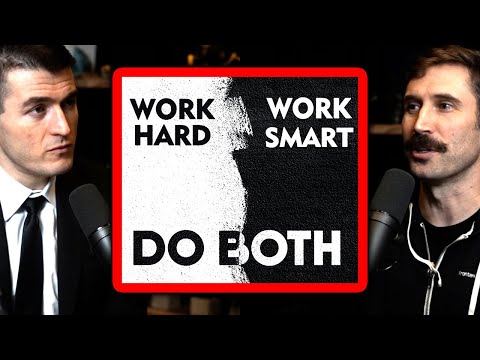
Working Hard vs Working Smart | ThePrimeagen and Lex Fridman
1. Criticism of "Work Smarter, Not Harder"
-
ThePrimeagen begins the conversation by strongly criticizing the phrase "Work smarter, not harder."
- He says his feelings go beyond dislike to "hatred" and explains why:
"This phrase carries an implicit assumption that you already know how to work smart. So you just take the easy path. But everything I've ever done was really hard, and most of the time I didn't even know what I was doing."
- He emphasizes that "the only way to learn to work smart is to work really hard."
"Once you figure out how to work smart, combining hard work with smart work produces much better results."
- He says his feelings go beyond dislike to "hatred" and explains why:
-
Lex Fridman agrees, pointing out that this phrase sends the wrong message:
"This phrase feels like 'if you can't see the easy path, you're a failure.' So many people get frustrated thinking 'I can't find that easy path.'"
2. "Working Smart" Is Impossible Without Effort
-
ThePrimeagen says "you must invest significant time and effort to find out how to work smart."
- He gives the example of excellent engineers, explaining that they too learned "how to work smart" through enormous effort.
"Great engineers don't know how to work smart from the beginning. They found that method through tremendous effort. But later they forget that process and give advice as if they always knew the easy path. 'Just do it this way,' they say. But that's not how it works. Absolutely not."
- He gives the example of excellent engineers, explaining that they too learned "how to work smart" through enormous effort.
-
He uses playing musical instruments and jiu-jitsu as examples, explaining that techniques that look "smart" are ultimately the result of countless hours of effort.
"Learning to move your hands 'comfortably' when playing guitar or piano takes thousands of hours. Jiu-jitsu is the same. Learning to use your body's biomechanics with proper timing and leverage takes a really long time."
3. Growth Through Failure and Frustration
- ThePrimeagen emphasizes that "failure and frustration" are essential parts of growth.
- He describes learning jiu-jitsu:
"While learning jiu-jitsu, for months you keep getting beaten, crying on the bus ride home, getting your ego completely destroyed. But in that process, one night or the next morning, a small realization arrives. That realization becomes a seed and you gradually grow."
- He says this process eventually leads to understanding "the simplicity and beauty of a skill."
"Eventually you realize how simple and beautiful skills like jiu-jitsu, guitar, or piano are. But the journey to that level is really grueling for most people."
- He describes learning jiu-jitsu:
4. Proposing "Work Hard, Get Smart"
- ThePrimeagen proposes "Work hard, get smart" as an alternative to "Work smarter, not harder."
"This phrase is much more realistic and closer to the truth. It's good enough to put on a t-shirt!"
5. Criticism of "The Journey Is Better Than the Destination"
- ThePrimeagen also criticizes the common phrase "The journey is better than the destination."
- He points out that the phrase is logically flawed:
"If you really think about this phrase, it means everything ahead of you from now on keeps getting worse. Why is the journey better than the destination? Shouldn't we celebrate the sense of achievement when we reach the destination?"
- He argues that "Enjoy the journey, celebrate the destination" is a more appropriate expression.
- He points out that the phrase is logically flawed:
6. Satire on "Toxic Positivity"
- The conversation wraps up with satire on "toxic positivity."
- ThePrimeagen references the "painful positivity" he experienced living in California for several years, introducing phrases like:
"Whatever didn't break you today, don't worry -- it'll try again tomorrow."
- He says these satirical phrases actually reflect reality better, drawing laughs.
- ThePrimeagen references the "painful positivity" he experienced living in California for several years, introducing phrases like:
Key Takeaways and Lessons
- "Working smart" only becomes possible after working hard.
- Seeking an "easy path" without effort is the wrong approach.
- Failure and frustration are essential parts of growth.
- Small realizations gained from failure ultimately drive big growth.
- "Work hard, get smart" is a more realistic attitude.
- Only after working hard can you learn how to work smart.
- Both the journey and the destination are important.
- Enjoy the journey, and celebrate the achievement when you reach the destination.
Memorable Quotes
- "The only way to learn to work smart is to work really hard."
- "While learning jiu-jitsu, for months you keep getting beaten, and your ego gets completely destroyed. But small realizations arrive in that process."
- "Work hard, get smart. That's the real phrase we should follow!"
- "Enjoy the journey, celebrate the destination. That's more accurate."
This conversation makes us rethink the deep meanings hidden in simple phrases and revisit the attitude needed for real achievement