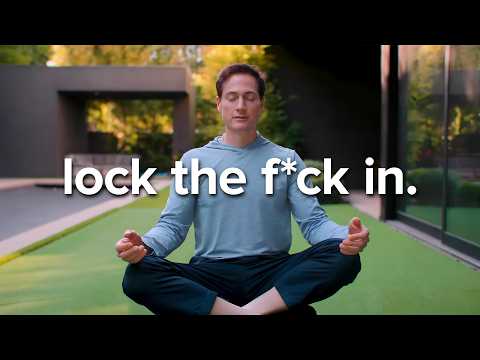
This video goes beyond simply providing motivation to present 8 practical steps for realigning and proactively transforming our lives. The author emphasizes that genuine change comes through 'discipline' and 'self-trust,' not conventional 'motivation.' In a unique format where future 'me' talks to present 'me,' it offers practical advice for deep change across all aspects of life—health, relationships, and mental state.
1. The Motivation Trap: Recurring Helplessness
The video begins by warning about the 'motivation trap' we commonly fall into. When we feel bad, we watch inspirational videos, feel momentarily better, but end up doing nothing—repeating this pattern endlessly.
"First you feel bad so you watch something inspiring. You feel good. Great. And the best part is you do nothing. Repeat."
It emphasizes that this is not a simple motivational or self-improvement video, but aims for 'system-level personal alignment.' Most people are in a state of information overload, excessive stimulation, and biological imbalance. We didn't choose this environment, but how we respond is our responsibility. The video promises to present 8 steps for realigning life through 'a series of principles that actually work'—not motivation or quick fixes.
2. The Truth from Future 'Me': YOLO Is Dead, 'Don't Die'
The video unfolds in an intriguing way—future Bryan Johnson appears to present-day Bryan Johnson. Future Bryan declares that YOLO (You Only Live Once) died in 2026 and 'Don't Die' has begun, saying he plans to achieve immortality by 2039, which shocks the present Bryan.
Future Bryan explains that while the present may feel bleak, it's because life is 'out of alignment.' He confidently says this year, they'll fix it forever.
3. The 8 Steps to Realign Your Life
3.1. Step 1: Do Hard Things
The very first thing to do is 'do hard things.' Change begins when you're willing to endure discomfort and do what's difficult. Most people are stuck not because they don't know what to do, but because they're trapped in 'comfort.'
"Nothing changes until you're willing to accept discomfort and do the hard things." "Most people aren't stuck because they don't know what to do. They're stuck because they're comfortable."
Excuses like "I don't have time," "It probably doesn't matter," or "This is just who I am" are not reality—they're 'stories' we repeat to ourselves. These stories keep us safe but simultaneously prevent growth. The author emphasizes that we have the power to change these 'stories,' and when we choose discomfort for growth, the false stories and excuses lose their power. This is the 'beginning of self-alignment.'
3.2. Step 2: The End Is the Beginning
While typical self-improvement videos start with a perfect morning routine, the author stresses the important truth that 'a day doesn't start when you wake up—it starts the night before.'
"Every successful morning starts with going to bed early."
'Sleep' is the most important starting point for regaining control, clarity, and alignment. Modern society is experiencing a global sleep deficit, which affects everything we do. The author stresses that sleep must be made the 'highest priority' above everything else.
Specific methods for becoming a 'professional sleeper' are presented:
- Finish your last meal at least 4 hours before bed to give your body time to digest.
- Dim the lights, block blue light, and turn off screens.
- Prepare your mind for sleep by reading, walking, doing breathing exercises, stretching, or meditating.
- Go to bed at the same time every night.
When sleep is well-aligned, everything else naturally follows.
3.3. Step 3: Start Your Day with Purpose
The first few hours after waking quietly determine the fate of your entire day. Most people start their day already behind, scrambling, scrolling, and absorbing chaos before even leaving the bedroom. Then they wonder why their lives feel scattered.
"Morning chaos becomes chaos everywhere else. That's why morning routines matter."
Morning routines matter not because they're trendy, but because 'consistency creates stability, and stability gives you the power to command your day.' The author suggests the following morning routine:
- Wake up at the same time every day.
- Get bright light exposure. Sunlight if available; full-spectrum light if not.
- Move your body. Walk, stretch, do breathing exercises. It doesn't need to be heroic—just enough to shift from a passive state to 'present.'
3.4. Step 4: Future-Proof Your Body
Exercise isn't just for today—it's about 'what kind of life you can live at 60, 80, 100.' The body adapts to what we demand of it—or don't.
"Being sedentary, being physically inactive is a disease. There's nothing more important than taking care of muscle health."
Most people treat exercise as a secondary habit for when time allows, but the author says it should be a 'non-negotiable daily practice.' Not for aesthetics or punishment, but for 'capability.'
- Build strength
- Practice mobility and flexibility
- Train your heart to increase VO2 max
All of these are major predictors of 'longevity.' Train now for your future self, maintaining resilience and building a body that carries life forward. This is the difference between 'independence and dependence.'
3.5. Step 5: Treat Food Like Medicine
Food isn't just eating—it's 'medicine' and 'fuel.' Over time, food either becomes our health or our disease. This is one of the hardest areas for people to change—not because it's complicated, but because 'the system itself is working against us.'
"We live in a food environment designed to exploit human weakness." "Additives, sugar, hyper-palatable combinations are designed to keep you hungry and sick."
Ultra-processed foods in the UK and US are associated with approximately 14% of premature deaths. While this isn't our fault, once we know this, 'responsibility' arises and 'awareness demands action.'
The author suggests these eating habits:
- Prioritize 'whole foods' and 'nutrient-dense foods.'
- Consume clean protein, unprocessed carbs, fruits, vegetables, and healthy fats.
- Actively reduce 'ultra-processed foods, added sugars, artificial additives, dyes, alcohol, and smoking.'
3.6. Step 6: Eliminate Distractions
Smartphone addiction, internet gaming addiction, and binge-watching demonstrate that what we repeatedly expose ourselves to shapes our 'physical, mental, emotional, and neurological' state.
"Every input shapes you." "Smartphones are like slot machines in your pocket."
This is 'ultra-processed content'—junk food for the mind. It feels stimulating but ultimately makes us scattered, anxious, and reactive. It actually changes the physiology of the brain, making us all resemble 'ADHD.'
The solution is to 'reduce inputs and strengthen the signal.'
- Set boundaries
- Decide what deserves our attention and what doesn't
- Use tools if needed: usage limits, time restrictions, app blockers, notification disabling
This isn't about disconnecting from the world—it's about 'protecting your clarity.'
3.7. Step 7: Eliminate Isolation
'Chronic loneliness and social isolation' can be as bad or worse for your health as smoking a pack of cigarettes a day.
"Talking to someone actually feels good. It increases positive emotions."
Doing hard things doesn't stop at discipline or routines. One of the hardest things in modern society is 'showing up for other people.' We weren't made to live alone. Loneliness isn't strength—it's 'slowly accumulating damage.'
Humans thrive through 'connection, emotional bonds, being seen, heard, and understood.' Life without connection may seem efficient, but it's 'empty.'
- Prioritize relationships. Be with friends, family, and loved ones.
- Have genuine conversations
- Share meals
- Go for walks
- Laugh together
These moments sustain us and remind us why we're doing all of this.
3.8. Step 8: Stop Watching Motivational Garbage
The final and most paradoxical step is 'stop watching motivational garbage.' Including this video! If you watched this video just to feel inspired and plan to wake up tomorrow as the same person, this video won't help you.
"If you're watching this just to feel inspired and plan to wake up tomorrow as the same person, this video won't help you."
In fact, motivation itself may be what's holding us back—because motivation provides 'the feeling of progress without the cost of change.' So what actually creates change? It's 'Self-Trust.'
"Real change doesn't come from hype. It comes from keeping small promises to yourself. Bit by bit, day by day, building trust, developing capability."
No more grand declarations, New Year's resolutions, or identity overhauls that vanish in a week. If you take just one thing from this video, it should be this:
- Choose one small thing.
- Do it today.
- Do it again tomorrow.
- Do it when it's boring.
- Do it when it's uncomfortable.
- Do it when you don't feel like it.
Repeat this long enough and something shifts. We begin to trust ourselves, and when we trust ourselves, we can do harder things. We can keep bigger promises to those around us and to ourselves. This is 'real effort,' 'alignment,' and 'how we reclaim our identity.' Be the person you can rely on.
Conclusion
This video goes beyond simply inspiring to urge proactive change across all areas of life based on 'self-trust' and 'discipline.' Being willing to endure hard things, fixing sleep and eating habits, reducing unnecessary stimulation, and building genuine relationships. And most importantly, it emphasizes that it's not about grand goals but about consistently keeping small promises every day—through which we can reclaim our true selves and build a better future.