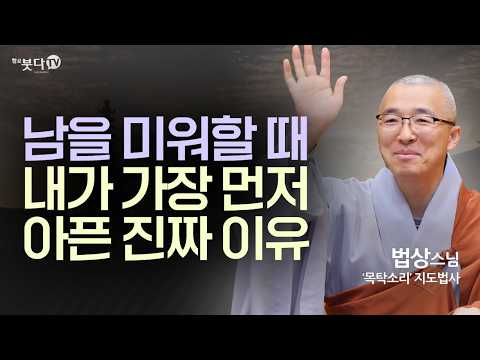
This talk explains that the mind that hates and judges others (discriminating mind) ultimately burns one's own heart first (anger), turning one's life into a prison. The key point is not "force yourself to endure" but rather to see through the illusion of 'I am right / that person is wrong' and to look at the root of discrimination itself. The monk therefore emphasizes that the karma of words, the Middle Way and non-abiding (not settling anywhere), and the attitude of "I simply don't know" are what make life light and free.
1. Even Saying "I Have No Desires" Can Itself Be a Desire: Don't Reveal Your 'Form'
The monk begins by reading a passage from page 96 of a book. It addresses lines like "I have few desires," "I know contentment," "I like to go off alone," or "I don't enjoy filth" — and says don't go out of your way to declare that you are like that. Because even though such statements look like practice on the surface, there is often a desire to show off hiding behind them.
"Do not say that you have few desires." "Do not say that you know contentment…"
The monk points out that the very mind that says "I have no desires" while subtly wanting to be noticed is already greed (attachment).
"You are proud of having few desires. You want to show it off, to put your 'form' on display. That mind itself is already greed."
A truly desire-free person, he says, doesn't live by mentally checking "do I have desires or not?" — they simply live naturally, without constructing a form (a self-image: 'I am this kind of person').
"They just live. That is what truly having no desires looks like. That is what truly having no form looks like."
2. Language Cuts and Distorts Reality: Why Words Always Carry a 'Fault'
The monk then gives a lengthy explanation of the limits of language. Words are not a tool that conveys reality as it is — they are a tool that limits, interprets, judges, and discriminates reality.
"Language and concepts… limit reality as it is, and serve to interpret, judge, and discriminate in one's own way."
He goes so far as to say that in "the place of truth," language is in principle unnecessary. But since we cannot avoid using language in the world we live in, he continues by saying we must use this imperfect tool carefully.
Also, words are not transmitted as you intend them. The same sentence is received completely differently by different people.
"I said this with this intention, but the other person… the meaning contained in it is different for everyone."
The monk says he deliberately uses "provocative analogies" like politics and religion to illustrate this point. Because the moment you bristle is precisely an opportunity to realize that you are already extremely in the grip of a particular position.
"At that moment, tell yourself: 'Ah, I dislike this so much my teeth are grinding…' That clearly reveals that you have fallen into an extreme."
And he drives home a core maxim: there is nothing absolutely right or absolutely wrong in the world.
"There is nothing in the world that is absolutely right or absolutely wrong."
3. Why We Speak Most Carelessly to Family 😓: 'Unnecessary Words' Create Karma
The monk cautions against the habit of blurting out words driven by impulsive frustration — things that were perfectly fine left unsaid. He says this happens most often in family relationships.
"This could have been said or left unsaid… but you say it just to get it off your chest. And where does that happen most? It happens most in family relationships."
He gives the example of speaking sweetly to others in public while easily saying hurtful things to the people closest to you at home. The image of a voice suddenly turning gentle when a phone call comes in — even in the middle of a fight — is a relatable analogy for anyone.
"Even in the middle of a fight with your spouse, the moment the phone rings you suddenly sound sweet, as if nothing happened."
The monk says that family is the relationship we are bound to for the longest time, so the karma of the words and actions we create in that relationship ultimately represents our relationship with the entire universe.
"What the karma between you and your family looks like… that represents the relationship between you and the universe."
And here an important declaration comes:
"Words… once you just throw them out, they carry power."
4. Words Become Rumors and Create 'Reality': The Mechanics of Group Conflict, Gossip, and Distortion
The monk says that when running a temple or any organization, a decision that splits opinion fifty-fifty will leave someone feeling hurt. Most people will let it go with "it happens," but if someone starts attacking with words charged with anger, something that was originally no big deal can suddenly transform into a massive problem.
"Something that would have been fine if left alone… once expressed in words, it morphs into something that seems terribly serious."
He also gives examples of how easily everyday conversations become distorted as they pass from person to person. A remark that a child is easily distracted can, after passing through a few households, turn into "I heard that child has mental problems."
"After it passes through two or three houses, it becomes 'I hear that child has mental problems'… it gets misunderstood and passed along like that too…"
There is also the scenario of saying "just one little thing to fit in," and that becoming a rumor that destroys a relationship.
"If I'm the only one saying my husband is great, I look like a show-off… so I joined in badmouthing husbands too." "Then the story goes around: 'That household is having marital trouble too'… that's how rumors can spread."
The monk discusses how, like celebrity gossip, once something is stamped as a "problem," a single line of clarification later cannot undo the damage — and concludes that words are not merely sounds but karma that draws results.
"That's what karma is. It carries power… it draws results." "Only by taking responsibility for your words does it dissolve."
5. The 'Need to Display' Good Deeds and the Purity Complex: Outward Emphasis Is Sometimes a Cover for Insecurity
Following the flow of the scripture, the monk says that even when you do good deeds and act virtuously, it is better to keep them hidden. The moment you reveal them, a form of 'I did well' is created.
"When you do good deeds and virtuous acts… it is better to hide them. Better not to reveal them. The very act of revealing them is 'form.'"
He also gives the example of religious communities that place an excessive emphasis on "we must be pure, we must be holy," explaining that such compulsion can actually be a mechanism to cover inner anxiety (a complex about not being pure enough).
"When one is psychologically not that pure… they overclaim 'we must be holy' in order to conceal it…"
This leads to the conclusion that a "truly fine person" doesn't feel the need to advertise or show off.
"Someone who is truly good… doesn't feel the need to reveal it."
6. "All Calamity Comes from the Mouth": The Words of Discrimination, Ego-Form, and the Sweetness of Gossip 🔥
The monk reads out some very strong passages directly:
"All calamity comes from the mouth." "Just as a raging fire burns down a house… words become fire and burn one's own body." "One's own unfortunate fate begins from one's own mouth."
He then explains, drawing on Buddhist mental structure (consciousness), why conversation constantly drifts toward self-promotion or criticizing others. Words are essentially a tool that concretizes discrimination, and at the base of that lies the habit of placing 'I' at the center. The monk unpacks this through the concepts of sixth, seventh, and eighth consciousness (technical terms, but the gist is: "beneath what you say lies an unconscious self-centeredness").
- Sixth consciousness (surface discrimination): judgments of right/wrong, correct/incorrect
- Seventh consciousness (deeper self-attachment): subtle self-promotion, the sense of rising by putting others down
- Eighth consciousness (storehouse of karma): repeated habits accumulate like seeds and become automatic reactions
The workings of the seventh consciousness are described memorably. Since openly boasting is distasteful, the easier method is to tear down admirable people.
"A less blatant way of putting yourself forward… is to tear down someone who is more decent than you." "If you insult a truly excellent person… you get the illusion that you are even more excellent than they are."
He also notes the bitter reality that conversations bond well when there is a common enemy to criticize together.
"When there's a shared enemy fixed in place… everyone joins in criticizing them."
A practical tip also comes up — "don't brag about your children" — because it triggers comparison and a sense of deprivation that easily damages relationships.
"If you go on bragging about your children… the other person feels relative deprivation and comparison, which makes it even more off-putting."
7. Anger Destroys Merit: Greed, Anger, and Delusion (貪瞋癡) Are Another Name for 'Discriminating Mind'
The monk emphasizes the danger of anger with the following passages:
"Anger is more fearsome than a savage fire." "There is nothing greater than anger as a thief that destroys merit."
He then summarizes Buddhism's core three poisons — greed, anger, and delusion — not in complex terms but simply as "the mind that divides into two (discrimination)."
"The cause of suffering is discriminating mind… dividing into two." "The mind that divides into two is delusion (ignorance), and when you divide into two, greed and anger arise."
There is one more key point here. He states that even hating and pushing away is a form of desire. We normally think of desire only as "wanting to have," but "wanting to eliminate" has the same structure.
"Someone you can't stand… you want to eliminate them from your life… this too is desire." "The desire to pull in, the desire to push away… that is greed."
In other words, the mind that hates someone may look like pointing a blade at the other person, but in reality it is a fire (anger) that ignites first within oneself, burning one's own merit and peace first. (This is why, as the title says, "you hurt first.")
8. The Middle Way and Non-Abiding (無住): Buddhism Is Not About Imposing 'Right Answers' but About Breaking Down Discrimination
The monk speaks at length about how people pressure others to take a clear side — "left/right," "us/them," "good/evil" — whether in politics, religion, or anything else. He even mentions receiving demands that "the monk should openly declare his political leaning."
"Why must the world operate by dividing into two?" "Make your identity clear… breaking that apart is mind practice."
He explains the Buddhist concept of the Middle Way not as "a compromise blending both sides," but as questioning the very framework of "absolutely right/absolutely wrong" from the outset.
"Buddhism always says to practice the Middle Way. Don't lean toward either extreme…"
He also speaks of an era when spirituality (awakeness to truth) matters more than the outer shell of religion, and sees humanity moving toward an age of integration that becomes aware of interconnection (dependent origination) rather than dividing and fragmenting.
"The whole world is connected as one." "When others die, I die too. When I help others, I am helping myself."
9. This Is Not "Endurance Practice": Without Seeing the Root, It Just Repeats
The monk points out that many people misunderstand Buddhism as training to forcibly endure "don't be greedy, don't be angry." But the heart of Buddhism is not "endure" — it is insight into the root ('I'-attachment) from which those minds arise.
"What Buddhism is saying is not to forcibly endure." "The root that produces the three poisons of greed, anger, and delusion is 'I'. Without removing the root… can it be done?"
Just as cutting leaves only brings them back in spring, pressing down anger on the surface while leaving the root intact means it will repeat.
"If you dislike the leaves and cut them all off… the root is still alive, so how can it be removed?"
The monk gives the example of Venerable Beopjeong's non-possession, saying that even this becomes another attachment if you cling to "non-possession is the only right way."
"Non-possession is the Buddhist life… that is abiding in non-possession." "Not abiding in possession and not abiding in non-possession — that is the practice."
Through a lucid dreaming analogy — if you know it's a dream, you don't burn with guilt or jealousy whether you dream of being rich or poor — he explains that understanding emptiness (空) makes life lighter.
"Once you know it's a dream… being rich is no problem and being poor is no problem."
10. What It Means That Buddhism 'Does Not Bind People': Using Expedient Means as Expedient Means
The monk shares an anecdote about someone who had become exhausted by excessive volunteering in another Buddhist organization, and so came to his dharma gathering fearful that they would "be expected to do something again." But when the gathering ended, no one held them back, and they were even told "we have enough volunteers, you don't need to do anything."
"What on earth do they want me to do?… Please, give me a homework assignment."
People want clear guidelines, but the monk says such guidelines are only expedient means (temporary tools), and that true wisdom is knowing how to break even those means when you have gotten close enough.
"Expedient means are just that — temporary. Once you get close enough, you need to know how to break them."
He also cautions against the way religions hold people and generate fear to prevent them from leaving (insularity).
"What is the number one sign of a cult? Binding people." "Not blocking those who come, not chasing those who go. That is true Buddhism."
He makes a personal admission that monastic life means "entering in search of freedom, yet simultaneously being bound by the eyes that the robe (monastic habit) invites," and uses the tradition of ancient Seon masters traveling from teacher to teacher as an example of non-abiding (mushu) as Buddhism's core.
11. The Moment Blame of Others Disappears: "Everything That Happens in My Life Is a Manifestation of Myself"
Reading a scriptural passage, the monk says that when conflict arises in the home, one should "not blame others but look for the cause in one's own mind and actions."
"Do not blame others. Look for the cause in your own mind and actions…"
Here he says that when you do mind practice, the very first thing to disappear is blaming others. Because 'others' don't exist separately — within the interconnection (dependent origination) where all of life is one, everything is a manifestation of "oneself."
"When you practice, the first thing to disappear is blaming others." "Your entire life is, as a whole, yourself. The whole universe is one single self — who is there to blame?"
Even if someone criticizes you, there is an entanglement to be resolved that has caused them to appear in your life — and so you stop fixing events as purely the fault of something outside.
"What is inside you is what appears."
12. Is 'The World I See' Real? The Same Subway Car Can Be Hell or Heaven
The monk says we are firmly convinced that "real objects exist out there," but in reality the world is constructed differently according to each person's conditions and interpretations. Just as humans see only visible light while insects can see ultraviolet and infrared, you cannot determine that "only what I see is real."
"Can I say that what I see is real? I'm only seeing a limited world."
A very practical example follows. Even inside the exact same subway car, one person whose life feels unbearably painful sees it as hell, while another person on the day love has just begun sees everything as beautiful.
"For one person it is hell… everything they see looks like hell." "And for someone else, wouldn't every little thing people do look beautiful?"
The conclusion: the world is not a single objectively fixed mass, but a 'world I have drawn' — filtered and colored by one's own discrimination.
"The world interpreted through your discriminating mind… it is the world you painted." "You spend your whole life trapped in that world you created, unable to escape."
13. When Trapped in Thought, Choices Disappear: 'Cognitive Constriction' in Workplace Pressure, Gaslighting, and Crisis
The monk says that when discrimination and fixed ideas intensify, cognitive constriction sets in and one's field of vision narrows. He describes cases where someone gripped by the belief "if I leave this company I'm finished" cannot see the option of "leaving," and makes an extreme choice.
"I can't leave the company… but staying feels like it's killing me, so I choose death."
He also gives the example of someone who, after years of gaslighting in a violent marriage, has had the belief "if I leave I'll die" hardened into them — unable to get divorced and feeling hopeless.
"You only live because of me… the moment you leave you'll be homeless." "They believed that thought. 'It seems I can't leave.'"
But the monk says that when conditions actually change, people ultimately call forth the wisdom and survival instinct to live, and asks: "Can you be sure that thought is true?"
"Can you be certain?" "When conditions change, people adapt accordingly."
14. The Concluding Key Is "I Simply Don't Know": When You Let Go of Certainty, Life Appears 'As It Is'
Finally, the monk pushes the Middle Way to its core: "there is nothing absolutely correct." What kind of place is the world? What kind of person am I? What does the future hold? — in truth, we don't know, and that is what is true.
"I know nothing. That is the truth. I simply don't know."
And he cites a very clear statement:
"Knowing that you don't know — that is said to be enlightenment…"
Once you are in the place of "I simply don't know," the desire to manipulate things as good or bad weakens, and you come to allow life in its entirety. At that point, he explains, dharma (truth) is not somewhere separate — it reveals itself as "this present reality, just as it is."
"You stop trying to manipulate things according to your own will." "Everything visible, exactly as it is, is all dharma." "Life is complete as it is… just as it is."
And so the monk concludes that from the place where discrimination has been shed, "every day is a good day." Not a good day in comparison with bad days, but a 'goodness' that is whole, beyond like and dislike.
"When you don't discriminate… beyond good and bad, it is just good as a whole."
The ending is brief and decisive:
"That is all I will say for today. May you succeed."
Closing
The practice this dharma talk describes is not a technique for enduring hatred, but the work of noticing the discrimination, certainty, and ego-form at the base of where hatred arises — and escaping the "prison of one's own making." It repeatedly emphasizes in particular that words become karma and return to your life, and anger burns your own merit first. In the end, the single key to making life lighter is this: "I simply don't know" — and from that humble place, true freedom begins.