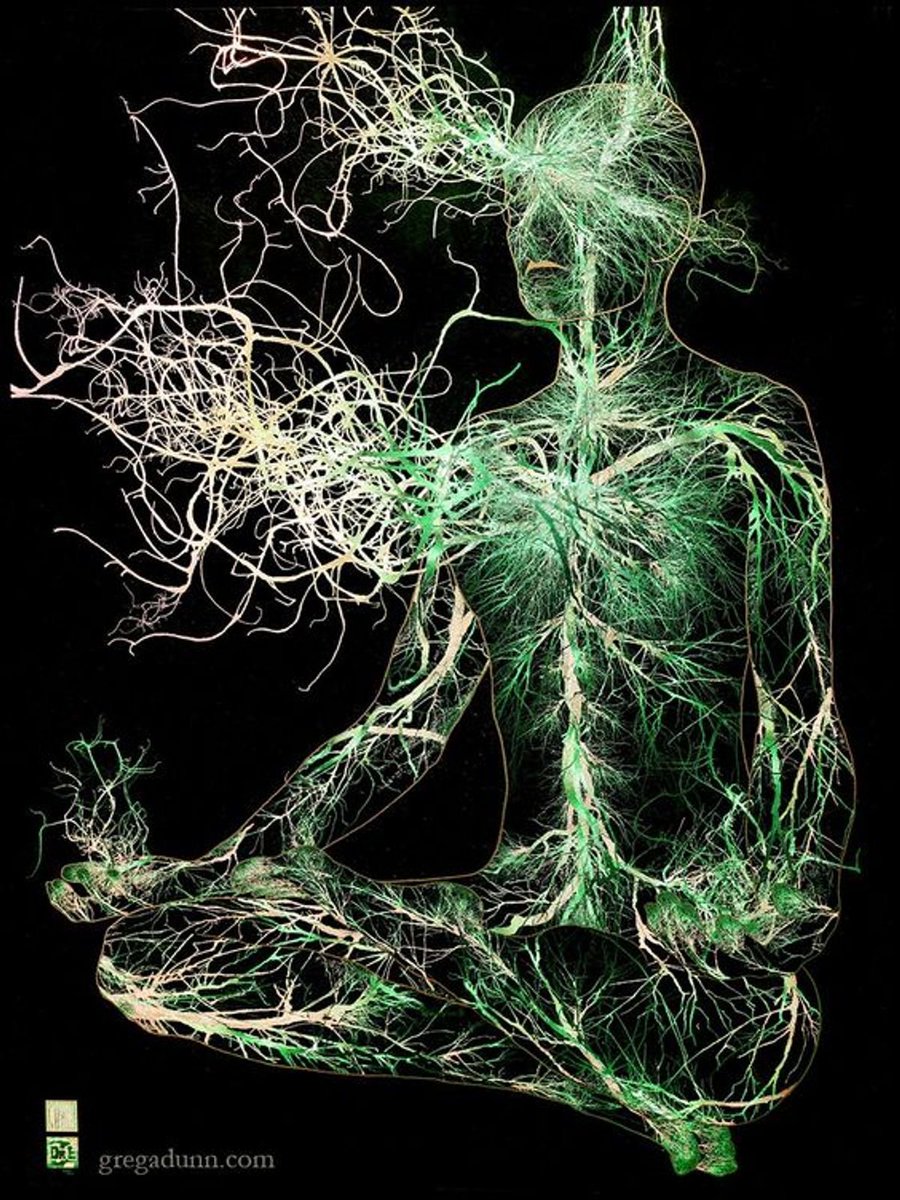
The claim is presented that anxiety cannot be resolved simply by correcting thoughts. The emphasis is that anxiety's fundamental signaling problem can only be resolved when we redirect attention to the sensations of the entire body, particularly the brain's neural networks. The most important message of this piece is that breaking the vicious cycle of anxiety requires not thought correction, but neural network rerouting.
1. Anxiety: Focus on the 'Signaling System,' Not 'Thinking Errors'
In the opening section, the author makes clear that anxiety is not a 'thinking problem' but a 'signaling problem'. For a long time, we have addressed problems like anxiety and depression through 'cognitive distortions' -- correcting faulty thoughts. But the key point is that simply changing thoughts doesn't stop the brain and nervous system from overreacting.
"Anxiety isn't a thinking problem -- it's a signaling problem. We've spent years focusing on correcting distorted thoughts, but all the while, the nervous system has remained on high alert."
While cognitive distortions like 'catastrophizing' are certainly important, they are just the tip of the iceberg -- beneath them lies a more complex web of brain neural networks and body systems.
2. The Brain's 'Default Mode Network (DMN)' and the Mechanism of Anxiety
The author explains that in an anxious brain, the Default Mode Network (DMN) becomes fixated on 'prediction.' The anterior cingulate cortex continuously searches for errors, and the amygdala interprets even ordinary everyday events as dangerous.
"The Default Mode Network (DMN) becomes fixated on prediction, the anterior cingulate cortex keeps scanning for errors, and the amygdala flags even routine events as threats."
In this state, we are not 'acting' but merely 'reacting'. That is, we cannot intentionally do anything ourselves and simply respond passively to situations.
"In this state, we're not acting -- we're just reacting."
Overthinking and cascading worries are also the result of these brain neural networks. This phenomenon is closer to a 'symptom,' not the cause of the problem.
"Overthinking is a symptom, not the real problem."
3. The Answer Is Not 'Thought Correction' but 'Neural Network Shifting'
Simply recognizing that your thoughts are distorted is not a clear solution. Rather, the author argues that you must switch the brain's active network itself to escape the trap of anxiety.
"Clarity doesn't come from recognizing that you're catastrophizing. It comes when you shift neural networks."
An effective method is redirecting attention to whole-body activities like walking or drawing. Through these activities, the brain shifts from the Default Mode Network (DMN) to the sensorimotor network (sensorimotor/SN).
"When you redirect your attention to whole-body activities like walking or drawing, your neural network shifts from the DMN to the sensorimotor network."
When this shift occurs, the unconscious loop of worry breaks, and the brain settles into a more predictable yet comfortable rhythm across life.
"Then the brain stops ruminating and overthinking, and moves through life predictively and harmoniously."
4. Discussion and Practical Advice: Use the Body's Changes
The author's tweets received many empathetic responses and questions.
- One user emphasized that "Anxiety is not a problem you can think your way out of -- you need to move your body to move your mind too."
- Another commenter expressed the view that "you shouldn't try to silence overthinking, but change how the mind makes predictions."
"You can't solve this by silencing overthinking -- you need to change how the mind makes predictions."
Effective methods repeatedly recommended include focusing on the body through the senses, meditation focused on deep breathing, and actually moving the body. These are introduced not as mere theory but as strategies anyone can practice.
"In summary: stop thinking, feel, and act. To calm the limbic system (the emotional processing center), don't pour energy into thoughts -- reconnect with your body. This perspective changes everything."
"Meditation, especially breath-focused meditation, helps enormously."
5. Diverse Reactions: Brain, Medication, Energy, and Artificial Intelligence
The conversation also included diverse interpretations and additional discussions about anxiety.
- The view that medication side effects or withdrawal symptoms can contribute to anxiety,
- A philosophical comment that "anxiety is desire trapped in the body,"
- The technological application that "AI therapists can actually change how the mind makes predictions,"
- And even the intriguing perspective that "robots may also experience anxiety in the future."
These diverse discussions demonstrate that anxiety should be treated not as mere theory but as a real phenomenon encompassing neuroscience, pharmacology, technology, and everyday experience.
In Closing
This article presents the important perspective that anxiety should not be seen simply as the result of faulty thinking, but rather we need to understand how the entire brain and nervous system send danger signals. Don't forget that rather than struggling to change your thoughts, shifting your neural networks by moving your body and redirecting attention to the sensory world is the key to escaping the quicksand of anxiety