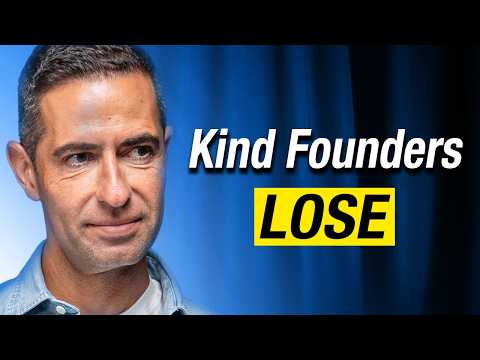
This is a summary of a conversation between AppLovin CEO Adam Foroughi and Harry Stebbings of 20VC. Adam shares deep insights on entrepreneurship, life as a CEO, AppLovin's success strategy, and the impact of artificial intelligence on business. Particularly striking are his candid views on how monetary motivation shifts over time, how he navigated the 2022 stock collapse, and where he believes companies must head in the age of AI.
1. The Founder Mindset: Chasing Wins 🏆
Adam Foroughi argues that the most important quality in a founder is chasing victory. He explains that being consumed by fear of failure causes you to miss critical opportunities and prevents you from realizing your full potential.
"I think anyone who's experienced success should almost only be motivated by winning. If you're gripped by fear of failure, you'll be almost trapped. You won't take meaningful risks, and you'll be defending the downside rather than pursuing the upside. I don't think that's what true entrepreneurship is."
He reflects on starting his business from nothing, knowing there was a 99.9% chance of failure, and how the drive to win was the core engine throughout that process. He adds that truly successful people ultimately draw their motivation not from money but from personal growth, development, and learning — because money eventually reaches a point where it stops being motivating, and lasting drive must come from other values.
2. The CEO Mindset: Pursuing Value Over Money 💰
Adam reveals that when he co-founded AppLovin he was already financially stable, so there was no pressure to make money from the business. He explains that this mindset was a key reason he was able to choose long-term company growth when an offer came in 2015 to sell for hundreds of millions of dollars in cash.
"I didn't need anything financially from this business. What's interesting is that when we were growing, in 2015 we received an offer to sell the business for hundreds of millions of dollars in cash. If I hadn't experienced success before, cashing out at that point could have been very attractive."
3. CEO Compensation and Its Hidden Burdens 💼
When the topic of Adam's total 2023 compensation — $83 million, making him the eighth-highest-paid CEO in the United States — came up, he explained the context and rationale behind CEO pay that most people don't understand. Specifically, at the bottom of AppLovin's 92% stock collapse in 2022, he asked for compensation for the first time, structuring it so that he would only receive it if the stock recovered above a certain threshold, aligning his incentives tightly with investors.
"At the 2022 bottom I decided to ask for compensation for the first time. The reason was that I felt bringing this company back was a massive undertaking, and I wanted to align myself with investors so that I'd only be compensated if the stock recovered."
He emphasizes that the CEO role is extraordinarily lonely and stressful, often requiring significant personal sacrifice, and that fair compensation for CEOs willing to make those sacrifices is justified.
4. Lessons from the Stock Collapse 📉
Even amid the extreme crisis of a 92% stock decline in 2022, Adam maintained an unshakeable conviction and led the company through it. While many people worried about him personally, he actually used the moment as an opportunity to overhaul the company's entire technology stack and make the bold decision to build a new AI-driven recommendation system from the ground up.
"At the 2022 bottom we were using a previous generation of machine learning, and we decided to throw out our technology entirely, rebuild it, and move to truly state-of-the-art recommendation system technology. Doing that was a major internal transformation."
In the process he made the difficult decision to replace staff who were comfortable with the old systems, rebuilding the team around "A-players" who aligned with the new vision. That decision looked risky at the time but ultimately drove AppLovin's stock recovery and dramatic growth. He stresses that even in crisis, retaining and motivating core team members is essential.
5. Workforce Restructuring and a "Doers" Culture in the Age of AI 🤖
Adam argues that today's large-scale layoffs across the industry have more to do with excessive pandemic-era hiring than with AI efficiency gains. AppLovin, however, had already begun preemptively restructuring its workforce years earlier by identifying roles AI could automate.
"If we identified a role that AI could automate, or determined that AI wasn't being adopted fast enough in a given department, we thought it was time to let those people go and rebuild the organization as if we already knew what technology is available today."
The biggest changes came in HR and creative production. He restructured the entire company around "doers", eliminating unnecessary process and management layers. This has made AppLovin an extraordinarily efficient organization with over $10 million in EBITDA per employee. He notes that the main reason other CEOs fail to build this kind of doers culture is that unwinding a bloated organization is simply hard once it exists.
"We have our CTO Giovanni constantly asking 'Why do we have this process?' and 'Why do we have these people?' — reminding us how important the 'Why' question is. We've slimmed every organization down to doers."
6. The Problem with Stock-Based Compensation and a Smarter Pay Strategy 💹
Adam raises the issue of excessive stock-based compensation (SBC) becoming a growing problem in the software industry. When stock prices fall, companies with heavy SBC exposure can enter a vicious cycle of talent flight and shareholder dilution. After the 2022 collapse, AppLovin changed its policy so employees receive only 10–15% of their compensation in stock, with the remainder in cash.
"One problem with stock-based compensation, especially when software company stocks have fallen recently, is that a downward spiral forms. Suddenly the company was burning 3% of equity per year in stock, and when the stock drops 66%, that becomes 10%. That's a dilution level that's extremely hard to recover from."
He explains that this approach relieves employees of the burden of stock price volatility while also protecting the company from unnecessary share dilution. He believes cash flow minus SBC is the most important metric for assessing company value.
7. Engineering and Value Creation in the AI Era 💡
Adam says AI is dramatically increasing engineering productivity, estimating that 80–90% of AppLovin's code is now AI-generated. But he stresses that simply generating a lot of code with AI isn't the point — the focus must be on creating value.
"What matters is whether your engineers are capable enough to use these tools to accelerate value creation for the company. And whether you can measure that."
AppLovin has no product organization — engineers themselves take on the product manager role and build directly toward business KPIs. He credits this structure with enabling the company to create value most effectively through AI. He warns that many companies risk accumulating token costs without producing real results by deploying AI without clear KPIs attached.
8. The Risk of Depending on External LLMs and Building Your Own Models 🚧
Adam warns that startups building interfaces on top of large language models like OpenAI's may face existential threats in the future, since LLM providers can easily commoditize or absorb them. AppLovin focuses primarily on its own recommendation system models, which go beyond simple LLM dependency and require proprietary, highly specialized technology.
"If your business is building an interface on top of a large language model, I'd be very, very nervous. Watching great companies like Anthropic launch their own products on top of their own models — that's genuinely dangerous territory."
9. Unconventional Management and Thoughts on Mentorship 🤔
Adam operates with a management philosophy that departs sharply from convention — he holds almost no mentoring sessions or one-on-one meetings. He believes truly capable people figure things out themselves and works to provide an environment where people operate autonomously without unnecessary management overhead.
"For anyone on my team — anyone who reports directly to me — I never do one-on-ones. I don't do reviews. If I don't like what they're doing, they'll find out in real time through chat. If I like what they're doing, they don't need to know. They know I respect them and that they're doing well. Capable people generally don't need that kind of hand-holding."
Instead, he keeps all communications logged — via Slack, recorded video calls, and similar tools — so new employees can use AI tools to learn independently and find the information they need. He frames this as the most effective way to develop autonomous talent in the AI era.
10. Public Speaking and the Importance of Delegation 🎤
Adam used to be afraid of public speaking. After the 2022 stock crash, he recognized the need to clearly articulate the company's vision to investors, and he began pushing himself to speak in public — uncomfortable as that was.
"I always had a fear of public speaking. I'm introverted and didn't want to put myself out there. But when I realized we were operating on a bigger stage and the company was growing, I understood we needed to go out and help people understand what we're doing."
He also describes learning to let go of his habit of controlling everything and embracing delegation. When his CTO Giovanni took over the product responsibility Adam had held for ten years, he was finally free to focus on long-term strategic thinking and external engagement.
"Giovanni took the product role from me that I had run and owned for ten years. And that was really good, because now I can see what the team is doing without getting caught up in the details. It gave me the freedom to do much more strategic thinking about long-term business strategy."
11. Short Sellers and the Dark Side of Market Manipulation 😈
Adam shares AppLovin's experience of being targeted multiple times by short sellers following its sharp stock run-up. He points to the structural problem of short sellers publishing exaggerated reports to frighten investors into selling, driving the stock down, and then buying back shares for profit — all while facing no accountability for misinformation, unlike the companies they target, which operate under regulatory scrutiny.
"I have a problem with the way short sellers operate in today's markets. There's no downside for them to manipulating the market or spreading false information. They can put out sensationalized, dramatic reports that scare investors into selling their shares."
For AppLovin, these attacks were a crisis but also an opportunity to communicate the company's value externally. Team members responded with pride in the company's technology, and leadership strengthened its communication with investors and the market.
12. Constant Self-Doubt and Conviction About the Future 🔮
Adam admits that no matter how successful he becomes, he wakes up every morning asking himself, "Could the company fail today?" He says this anxiety actually serves as a powerful motivator, driving constant innovation and progress. He believes AppLovin can only survive in the fiercely competitive advertising market by never resting on its laurels and always pushing forward.
"I always have doubts about whether what we've built is real, whether what we're building will last, whether what we're building will truly become something enormous. That fundamental 'fear of collapse' is one of my biggest motivators."
13. How AI Advancement Will Impact SaaS Companies 📊
Adam predicts that the rapid advancement of LLM technology will pose a serious threat to traditional enterprise SaaS companies. The pace of AI development makes the future hard to predict, which will cause investors to hesitate before committing to SaaS businesses. He warns that many SaaS companies have already entered a downward spiral and must dramatically strengthen their competitive position and maximize efficiency to survive the AI era.
"The pace of product launches in the large language model space is so fast that many traditional enterprise SaaS companies will face unpredictable outcomes. This will compress valuations and cause investors to pull back."
14. Balancing Parenthood and Entrepreneurship 👨👩👧👦
As an entrepreneur with children, Adam speaks candidly about how difficult it is to balance personal life with professional success. Performing at the highest level requires focused dedication to specific goals, and that inevitably means falling short in other roles — as a parent or a spouse.
"To become truly good at something as a human being, you need to focus on it and put in enormous effort. I, at least, am not good at multitasking. Being a parent is genuinely hard. So if you're running something as a founder and you want to be the best, you have to prioritize that. And the moment you do, being a parent, being a spouse, being a good person in your personal life naturally gets deprioritized."
He reflects with regret on moments when he was so absorbed in work that he wasn't truly mentally present with his children, and says finding balance remains a lifelong challenge.
15. Reflections on Entrepreneurship and Leadership 🗣️
Adam says he hasn't fundamentally changed his thinking over the past twelve months. He believes today's outcomes are the product of past decisions, and that today's actions will shape tomorrow's results.
"When I hit the bottom in '22, I started looking out three to five years and planning from there, working backwards. And I think what happens in any given twelve-month period is defined by decisions we made in the past."
He also comments on boards, arguing that the best people must occupy those seats. He mentions handing off the board chair role to Craig Billings so he could stay focused on running the business.
On the topic of founders angel investing, Adam is skeptical. Investing requires selling company shares, which distracts from the primary mission. He says his ultimate goal is to make AppLovin as great as it can possibly be, and that demands dedicating all of his time to exactly that.
Finally, he discusses his aggressive leadership style — acknowledging it can feel uncomfortable for some people, but arguing it is essential for eliminating wasted time and moving fast. He believes kindness can slow things down, and that moving forward without second-guessing yourself is what matters most.