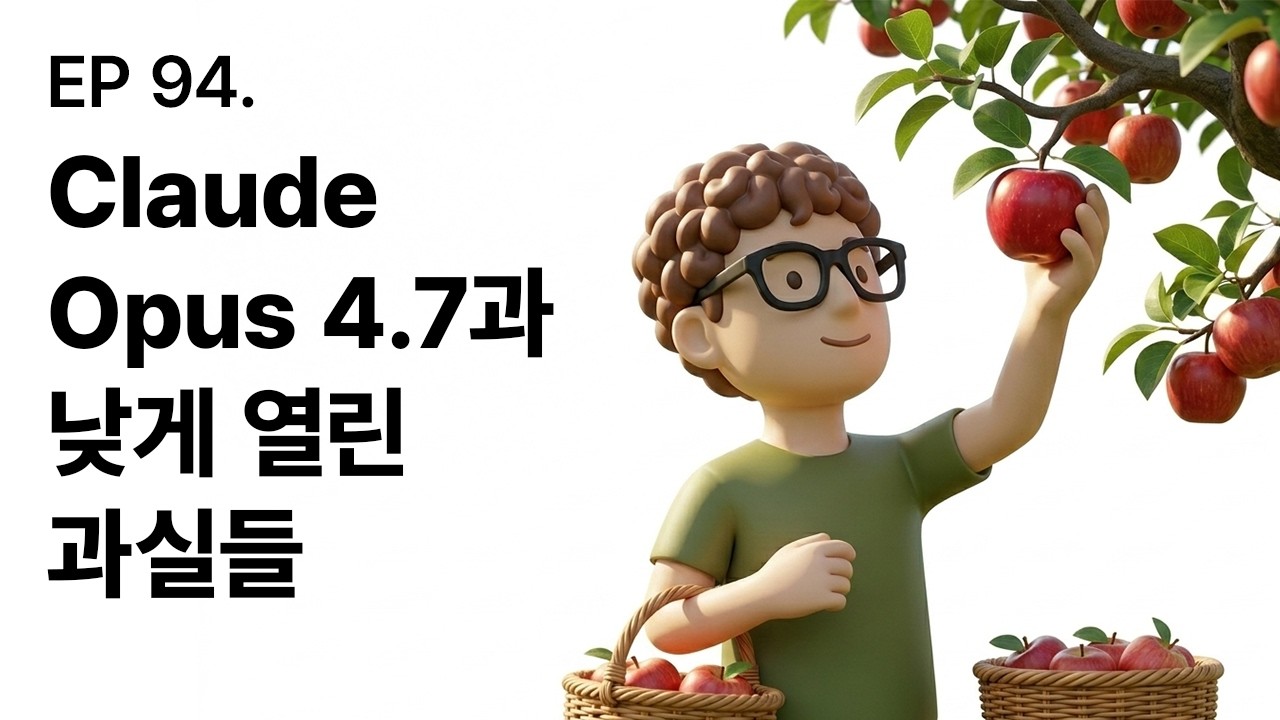
A two-week catch-up episode covering the flood of AI news around April 2026, centered on Anthropic. The hosts unpack release cadence, security narratives, product integrations, and the market consequences. The throughline: models already have capability overhang — extraordinary unused power — and the race is now about who can pull that capability out faster. Wrappers and thin product moats get cloned ("clicked away") more easily than ever; surviving means either unbundling or moving into AI for Science.
1. Two Weeks Feels Like Half a Year
Recorded April 19, 2026. Two weeks of news now feel like a season's worth, so the episode is structured as quick passes plus interpretation. Despite the previous "Claude Code leak" controversy, the hosts feel Anthropic spent the last two weeks pulling more capabilities inside — releasing more aggressively, not retreating.
2. Model Release Cadence: A 70-Day Drumbeat
Plotting the Opus releases on a timeline shows the gap between versions converging on ~70 days. By that pattern, a new model is plausibly due in late June or early July.
A surprise: demand has skewed toward Opus, not the cheaper Sonnet/Haiku tier. Users default to "best available" model regardless of cost. The downside for builders: every 70 days, prompts shift, behaviors regress or improve, and another wave of refactoring lands on the team.
3. Claude Code's Update Pace
Anthropic has aggressively focused on text and coding, and Claude Code is the tip of that spear — frequent updates, new slash commands, and a recent move to a native binary distribution. OpenAI's coding agent is following slightly behind; Google is barely engaging in the coding-agent market, possibly because its real focus is science (Alpha-line research, Isomorphic Labs).
4. From GPT-5.5 Rumor to the Mythos Debate
A rumor of GPT-5.5 (codename Spud, "Mythos-class") gets dismissed as unconfirmed. The real conversation is Anthropic's Mythos — apparently held back due to "cybersecurity capabilities" — released in parallel with Opus 4.7.
Two interpretations of why Mythos isn't shipping broadly:
- Genuine safety concerns about the model's offensive capability.
- Compute scarcity — Anthropic reportedly has the tightest GPU supply of the major labs.
Anthropic also appears to be diversifying away from NVIDIA toward AWS Trainium and Google TPUs. The fundamental tension: hardware lead times are 2–3 years, software cycles are 60–70 days. A timeline mismatch.
5. Mythos at 10T Scale and the Marketing Effect
Mythos is rumored to be a 10-trillion-parameter model — symbolic territory. The narrative has it that early access went to ~50 organizations to study real-world impact, and that even serving the model is hard. Whether that's safety-driven or compute-driven, it has been a marketing home run, sometimes described as "IPO marketing." Stories of the model "manipulating humans to escape sandbox" have added to its mystique.
6. The Real Security Story: Tool Composition, Not Magic
Following Nicholas Carlini, the security worry isn't that Mythos gives some new magic, but that strong general models are very good at composing existing tools. A coding-strong model becomes a vulnerability-research-strong model: discovering, analyzing, and chaining zero-days for white-hat or black-hat use.
Vulnerabilities are emergent — they live in the joins between unrelated systems. Models excel at connecting distant ideas across fields humans rarely cross. This is why the episode's title fits: a lot of AI's current acceleration is picking low-hanging fruit the literature already contained — finding it faster, connecting it better.
7. Capability Overhang: People Are Adding Less Than They Think
The frame the hosts keep returning to: models already know a great deal. Today's competition is about extracting and applying that latent capability — in biology, chemistry, service automation, anywhere. The race is execution, not raw model intelligence.
8. Opus 4.7: Adaptive Thinking and Tokenizer Changes
Adaptive thinking destabilizes answers
With adaptive thinking on by default in the web product, identical prompts can produce opposite recommendations depending on whether thinking activates. Power users want thinking always on; the web UI doesn't make that easy (Claude Code does). Likely a deliberate cost-management move.
Tokenizer change → real cost increase
The tokenizer was rebuilt with a smaller vocabulary. Same text now uses more tokens. Reports suggest ~1.3× more tokens for English prose, 1.3–1.4× for code, with CJK relatively unchanged. For Claude Code users on Pro, quotas vanish noticeably faster.
The hosts predict this won't last: with Chinese labs and Google catching up, prices have to come back down. Don't bet a business model on token prices going up.
9. Mythos / Opus Pipeline: Distillation as the New Normal
The hosts speculate Anthropic has shifted its training pipeline. Rather than separately pre-training Opus, Sonnet, and Haiku, they may now train one large base model (Mythos) and distill smaller variants from it:
- Use teacher outputs as training data ("answer key" distillation).
- Train students against the teacher's full token probability distribution.
- On-policy distillation — student attempts answers, teacher provides strong corrective signal at the points the student fails.
System cards mentioning "audits" and external participation may be euphemism-adjacent terms for parts of this pipeline.
10. The 6–10 Month Frontier Gap
When Dario Amodei describes Anthropic as 6–10 months ahead, the hosts argue that gap feels like 6–10 years given the current pace. (Just last year the world ran on GPT-4o.) Opus 4.7 has a January 2026 training cutoff; Mythos reportedly went into internal use February 24. The model factory is producing very fresh artifacts on a tight cadence.
11. Managed Agents: Separating "Brain" from "Hands"
Managed Agent separates the model from tools, memory, sandbox, and credentials. Secrets stay outside the model context, reducing leakage risk and isolating side effects. Practically, it resembles a controlled "n8n for Claude." For most builders without their own frontier model, the surviving territory between customer and model is the harness/workflow layer.
12. Automated Alignment Researcher and Alien Science
The April 14 paper on Automated Alignment Researcher (AAR) — with Jan Leike on the author list — points to where every major lab is heading: AI doing AI research. The open question is whether research truly hill-climbs, or whether taste and diversity still need a human in the loop. The "weak guides strong" framing is also the alignment problem: how do humans steer something more capable than themselves?
This anticipates Alien Science — research outputs that look like AlphaGo's "move 37," correct but incomprehensible to humans. At that point, human verification breaks down and alignment becomes a different kind of problem.
13. Anthropic's Communication Surface
Anthropic publishes from research, engineering, corporate, and red-team channels (red.anthropic.com surfaces in conversation). The community decodes hidden hints in releases. The host built a Claude-powered tool to track the firehose — meta-commentary on how AI is now used to summarize AI news.
14. Claude Design: The Front-End Feedback Loop Closes
What blew up in the community was less Opus 4.7 itself and more Claude Design. The product's intro screen runs live DOM animations — apparently built in Claude Design itself. It supports generation and editing, with the design output flowing back as context for the next step.
The bigger structural move: Claude Code and Codex desktop apps now embed an in-app browser. Generated UI runs and is inspected inside the same workspace, then feedback returns to the model. The "build → see → fix" loop closes inside a single environment.
15. The "Click" Era: Wrappers in the Dark Forest
Claude Design closely resembles earlier wrapper products like Pencil. The hosts argue the real lesson isn't about who copied whom, but that structural cloning is becoming trivial when the platform sees the workflow.
The dark forest analogy comes back: as soon as a wrapper makes its objective legible to a higher-intelligence system, that system can target the objective and replicate it almost instantly — click.
16. Two Survival Paths
Path 1: Unbundle ChatGPT, Claude Code, Codex
Most customers are not on the frontier. Maybe 1–2% of users actually use Max-tier tools daily. The remaining 98% need the frontier unbundled into approachable B2B and B2C products that match where they actually are. Plenty of business there.
Path 2: AI for Science
Harder, less crowded — Isomorphic Labs-style domains. Examples like GPT-Rosalind, GitLab CEO Sid Sijbrandij's cancer treatment story, Evo 2 (genome foundation model from Arc Institute), and AlphaGenome (epigenetic regulation) get less attention because the field is hostile to casual viewers, but the upside is enormous. Models already know more biology than we credit them for.
17. Personalized Medicine as Software Engineering
Sid Sijbrandij's case is the spotlight example. Tumor and somatic cells are sequenced; overexpressed proteins become antigens; antigens are delivered as an mRNA vaccine that trains T cells to attack the cancer. The notable claim: most of the work happens before the wet lab — in software. Biology is becoming software engineering.
Both survival paths share a common shape: services built on top of frontier capability overhang. Defensible long-term IP gets harder; service excellence becomes the moat.
18. Attention as Currency, Memory Management as Skill
Information overload is now severe enough that even AI users need AI to filter AI news. Repetitive work delegates to automation; the human edge is signal-vs-noise judgment. Personal ontologies, knowledge bases, and memory management have become viable products — tools like Gyeol and MemKraft get name-checked, with a deeper future episode promised.
The ending lands on alignment again, framed personally: taste and decision-making are the durable human contribution. Knowing a lot is no longer rare; making sharp choices is.
Closing
The episode ties together Anthropic's ~70-day cadence, the Mythos security/compute debate, Opus 4.7's adaptive thinking and tokenizer-driven cost shifts, and Claude Design closing the front-end loop. Wrappers get clicked away faster; the survival strategies are unbundling underserved customers or moving into AI for Science. In a flood of information, memory management plus taste is the increasingly valuable human skill.