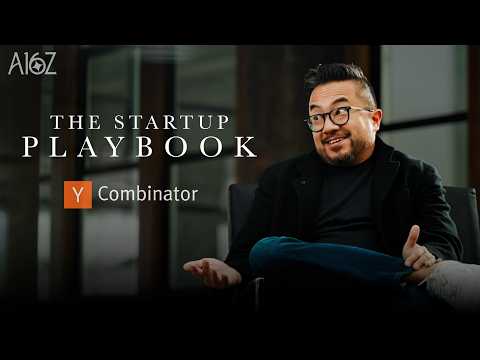
This conversation covers Garry Tan, the head of YC, discussing the founding principles he learned from past mistakes and the wide-ranging ways AI is changing how startups, organizations, and society operate. The core message is to trust the problems and people you know firsthand rather than chase trends, and that AI agents let even small teams execute at the level of yesterday's large companies. He also believes change will not arrive immediately on the strength of technical capability alone — human organizations and institutions will adapt far more slowly than expected.
1. A lesson from the downturn: choose what you know, not what's in fashion
Garry Tan recalls graduating from Stanford in 2003. It was right after the dot-com crash, and simply finding a job in the Bay Area was very hard. He wanted to join a startup, but realistically the options were Windows Mobile at Microsoft and Expedia, and with student loans to pay he ended up at Microsoft.
The mood then, unlike today, was closer to a feeling that "the tech industry is over." Working in tech or at a startup was not regarded as high-status. Yet, as he realized only later, that was exactly the moment to dive deepest into web and social.
"People said the web was over, but that was the perfect time to be doing web and social."
He recalls that although he already had extensive web programming experience, he was swept along by the market's line that "mobile is what's next" and left the web behind. The outlook on mobile may have been right, but abandoning the field he knew best and loved most was the wrong judgment.
Garry frames this as a lesson that applies directly to founders today. The question founders commonly get from investors — and commonly ask themselves — "What's hot right now? What should I do?" is the wrong question to begin with.
"That's the wrong question. The right question is, 'What am I interested in? What do I know that others don't?'"
The phrase he has emphasized at Startup School, "Don't LARP" — don't play-act the role of the founder, investor, or tech worker that others think looks cool — connects here too. Seriousness and honesty, that is, earnestness, comes not from naivety but from the courage to trust your own experience.
"Even if someone's blog post or tweet contradicts you, you have to be able to trust what you experienced directly."
2. Silicon Valley's real origin: the strange, earnest fringe
The two discuss why Silicon Valley culture constantly produces anxiety, competition, and the sense that "I'm falling behind." Garry believes people spend far too much time circulating information and competing on reputation. But the truly interesting opportunities usually come not from the center everyone is watching but from the strange fringe.
Garry notes that the vision of a personal computer on every desk and in every home was not obvious common sense at first either. The people who built it were not the mainstream elite of their day but outsiders following their own obsessions.
"The people who built computers were actually weird punks on the fringe."
"The Homebrew Computer Club wasn't a place people went to look cool. They were just following the strange obsession of 'I want my own computer.'"
One of his criteria for judging a good idea is, "Can you find the end of that conversation?" A genuinely interesting problem does not reveal its intellectual limits after a little digging. You may be able to find the edge of the conversation, but it is hard to find the edge of what there is to think about.
The internet has the power to help you find "people like me" much faster. In the past you could only be a "cool person" in the one prescribed way available at your school or in your local community; now you can instantly meet people who share very particular tastes and interests on Reddit, X, Instagram, and elsewhere.
"Now you can find your tribe almost instantly."
The essence of Silicon Valley, as Garry describes it, therefore does not lie in reproducing mainstream trends. It lies in finding a problem you seriously believe in even though others don't understand it — and the people who believe in that problem with you.
3. Turning down Palantir, and looking at the territory instead of the map
Garry describes one of his biggest regrets: declining an early offer to join Palantir. His Stanford friends Joe Lonsdale and Stephen Cohen were working at Peter Thiel's hedge fund, and as they started Palantir they tried to recruit him. Peter Thiel even offered him a $70,000 check, matching his Microsoft salary at the time.
But Garry could not give up the possibility of a promotion at Microsoft.
"I said, 'Thank you, Mr. Thiel, but I might get promoted to level 60 this year.'"
He did get promoted — but by today's standards he calls that choice a "$2–4 billion mistake." Of course, he isn't only talking about regret over a missed financial opportunity. He sees it as another instance of following market reputation, a stable career path, and what others considered a "good choice," while failing to trust the outstanding people and problems he knew firsthand.
"I was reasoning backward from the map. I wasn't judging by looking down at the territory."
Here the map means social reputation, investor opinion, and industry conventional wisdom. The territory means the people you have actually met, the problems real users experience, and the concrete possibilities of a technology. What Palantir saw at the time was the reality that government agencies and intelligence services in Washington had no access to the technology that Silicon Valley's best computer scientists could build.
Garry says this kind of direct observation resembles a scientist's posture: don't just read the papers and the received wisdom, go look at the actual experiments and the experiences of the people involved.
"If you look at the experiments yourself and talk to the people going through it, you gain secret knowledge."
Another striking conclusion he drew from the Palantir experience is this:
"Everything cool in my life has been a kind of cult."
"Cult" here means less a blindly following group than a community gathered around some strong truth and belief that runs against established orthodoxy. Great companies and movements usually look unfamiliar, overblown, and out of step with the mainstream at first.
4. The opportunity YC creates: a birthright for tech outsiders
Garry explains that Y Combinator is special in Silicon Valley because it opened up a world that was previously accessible only to people with access to the "right schools, right networks, right parties." In the past you had to come to the Bay, meet the right people, get invited to the right gatherings, and break through a complicated social network.
Inside YC, people of that type are called, slightly sardonically, "scenesters" — people skilled at the scene and at networking rather than at actually building.
YC's approach is far simpler. You answer questions on a website, submit a short video, and builders who have actually started companies evaluate the idea fairly. Garry calls this "a birthright for tech."
"It doesn't matter where you're from or who you are. What matters is what the idea is, and whether you can execute."
He notes that YC brings thousands of people to San Francisco each year, and sees this process as meaning more than investment or education alone. Because founding is lonely in particular, YC's core value lies in providing a peer group where you can speak honestly about a hard reality.
"On the day you lose your biggest customer, the day your best engineer quits, the day your co-founder has lost hope and you can't afford to lose hope — who do you call?"
Unlike tech events where everyone says "things are going great," founders need a community where failure, fear, and fractured relationships can be discussed without hiding. Turning outsiders into insiders, he explains, is not merely a matter of conferring a brand — it is providing standards of execution and a network of honest relationships.
5. Founders in the AI era: one person can be 400 people
The conversation turns to the economics of founding as AI has changed them. Garry says he has traditionally believed it is far better to have a co-founder. Just as an individual act becomes a collective movement when a second person joins the first person's belief, a co-founder provides important momentum and validation for a company.
But with the rapid advance of vibe coding and agent-based development, he thinks one person can now do hundreds of times more than they could before.
"Now any one person can be 400 of themselves from two years ago — no, from nine months ago."
He stresses that this does not mean founders should think smaller; it means they should think far more ambitiously.
"Founders should be more ambitious than ever."
But you cannot simply copy old success formulas. He judges in particular that traditional per-seat SaaS is unlikely to retain the same standalone strength five to ten years from now. Using SaaS as a starting point or a customer entry path is possible, but it must eventually lead to a stronger moat such as data, network effects, or a proprietary operating system.
"If you're doing pure per-seat SaaS in 2026, you'd better hope you can leap to a moat like data or network effects."
Behind this shift lies the fact that code is no longer a scarce, precious asset. You used to have to go through product specs, hiring engineers, QA, and testing; now you can build and test an idea immediately.
"You used to have to be a PM, write the spec, find engineers, worry about QA. Now you just say, 'QA it.'"
Garry says he didn't set out to build a huge business — he built various AI tools just for fun. But by continuing to use them himself he accumulated intuition, and in recordings of YC partners' office hours he found conversational patterns that raise a founder's ambition. From that he also built a markdown prompt for startup advice.
What he emphasizes is a posture of actually using things — including small and seemingly useless things — rather than trying only to "study" technology seriously.
"Try every model, and build very small things as a frame for learning the new technology."
In the AI era, the value of agency and taste rises rather than falls. And these are not the innate abilities of a chosen few but capabilities you can develop by continuously building, revising, and choosing.
"That ability improves with practice. Just do it, and keep exercising it."
6. An organization where a markdown file is an employee
Explaining how organizations operate in the age of AI agents, Garry uses the tools and experiments he has built as examples. He combines search, memory, and retrieval-augmented generation (RAG) so agents maintain the large context a task requires, and builds environments where they can spend ample tokens and compute.
He acknowledges that using a high-performance agent at maximum capacity can cost $50,000–$100,000 a year. But for a CEO or founder it is well worth the investment, and doing so lets you experience the future way of working today.
"If you do that, you're living in 2028 today."
The core of this approach is to perform a piece of work well once, then save that process as markdown documents + code + tests to become a reusable skill. Connect that to scheduled runs, and work that a person used to repeat becomes automated.
"A markdown file is an employee."
"That employee does the job perfectly every time, and can do it as many times as you want."
At first the agent's output may be poor and expensive. But if the founder can give fast feedback — "this is wrong," "fix this part" — the execution record itself accumulates into a better skill file. If it makes a mistake again in the future, that is not a one-off failure but a bug fix applied permanently.
This applies not just to development but to almost all work: sales, marketing, customer support. Garry believes companies could appear that reach $15 million in annual recurring revenue within a few months with only a handful of people and hundreds of agent skill files.
That said, as skill files and data multiply, managing provenance — where each piece of information came from and when it was updated — and handling conflicts becomes important. When two facts disagree, you have to pick the more recent one from the more trustworthy source, and verify this regularly.
Garry thinks founders in their 30s and 40s may be especially well positioned. They have already experienced the problems of running multiple organizations and companies, so they know what to automate. Attach agents to one such experienced person and you can get capability similar to hundreds of that person working at once.
7. Agents that reduce conflict and bureaucracy
The two agree that conflict in an organization need not be seen as purely bad. Emotional clashes are exhausting, but constructive conflict — testing different approaches and moving closer to the truth — is necessary. AI systems can separate this from human ego and political calculation and enable more experimentation.
Garry describes the case of Pedro at Brex. He aggressively adopted agents such as OpenClaw, and to reduce security risk also built an open-source layer that monitors network traffic and agent behavior. In particular, he has agents analyze the notes of meetings run by his direct reports, so he can see what problems arise and who is clashing even in meetings he did not attend.
"He can walk into a meeting, say 'You're right, let's do it your way,' and walk right back out."
This is not merely a convenient management tool; it solves the fundamental problem that as an organization grows, the whole company no longer fits in one person's head. An agent's memory and retrieval abilities pull context from meeting notes, workflows, and real data and deliver it to the executive.
"A person can hold about seven things in their head at once. But you and an agent can hold three Harry Potter books' worth in your head."
He believes most companies and governments today were built on the premise of limited human memory and slow communication. AI, he argues, should not stop at making products and services cheaper — it should deliver experiences that are 10x, 100x, 1,000x better.
"We may never reach utopia. But it's worth trying, and it's worth attempting."
The ideal he describes does not mean tech promises a perfect world. It means we should try seriously to build better products, better services, and more humane workplaces.
To illustrate bureaucratic inefficiency, Garry recounts an anecdote from his Microsoft days. The Windows Mobile team asked the Windows team to fix a bug, but the emails were ignored, and in the end he had to go over there with his PM mentor — carrying a baseball bat. The point is not that they intended actual violence, but how absurd it was that an organization required going that far to get a problem solved.
"They didn't answer emails, didn't fix the bug, didn't even mark it 'won't fix.' So we had to show up with a baseball bat."
"Startups can do it. And every startup absolutely must."
He thinks a substantial portion of middle management can be replaced or assisted by agents. Executives set direction and individuals do the actual execution, while AI takes on coordination, dependency mapping, conflict resolution, and status tracking. As a result, a product launch that used to take months could happen within days.
AI can also give more improvement authority to the people doing the work on the ground, rather than reducing people to entities executing fixed instructions "below the API." Citing the Toyota Production System, where the actual workers had the authority to improve the production line, he explains that the person with the most context should be able to fix the system.
8. Change is fast, but society is slower than you think
To the pessimistic view that AI will eliminate all white-collar jobs too fast and create a permanent underclass, Garry counters that the slowness of human organizations may actually be a positive factor — a "white pill."
"This change will be slower than people think."
Because of corporate bureaucracy, institutional complexity, middle-management structures, and limited human attention, the existence of powerful AI does not instantly transform an entire organization. Governments are slow, large companies are slow, all of society is slow. He sees this not as a mere obstacle but as a realistic buffer that gives society time to adapt.
"Society is much slower than you think, the government is slow, and every company in the world is slower than you think."
The younger generation are AI natives who came of age in the era of ChatGPT. They will naturally work and build with AI, but Garry expects it could take about twenty years before the way they expect things to work becomes the default across society. Large companies like Microsoft do not disappear easily either, precisely because of structural moats and the inertia of existing systems.
The founder's opportunity therefore does not lie only in instantly replacing every incumbent. It lies in building new companies that deliver faster, better experiences in the gaps where existing systems change slowly.
9. The next computer and the competition in consumer AI
Asked what the next computer will look like, Garry thinks the current form will hold in the short term, but that in the long run it will likely move toward a voice-first interface. And what will matter is not a chatbot that merely understands speech, but an entity that continuously understands the user's context and memory.
"You'll want something benevolent that knows your hopes, your fears, your desires, and is constantly working to help you in that way."
This requires combining many capabilities: computer use, long-term memory, speaker separation, and gathering and organizing information. People are satisfied today with what ChatGPT or Claude can do, but the expectation is that in the long run they will want far deeper context and personalized support.
Garry expects that around 2027 the "harness wars" — competition over the tools that manage a user's personal context and workflows — could begin in earnest. A harness here refers less to the model itself than to the operating environment that connects the model to memory, tools, computer control, and user information so it can do real work.
For now, though, it is expensive to serve high-performance models to consumers at scale. But if today's cutting-edge model performance becomes available for tens to a hundred dollars a month a few years from now, an enormous competition could break out over hundreds of millions to a billion consumers.
The host summarizes the phenomenon: "Tokens from the newest model are very expensive, but the price of the model that was state of the art a week ago quickly approaches zero." This cost decline matters especially for consumer AI. Consumer products generally depend on free trials and low marginal distribution cost, and that model breaks if inference costs are too high.
The two lament that now that computers have for the first time acquired emotional texture and conversational ability, more ambitious consumer products still haven't appeared. At the same time, Garry corrects himself: he too was captivated by agent technology and thought the change would come immediately, and now thinks that expectation was too early.
10. Local politics and the role of the citizen: fix what's nearby first
Finally, the conversation moves to San Francisco local politics. Garry says some of the problems around AI and technology are not problems of intelligence but problems of human cooperation and political coordination. He remains hopeful because the United States still has the rule of law, voting, and civic institutions people can participate in.
"The white pill is believing that America still has the rule of law, and that people inside government are, to some degree, seriously trying to help people."
He describes serving jury duty in San Francisco, watching citizens of different backgrounds participate in the institution in an orderly way, and coming away with a sense that government does not exist fundamentally to ruin people's lives.
What drew Garry into local politics actively were crime and education problems in San Francisco during COVID-19. He criticizes the fact that although Asian Americans make up a substantial share of the electorate, serious crimes against elderly Asian residents were not adequately addressed, and that education policy in public middle schools was hostile to Asian students who wanted to take algebra.
Middle-school algebra was a deeply personal issue for him. He too was a public school student in Fremont in the East Bay, and had he not been able to take algebra in middle school, he would have struggled to take calculus in high school — and his chance to major in engineering at Stanford and live the life he has now would have been different.
"That's when I thought, 'Okay, now it's personal.'"
He believes San Francisco's problems were amplified by a political posture that ignores data and housing supply, blocks construction, and denies real incentives and supply and demand. He also sharply criticizes local media for failing to properly cover anti-Chinese and anti-Asian crime.
"The institutions failed us."
But he argues that the more broken institutions feel, the less citizens should retreat. You need to be prepared to accept reputational damage or personal risk for your convictions, and he sees that as the responsibility you hold to your fellow citizens.
"You can't do this to us. We're going to stop it."
He judges that San Francisco is not perfect but is clearly improving, and says he wants to apply the lessons learned in this city to others such as Los Angeles, New York, Minneapolis, and Seattle. The project he built for that is GarrysList.org.
Finally, Garry emphasizes that rather than being consumed by national politics, each of us should solve concrete problems close to home — housing, crime, treatment, recovery.
"Act locally. Take care of the people right next to you."
"Fix the local, and the state and the country will get better in the end."
Closing
Garry Tan's message is consistent: trust the truth you experienced firsthand rather than trends and reputation, and find the problems and people worth committing to seriously, even if they look strange. AI can make a small team enormously powerful, but using that power properly requires using the technology yourself and repeatedly training your taste, agency, and operating methods.
And a better future does not arrive automatically. From reducing bureaucracy inside companies to solving the real problems of your local community, change begins when founders and citizens believe and act on the conviction that "it's worth trying to make a better world."