
Heart rate variability (HRV) has been repeatedly confirmed over recent decades as an important tool for precisely monitoring each athlete's training adaptation, fatigue status, and recovery process in team sports. This summary provides a clear and friendly chronological overview of field-applied HRV research results, practical usage guidelines, and individualized training recommendations for team settings. Key conclusion: HRV measurement is most valuable when it captures individual athlete changes and context rather than simple numerical assessment, and consistent monitoring and analysis enable more efficient and safer team management.
1. Introduction and the Significance of HRV Monitoring in Team Sports
In team sports, individual athletes respond differently to training, making it critical to measure appropriate internal load and adjust training accordingly. Recently, HRV as a physiological marker has gained prominence as a leading tool for this purpose. The "big picture" view and coefficient of variation (CV) emphasized in data analysis are highly effective for monitoring athlete-specific fatigue, recovery, and adaptation states.
"Because each athlete responds differently, training adjustments based on individual data using internal load measures like HRV are necessary."
This article covers HRV research results applied in real team sports settings, practical coaching guidelines, and analysis examples using software (HRV4Training Pro).
2. HRV Study Selection and Analysis Methods
While extensive research has accumulated over the past 50 years, only studies practically useful for coaches and athletes in team environments were carefully selected for analysis here.
- Recent advances in digital devices have made HRV measurement extremely convenient for routine field data collection, and the reliability of research results has improved.
- Selection criteria included studies repeatedly validated across sports, technologies, and measurement protocols — only data that objectively demonstrates "expected physiological responses."
Based on these carefully selected studies, the article explains in accessible terms how HRV variation patterns can be applied to actual training adjustments and athlete management.
3. Practical Guide for HRV Measurement and Interpretation
3.1 Measurement Protocol
- Measurement metric: rMSSD has the highest reliability and validity and is the most widely used in practice. Its log-transformed version (ln rMSSD) is commonly used as a "recovery point." As Flatt et al. note, "the speed at which rMSSD returns to baseline after exercise is a key recovery metric, and scheduling high-intensity training when HRV is above baseline supports endurance improvement."
"Post-exercise ln rMSSD return to baseline is directly linked to recovery, so it's advantageous to schedule high-intensity training when HRV is above baseline."
- Measurement timing: 1-2 minutes in the morning is most recommended for both reliability and practicality, with 3+ days per week (ideally 5+) being optimal. If measurement days are limited, prioritize mid-week days (Wed-Fri) farther from match days.
- Analysis methods:
- HRV baseline: Compare the recent 3-5 day or weekly average to each athlete's personal "normal range."
- Coefficient of variation (CV): Day-to-day variation (standard deviation/mean) in HRV serves as a sensitive marker of training/recovery adaptation.
3.2 Data Interpretation and Practical Application
- Preseason:
- Athletes with decreasing HRV and increasing CV = possibly struggling with training load → recommend load reduction or recovery strategies (sleep, nutrition, yoga, etc.)
- Stable/increasing HRV and CV = normal adaptation
- Decreasing CV with stable HRV = well-adapted state
- In-season: Use the above patterns as a continuous feedback loop, immediately applying them to training adjustments and recovery strategies
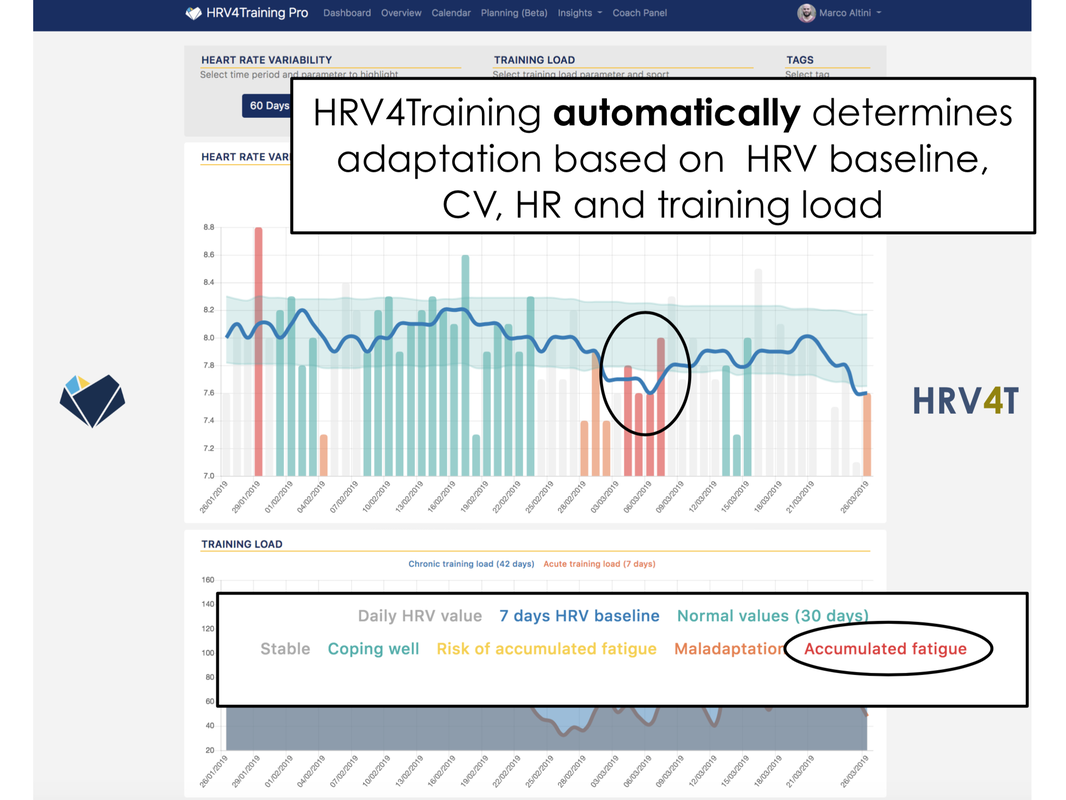
4. Real-World Visualization Examples with HRV4Training Pro
In practice, the relationship between "HRV baseline" and "daily variation (CV)" provides critical information.
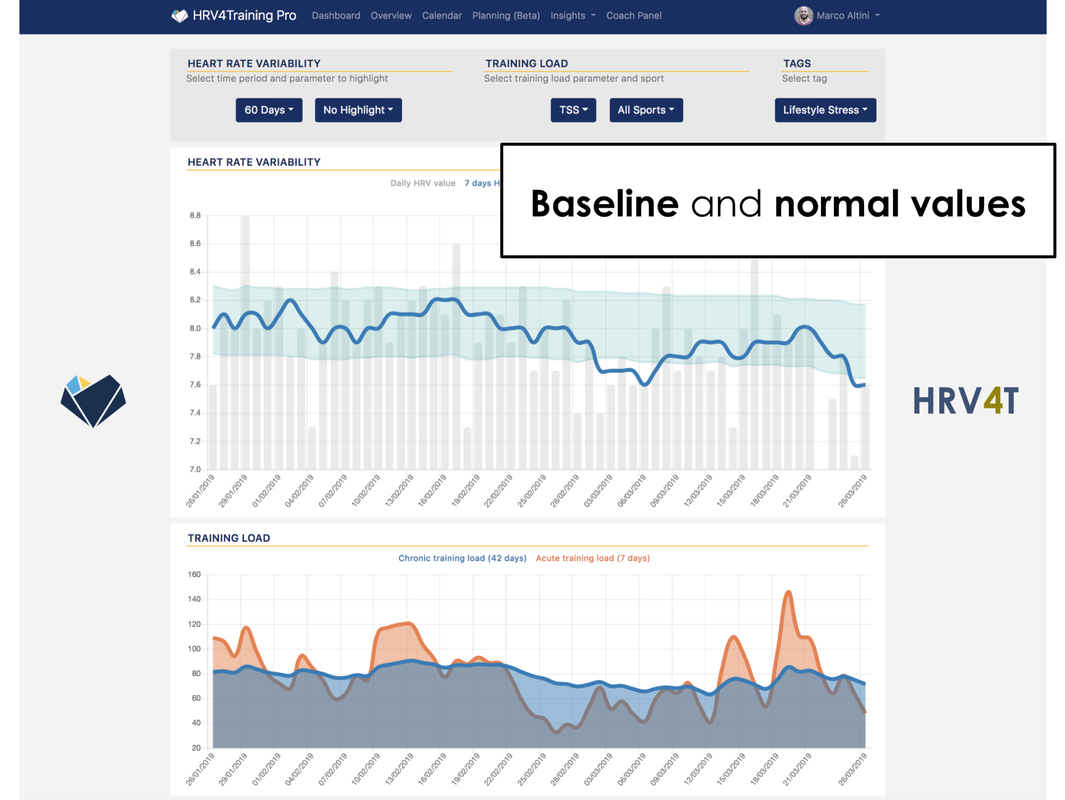
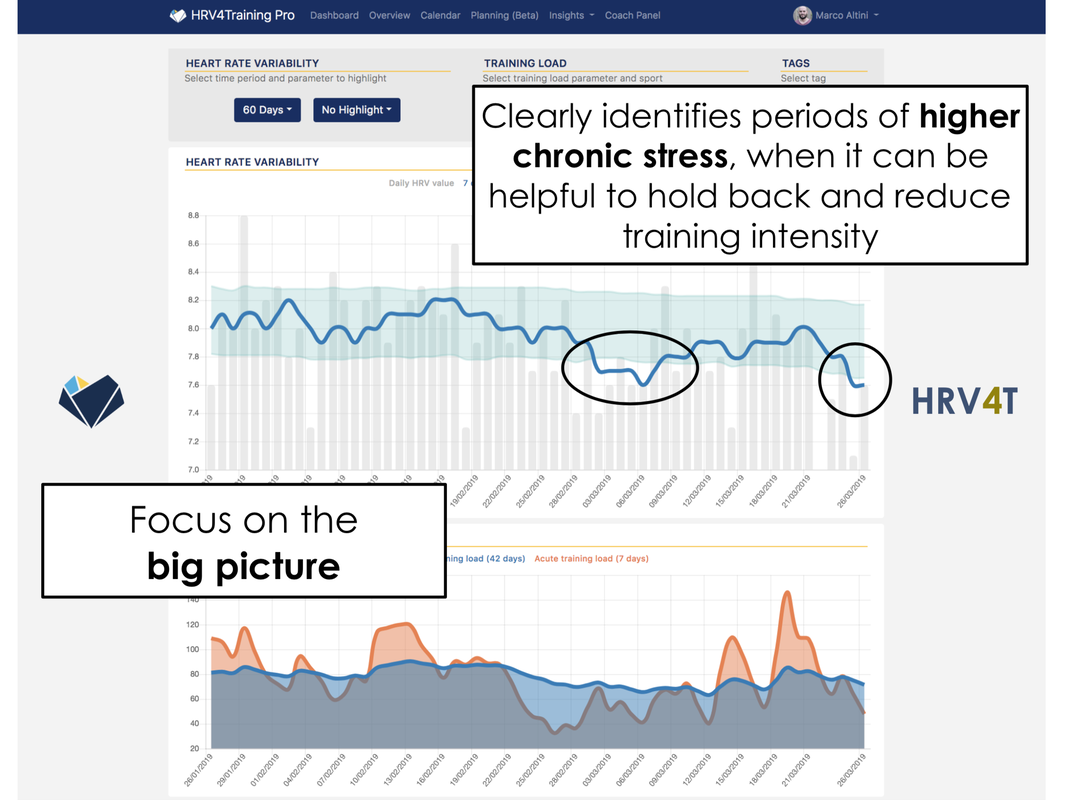
CV visualization examples:
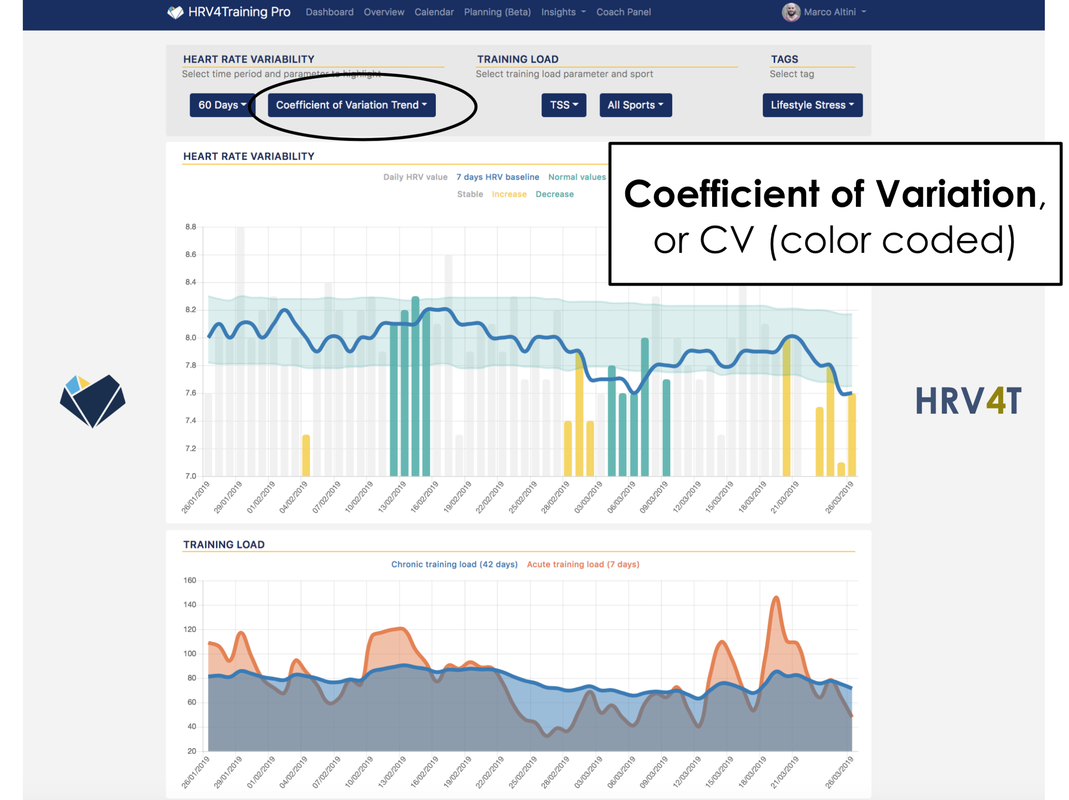
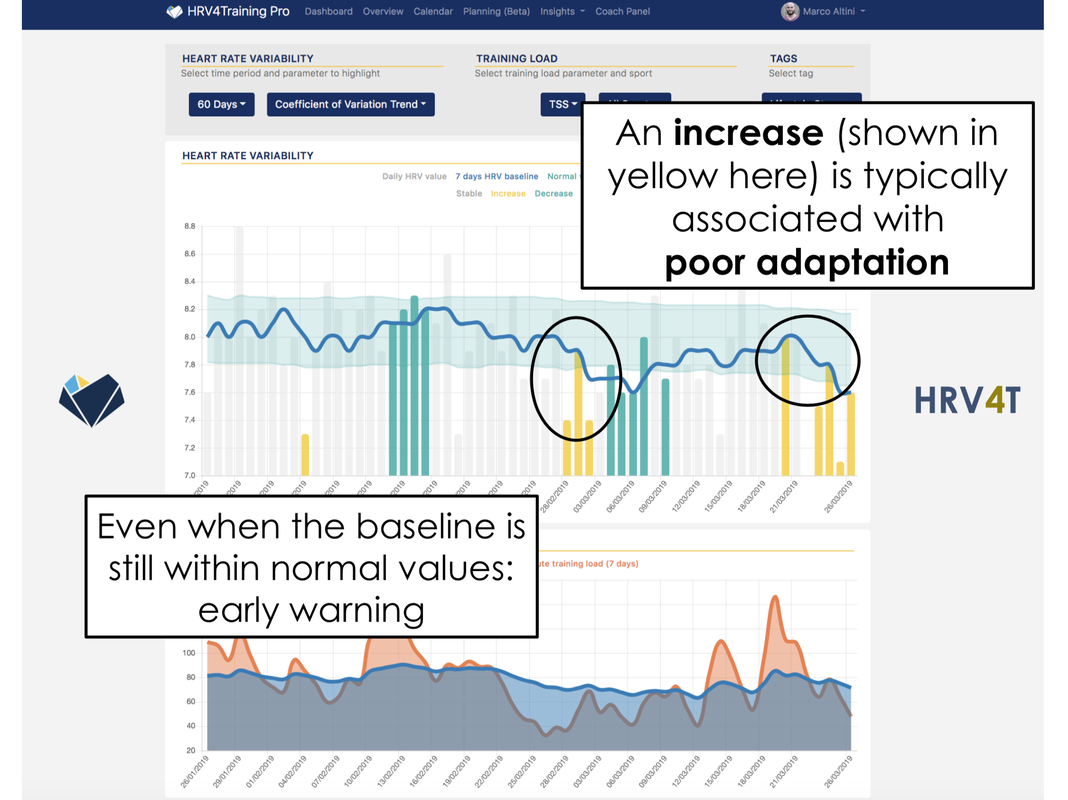
Automatic trend detection example:
5. Group-Level HRV Research Summary and Implications
5.1 Age and HRV
Botek et al. (2016) divided data from 153 soccer players by age group and observed HRV (ln rMSSD) decline and increased sympathetic nervous system activity after age 25. This suggests the cause isn't simply age but the cumulative psychological and physical stress (allostatic load) from a professional athlete's career.
"A clear decrease in heart rate variability and slight increase in sympathetic activity was observed in players over 25."
- Accordingly, customized recovery programs (nutrition, yoga, etc.) or individualized training adjustments through HRV monitoring are needed.
5.2 HRV Differences by Skill/Team Level
Proietti et al. (2017) compared HRV across three levels (Champions League, Europa League, second division) but found significant overlap between groups, making it limited for identifying individual athletes.
"HRV is more suited to individual athlete change monitoring and personalized feedback than group-level difference analysis."
6. Individual Athlete HRV Analysis and Application Cases
6.1 Seasonal Changes (Preseason to In-Season)
- Multiple studies (Oliveira et al. 2013, Boullosa et al. 2013, Nakamura et al. 2015, Soares-Caldeira et al. 2014) showed the common result of HRV increase after preseason → stable maintenance during the season.
- This represents the typical HRV response pattern as athlete conditioning transitions from suboptimal to optimized. During the season, HRV should be used to balance training load and recovery rather than focusing on absolute values.
"Autonomic markers (HRV) improved significantly during the preseason and were maintained throughout the season."
6.2 Training Load Response and HRV
- Flatt et al. (2015, 2017) and Buchheit et al. reconfirmed the sensitive response that as training load increases, HRV decreases and CV increases.
- Day-to-day CV (variability) is closely linked to "psychological fatigue and adaptation" — CV is larger during tough weeks and stabilizes during reduced-load (recovery) weeks.
6.3 Training Adaptation and Performance Prediction
- Flatt et al. (2016) and Esco et al. (2016) confirmed that athletes with decreasing CV showed greater additional fitness improvement and performance gains (VO2max, etc.).
- In other words, "CV decrease = positive adaptation, CV increase = fatigue/poor adaptation" — and this change shows strong correlation with actual performance feedback
- HRV monitoring is also used to predict early "trainability" — how well an athlete is adapting.
"Athletes with decreased CV showed notably improved fitness test results (yo-yo test) and VO2max."
- However, all researchers emphasize that "continuous observation and individual change tracking" is far more meaningful than simple HRV/HRV CV evaluation.
7. Conclusion
HRV in team sports has been confirmed as a highly practical tool that genuinely helps with individual athlete adaptation tracking and fatigue management — not just a "number." Through consistent, standardized HRV monitoring and interpretation of variability metrics like CV, teams can improve training efficiency for each athlete and the team as a whole while reducing injury risk. In short, "building customized training and recovery strategies based on individual athlete data" remains the best team management approach in 2025!
"HRV is far more valuable when observing individual changes than group-level differences, because it allows more accurate assessment of athlete adaptation and fatigue status."