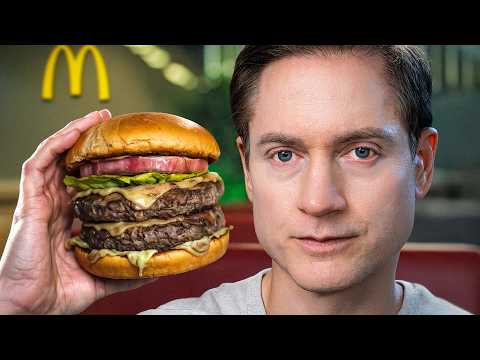
This video follows Brian Johnson as he orders McDonald's most popular items, explains hidden harmful ingredients and their effects on the body with scientific framing, and warns about fast-food risks. He argues that fast-food consumption fuels obesity, chronic disease, and accelerated aging—and makes the case for healthier dietary choices.
1. The "fast-food epidemic" and nostalgia for McDonald's
The video opens with Brian ordering McDonald's most popular menu items. He warns that we live in an era of a fast-food epidemic. Over the past twenty years, childhood obesity has doubled; processed foods account for 73% of the U.S. food supply; and some chemicals banned elsewhere are still used in the United States.
"Millions of people are eating this stuff for breakfast, lunch, and dinner without realizing that these companies are shortening your lifespan and destroying your health."
In the car on the way to McDonald's, he describes mixed feelings. Because he visited often as a child, he says he smelled the familiar scent as soon as he got in—and felt something like nostalgia. 🍔🍟
2. French fries: toxins behind the tempting smell 🍟
McDonald's large fries—one of its best sellers—give off a nostalgic, appealing smell. Brian says he understands why people obsess over them.
"Everyone wonders why McDonald's fries taste so good. The answer is simple."
McDonald's advertises "0g trans fat," but Brian digs into the labeling trap: under FDA rules, anything under 0.5g can round to 0g. The fries are fried in several refined seed oils that oxidize quickly into unsaturated fatty acids, producing carcinogenic toxins such as aldehydes. Those toxins can damage proteins, cell membranes, and DNA—and are linked to heart disease, liver disease, Parkinson's, and Alzheimer's. 😱
Fries are also rich in AGEs (advanced glycation end products). Formed when starch is cooked at high heat, AGEs show up at levels roughly twenty times higher than in a home-baked potato. AGEs drive oxidative stress and inflammation throughout the body—linked to insulin resistance, vascular damage, and accelerated aging.
"But Brian, calm down—it's just fries, it's just potatoes. Live a little." "But you know what? I don't think it's worth it. There's too much junk and too many toxins. I'm not eating it."
3. Big Mac: the devil's bargain—hunger instead of satiety 🍔
Next comes the Big Mac. Brian praises the golden bun, neat pickles, melting cheese—"a really attractive design"—then starts unpacking what hides behind that appeal. 👿
- Nutrition: A Big Mac has about 580 calories, 45g carbs, 11g saturated fat (roughly half the daily guideline), and 1,060mg sodium (nearly half the daily guideline)—but only about 3g fiber.
- The satiety illusion: A Big Mac feels filling but can actually make you hungrier, largely because of heavy added sugar and ultra-processed carbs. About 9g of added sugar—roughly a glazed donut's worth—spikes blood sugar; around ninety minutes later mood can crash and hunger returns.
- The "100% beef" story: McDonald's stresses 100% beef, but meat from factory-farmed cattle often has an imbalanced fat profile—low omega-3, high omega-6. The patties are also cooked in oils that are bad for health.
- Pickle plot twist: Even emulsifiers in the pickles can disrupt gut microbiome balance and contribute to chronic inflammation and metabolic disease.
"In my personal opinion, from start to finish this thing is just a death machine. So I'm not eating it."
4. Hotcakes: a morning sugar bomb 🥞
Then there's the hotcakes breakfast. It is among the highest-calorie options on the menu—about 1,340 calories. 😲
"Honestly, I can't believe people eat this." "When this goes inside your body, it can't be good. There's no way it helps you."
The hotcakes pack 41g of added sugar, spiking blood sugar and encouraging fat storage—and again, paradoxically, can drive hunger. Brian argues McDonald's avoids real backlash because everyone shares this addiction.
"It's interesting how many excuses McDonald's can make. Probably because everyone shares this addiction. Everyone. So nobody can call out the abuser—because you're trapped too."
5. Chicken McNuggets: aluminum and carcinogens 🐔
Next: a 20-piece Chicken McNuggets. Brian is stunned by the sheer quantity.
"What is this? Twenty pieces—what does that even look like?" "Wow—that's a lot of chicken nuggets."
Having avoided fast food for a long time, he says he can look at nuggets more objectively—and finds it absurd that they sell. They barely look like meat. 😨
- Sodium aluminum phosphate: Used in the batter, it is linked to dementia risk. A French study associated 0.1mg aluminum per liter of water with cognitive decline, dementia, and higher Alzheimer's risk. A 20-piece box can contain up to 2.8mg of aluminum—28 times that study's threshold per liter.
- TBHQ (tertiary butylhydroquinone): An antioxidant stabilizer in the frying oil so it can be reused. Rodent studies tied TBHQ to cell death, DNA damage, and tumor promotion.
"You may not care—but for me, I'm really not eating this."
6. Caramel Frappé: liquid sugar and a carcinogenic color 🥤
The caramel frappé is, spoiler, Brian's pick for the worst item.
"And spoiler alert—this is the worst one."
It contains about 70g of added sugar—especially dangerous in liquid form because it absorbs fast. A Swedish study linked a 5% increase in added sugar with a 23% higher all-cause mortality risk.
- 4-MEI (4-methylimidazole): A byproduct in caramel coloring, it caused lung tumors in mice and is listed under California Prop 65 as a potential carcinogen.
"These guys know how to tempt us—you have to admit. They're clever villains."
7. McGriddles: a disgusting lump of sugar 🤢
Next: McGriddles. Brian's first reaction is fear and disgust.
"Oh my God—this is really gross. Even touching it is gross."
The McGriddles smell like sugar-soaked pancakes; visually he calls them a "monster" that barely counts as food.
- Ultra-processed meat: Bacon and sausage are among the worst food categories; multiple studies tie them to higher all-cause mortality. They can contain nitrites, known carcinogens.
- Sugar overload: As the smell suggests, McGriddles include 13g of added sugar. Brian can't fathom why a breakfast sandwich needs that much. 😥
- McDonald's as villain: Seeing McGriddles, he labels McDonald's "evil"—not a happy place or a net positive for society. Offering what people want is no excuse for pushing harm.
"McDonald's is evil. It's not a happy place. It's not a company that's good for society." "You might say you're just giving people what they want—but don't. If people want to do something bad, don't encourage them. That's not a good excuse."
8. Egg McMuffin: less awful, still risky 🍳
After McGriddles comes the Egg McMuffin. Brian says the texture is better than McGriddles—but it's still not healthy.
- Processed meat: Like McGriddles, it uses heated processed meat, which raises cancer risk. The Egg McMuffin is a less harmful cousin—not something to eat freely.
9. Double Quarter Pounder with Cheese: Big Mac, supersized 🍔
Next: the Double Quarter Pounder with Cheese. Brian praises how appetizing it looks.
"Well—that's a delicious burger." "Beautiful, beautiful, beautiful." "Really beautiful. Again—nicely browned bun. Thick patties, a little char like backyard barbecue. Ketchup, onion, cheese. It's a well-designed product. It might kill you—but it's well designed."
He explains it as essentially a bigger, more harmful Big Mac: more saturated fat, trans fat, and about 740 calories. Even with 48g protein, how "clean" that protein is is questionable—and paired with sugary cola or a caramel frappé, satiety may never arrive.
10. Oreo McFlurry: a sugar bomb that wrecks metabolism 🍦
Then the Oreo McFlurry. Brian says it packs an insane amount of calories and sugar—410 calories and 48g sugar. 🤯
"When it comes to added sugar, there really isn't a 'good amount.' You want to get as close to zero as possible."
Added sugar brings pure destruction to metabolism, liver, pancreas, and blood vessels—and accelerates aging body-wide. Fructose can generate dreadful AGEs eight to ten times faster than glucose.
11. Snack Wrap: danger behind "healthy" 🌯
Finally, the snack wrap, marketed as a healthier option. Brian is sarcastic about ads celebrating its return—and puzzled by a "double-check accuracy" sticker.
"Double-check accuracy? What does that mean? Why does only this one get a sticker? Weren't my other foods double-checked? Why is the sticker only here?"
As expected: tortilla, fried chicken, sauce, cheese, lettuce. At 390 calories it's lower than other items—but still 6g saturated fat and 900mg sodium.
- Sodium aluminum phosphate: The same sodium aluminum phosphate found in nuggets batter on the fried coating can contribute to cognitive decline and dementia.
12. Taste test refusal and closing thoughts 🙅♂️
The team urges Brian to taste; he refuses. Before McDonald's, childhood memories gave him odd excitement and curiosity—but after seeing the items and walking through ingredients, he feels revulsion.
"Honestly, right now it's disgusting." "I know when you don't understand this stuff you might think like I did—'once in a while is fine,' 'it's no big deal,' 'there's some lettuce, pickles, meat must be okay.'" "But honestly, I've really changed my mind. I didn't want to eat before—but after going through all of this, I've really changed." "This is genuinely evil. I can't believe one company can do this. It's awful."
He criticizes marketing to children—cute mascots and fun vibes while causing serious harm. He says companies like McDonald's should shut down.
"Especially for our kids—they promote this, put on a pretty face, dress up this clown to make it fun and cool, but they're doing legal harm." "It's awful. They should just close up shop."
He encourages viewers to choose better—with courage. 💖
"I'm a voice of courage and strength. When you have to decide whether to eat this—I believe in you. You're better than this. You'll stand up and make better choices for your life."
Closing
Brian Johnson uses the video to show that McDonald's-style fast food isn't just "tasty and convenient"—it's a bundle of toxins that seriously threatens health. He dissects harmful ingredients across the menu and explains risks beyond calories and fat alone. The piece invites a more critical look at everyday food and a renewed emphasis on healthier eating. 🍏🥦