
Stripe conducted large-scale experiments and analysis to measure the real impact of various global payment methods on revenue and conversion rates. The results showed that offering major payment methods beyond cards increased revenue by an average of 12% and improved conversion rates by 7.4%. This summary walks through how the experiment was designed and conducted, the key lessons and analytical methods Stripe used, and how to apply these findings in practice.
1. Background and Key Results
Stripe recently published new data on "how 50+ global payment methods positively impact customer conversion and revenue."
"By exposing one or more relevant payment methods beyond cards, revenue increased by 12% and conversion rates rose by 7.4% on average."
The addition of locally popular payment methods, digital wallets, and bank transfer options drove particularly strong results. To understand exactly how much these various payment options help, Stripe designed and ran a large-scale real-world experiment.
2. Experiment Design 1: Randomized Yet Consistent Customer Experience
The first goal was to measure how conversion rates and revenue change when different payment method combinations are offered. Stripe applied a "randomization" algorithm to hide certain payment methods per customer.
But simply randomizing could confuse customers. For instance, if the payment methods changed every time a customer refreshed or returned to the checkout page, it would undermine both trust and experience.
To prevent this, Stripe applied a consistency policy. When using Stripe Checkout, a unique session ID ensures each customer always sees the same set of payment methods. For Payment Links, which generate new sessions each time, they combined the following to create a "nearly unique user identifier":
- Request IP (differentiating requests from the same network)
- Browser UserAgent (identifying specific browsers and devices, distinguishing different customers on the same network)
- Stripe merchant ID (distinguishing when the same customer purchases across multiple stores)
- Date (including repeat purchases by the same customer within a single day)
These pieces are combined into a single string, hashed into a random number, and matched to a unique number for each experimental payment method combination to hide certain options.
"This way, even after refreshing, the same customer sees consistent payment methods, keeping the experiment reliable."
3. Experiment Design 2: Phased Verification for Adequate Sample Size
Ensuring "sufficient sample sizes" was also critical. Stripe followed a "phased experimentation strategy" similar to clinical trials to determine whether region or device differences affect payment method effectiveness.
-
Phase 1 — Power Analysis:
- Calculate the minimum sample size needed to detect statistically significant changes (conversion rate increases) for each payment method.
-
Phase 2 — A/A Test:
- Without any actual treatment, randomly split checkout sessions into two groups (control and treatment) to verify proper sample distribution.
-
Phase 3 — Pilot Experiment:
- Run the actual experiment at small scale, verifying that samples accumulate as expected for each payment method/segment.
"This process takes a lot of time and resources, but we invested heavily in internal resources to boost confidence in the results."
4. Results Analysis: AI "Causal Forest" Model
For analyzing results, Stripe went beyond simple statistics and actively leveraged AI. With 50+ payment methods across 200+ countries and various industry verticals, the experimental groups exceeded 2 million combinations, creating enormous complexity.
"Using an AI-powered 'causal forest' model, we could quickly identify what's meaningful for business among millions of data points."
The causal forest model progressively splits data into smaller groups, separately calculating the conversion lift effect for each split. For example, it precisely analyzes how much each payment method actually affects conversion depending on country, device, and industry. This enabled Stripe to deliver "user-specific, actionable insights."
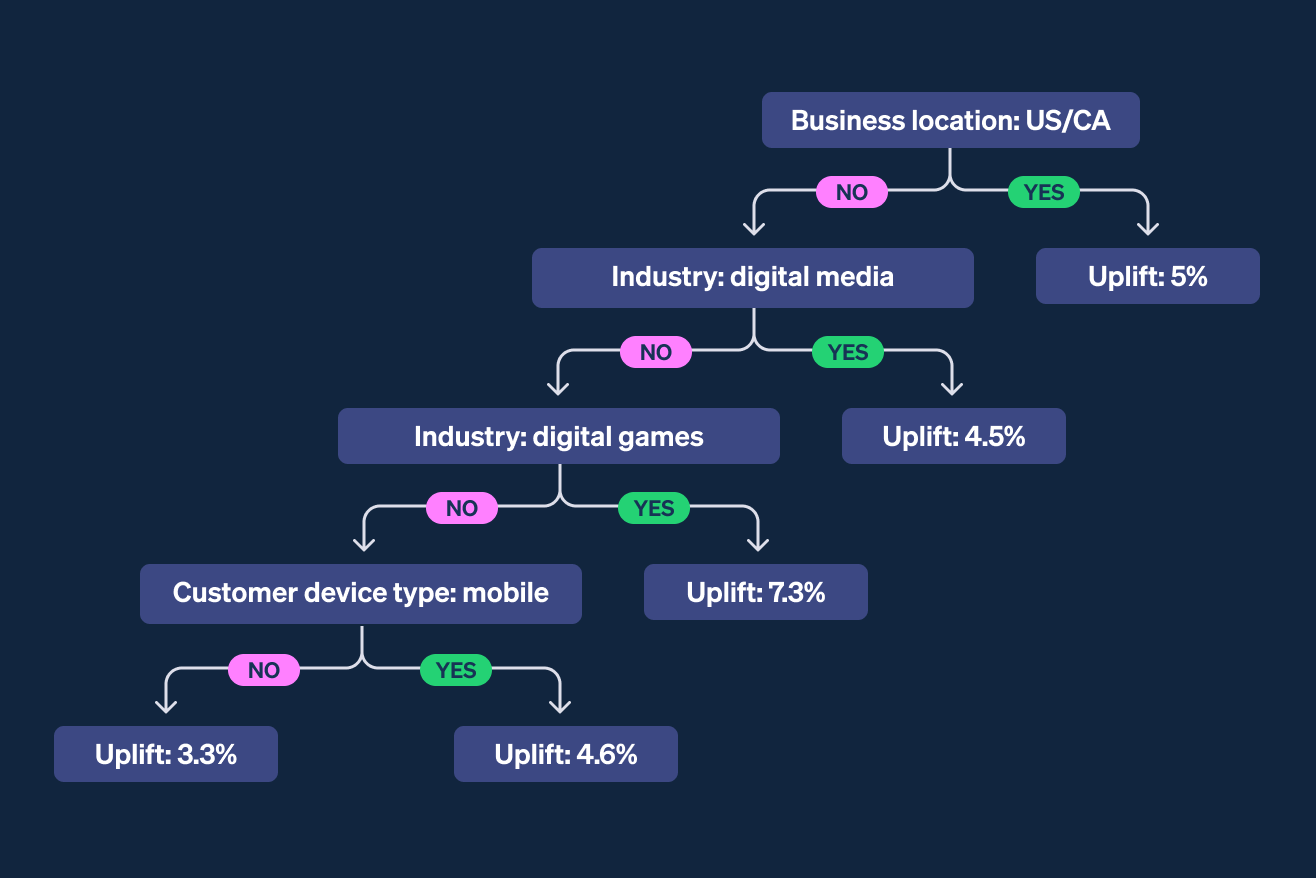
"By constructing hundreds of causal trees, we can provide users with far more granular analysis results."
5. Practical Application and Stripe's Continuous Optimization Tools
Stripe is rapidly applying the insights from this experiment to actual payment UX. Now, using Stripe's Optimized Checkout Suite, merchants can immediately access "40+ payment methods with a single integration." Additionally, tools for codeless A/B testing and an AI-based system that selects the most suitable payment method for each transaction are also available.
"The AI model built into the Optimized Checkout Suite automatically surfaces the right payment method per transaction, eliminating the need to configure complex logic yourself."
For more information or to consult with a Stripe expert, refer to the official documentation or contact Stripe directly.
Conclusion
Stripe's experimental process and results demonstrate that offering diverse payment methods in online payments doesn't just mean more options — it leads to real revenue and conversion rate increases. From experiment design to AI-powered analysis and practical business application, Stripe's thorough approach provides rich insights for practitioners interested in data-driven growth.