This study tested the effects of 'resonance breathing (RB)' guided by a lighting device attached to a monitor on stress recovery in an office setting. With 80 participants subjected to physical and cognitive stressors, the results showed that breathing in sync with the light activated the parasympathetic nervous system and was far more effective for stress recovery than simply resting. The breathing technique was rated as more enjoyable and useful particularly after cognitively demanding tasks, suggesting it could be a practical aid for stress management among workers in the digital age.
1. Introduction: Workplace Stress in the Digital Age and a New Solution
In modern society, workplace stress constitutes a significant portion of the overall stress burden. Computer-intensive work environments in particular have emerged as major contributors to occupational stress in the digital age. Various methods for building individual coping capabilities have been studied, and among them, slow breathing (SB) is known as a simple yet effective stress reduction technique.
We normally breathe about 12–20 times per minute, but intentionally reducing this to about 6 breaths per minute activates the parasympathetic nervous system, increases heart rate variability (HRV), and promotes calmness. The researchers took this further by focusing on resonance breathing (RB)—a breathing rate optimally tuned to each individual.
Workplace stress accounts for a significant portion of the overall stress burden, and computer-based work has emerged as an important factor contributing to occupational stress in the digital age.
However, most previous studies only examined effects in relaxed conditions and didn't adequately validate recovery effects immediately after stress situations resembling real work environments. The researchers therefore developed a new intervention: attaching lighting devices that serve as 'visual pacemakers' to either side of a computer monitor, allowing users to naturally regulate their breathing speed by following the movement of light.
The researchers set out to test how much more effective this light-guided breathing technique was compared to simply resting, after subjecting healthy adults to two types of powerful stressors (physical and cognitive).
2. Study Methods: The Stress-and-Recover Experiment
Participants and Preparation
Eighty university students participated in this experiment. The researchers first identified the most comfortable and effective breathing rate (individual resonance breathing rate) for each participant. Participants could customize the LED light color (purple, blue, green, etc.) and brightness on the monitor-attached device to their preference. They inhaled as the light moved up and exhaled as it moved down.
Stress Induction Tests
The researchers used two methods to simulate the kind of stress encountered in workplace settings.
- Modified Cold Pressor Test (mCPT): Participants competitively held their hands in ice water and endured it. This induces stress from physical pain and social evaluation.
- Computer-Based Cognitive Task (PASAT-C): An extremely demanding mental arithmetic task where numbers flash on screen and must be added to the previous number. Wrong answers trigger a loud warning buzzer, inducing cognitive load and frustration.
Experimental Procedure
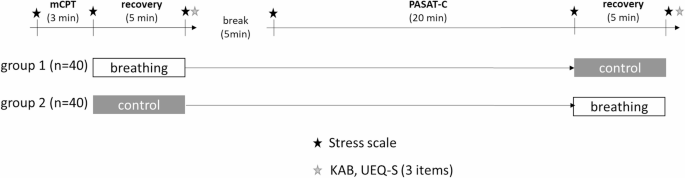
Participants were randomly divided into two groups. All participants experienced both stress situations described above. Immediately after being stressed, one group performed 5 minutes of resonance breathing (RB) while watching the light device, while the other group simply sat quietly and rested (control condition). Later, roles were switched (see figure below).

The researchers measured physiological stress recovery through heart rate (HR) and heart rate variability (HRV, specifically the RMSSD metric), and assessed subjective stress and satisfaction through questionnaires.
3. Results 1: Recovery After Physical Stress (Cold Water)
Let's look at the results after the first stressor—the ice water endurance test (mCPT).
Interestingly, while participants' bodies (hearts) showed stress responses from the ice water, their subjective perceived stress wasn't particularly high. Perhaps because of the competitive element, they perceived it as an approachable 'challenge' rather than a 'threat.'
However, there was a clear difference in the recovery process. The group that performed resonance breathing (RB) showed a significantly greater increase in RMSSD—the measure of parasympathetic nervous system activity—compared to the group that simply rested. This means their bodies regained stability more quickly and effectively.

In the graph above, you can see the black line (resonance breathing) maintaining a much higher level than the gray dotted line (regular rest) during the recovery period. This demonstrates that light-guided breathing is excellent at releasing physical tension. Participants rated this breathing method as much more 'enjoyable' than regular rest.
4. Results 2: Recovery After Cognitive Stress (Mental Arithmetic Task)
The second situation—the mental arithmetic task (PASAT-C)—caused tremendous stress for participants. Both mentally and emotionally draining. What effect did resonance breathing have here?
Here too, resonance breathing (RB) showed far superior recovery effects compared to regular rest. The graph below shows that RMSSD values that dropped sharply during the stress situation (PASAT-C) rose higher during the recovery phase with resonance breathing (solid black line) than with regular rest (gray dotted line).

The subjective evaluation differences were particularly notable after cognitive stress:
- Tension relief: Psychological and physiological tension was lower after resonance breathing.
- Usefulness: Participants felt the breathing technique was more 'efficient' for stress relief than simply resting.
- Enjoyment: Breathing while watching the lights was rated as much more engaging than sitting idle.
The RB (resonance breathing) intervention elicits a more pronounced cardiac stress recovery response than standard rest (control condition).
5. Discussion: Why Is Light-Guided Breathing Effective?
This study made two important findings.
- Customized recovery by stress type: Physical stress and cognitive stress trigger different responses in our bodies. But light-guided breathing activated the parasympathetic nervous system and aided recovery in both situations. It was particularly effective at rebalancing a disrupted autonomic nervous system when mentally exhausted (cognitive stress).
- The importance of user experience: No matter how good an exercise is for your body, you won't do it if it's not enjoyable. Participants rated the lighting device-assisted breathing as 'enjoyable.' This could be a crucial factor enabling workers to consistently find time for stress management during busy schedules.
The researchers believe the positive results came from the addition of visual elements (light movement) beyond just breathing, making it more immersive and easier for users to follow along.
6. Conclusion
This study demonstrates that effective stress management is possible while sitting at an office desk. Simply breathing slowly in sync with signals from a simple lighting device attached to a computer monitor allows our bodies to calm down faster and our minds to become more at ease.
Of course, this experiment was conducted with healthy university students, so results might differ for actual office workers or older individuals. However, it clearly demonstrates the potential of 'light-guided resonance breathing' as a highly useful and enjoyable relaxation tool for modern people suffering from excessive workload and digital stress.
This study provides strong evidence that light-guided RB (resonance breathing) is an effective intervention for workplace stress recovery.
Perhaps one day, your office monitor might also come with its own breathing guide light. When that happens, why not pause what you're doing and take a few deep breaths following the light?