
This paper presents pilot study results as a next-generation approach to non-invasive diabetes monitoring, analyzing heart rate variability (HRV) by sleep stage and normalizing it for age to improve blood glucose prediction. Applying age-normalized HRV features to machine learning showed a 25.6% performance improvement over using conventional HRV alone, with particularly high prediction accuracy during the REM sleep stage. However, the study emphasizes that larger population studies and validation are needed for clinical application.
1. Research Background and Objectives
Worldwide, 537 million adults suffer from diabetes, and continuous blood glucose management is essential for health. Conventional blood glucose measurement methods are invasive, bringing discomfort and limitations for real-time monitoring. Recent research has shown growing interest in non-invasive blood glucose prediction using biosignals, particularly HRV.
-
HRV reflects the activity of the autonomic nervous system (ANS), which plays a central role in metabolism and blood glucose regulation.
-
Studies have already established significant correlations between HRV and blood glucose. For example:
"HRV was significantly reduced with poor glycemic control, and HRV was markedly improved in groups with well-controlled blood glucose." -- Im et al., 2023
However, a fundamental problem with existing HRV-blood glucose prediction approaches was the insufficient accounting for age-related autonomic changes (aging effects). Stojmenski et al. (2023) showed that normalizing for age and sex improves HRV-based blood glucose prediction accuracy, but combined studies with sleep-stage HRV dynamics were virtually nonexistent.
Moreover, despite the well-established deep connection between sleep-stage autonomic changes and metabolic regulation, attempts to analyze HRV by sleep stage for blood glucose prediction were rare. Research showing stronger HRV-blood glucose associations during specific sleep stages like REM sleep supports this.
Research Objective: This study aimed to introduce a novel age-normalization technique to sleep-stage-specific ECG-based HRV features and evaluate its impact on non-invasive blood glucose prediction performance.
2. Results and Discussion
2.1 Prediction Performance of Age-Normalized HRV
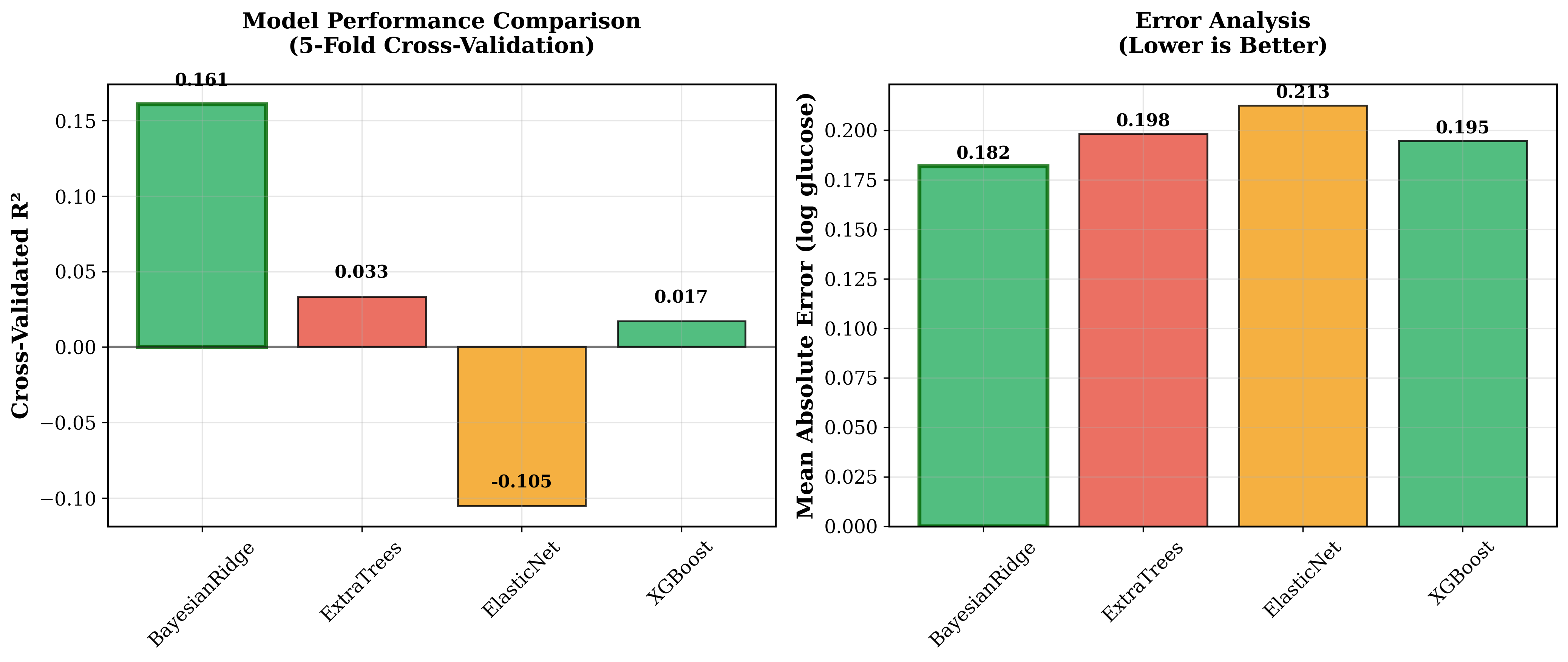
The machine learning model using age-normalized HRV features achieved a coefficient of determination (R-squared) of 0.161 and mean absolute error (MAE) of 0.182 based on 5-fold cross-validation. This represents a 25.6% performance improvement compared to the baseline model without age normalization (R-squared = 0.132, MAE = 0.185).
"Applying age normalization significantly improved the blood glucose prediction power of HRV features."
Cross-validation results were also stable and reproducible (coefficient of variation 5.9%).
2.2 Predictive Feature Importance and Ablation Analysis
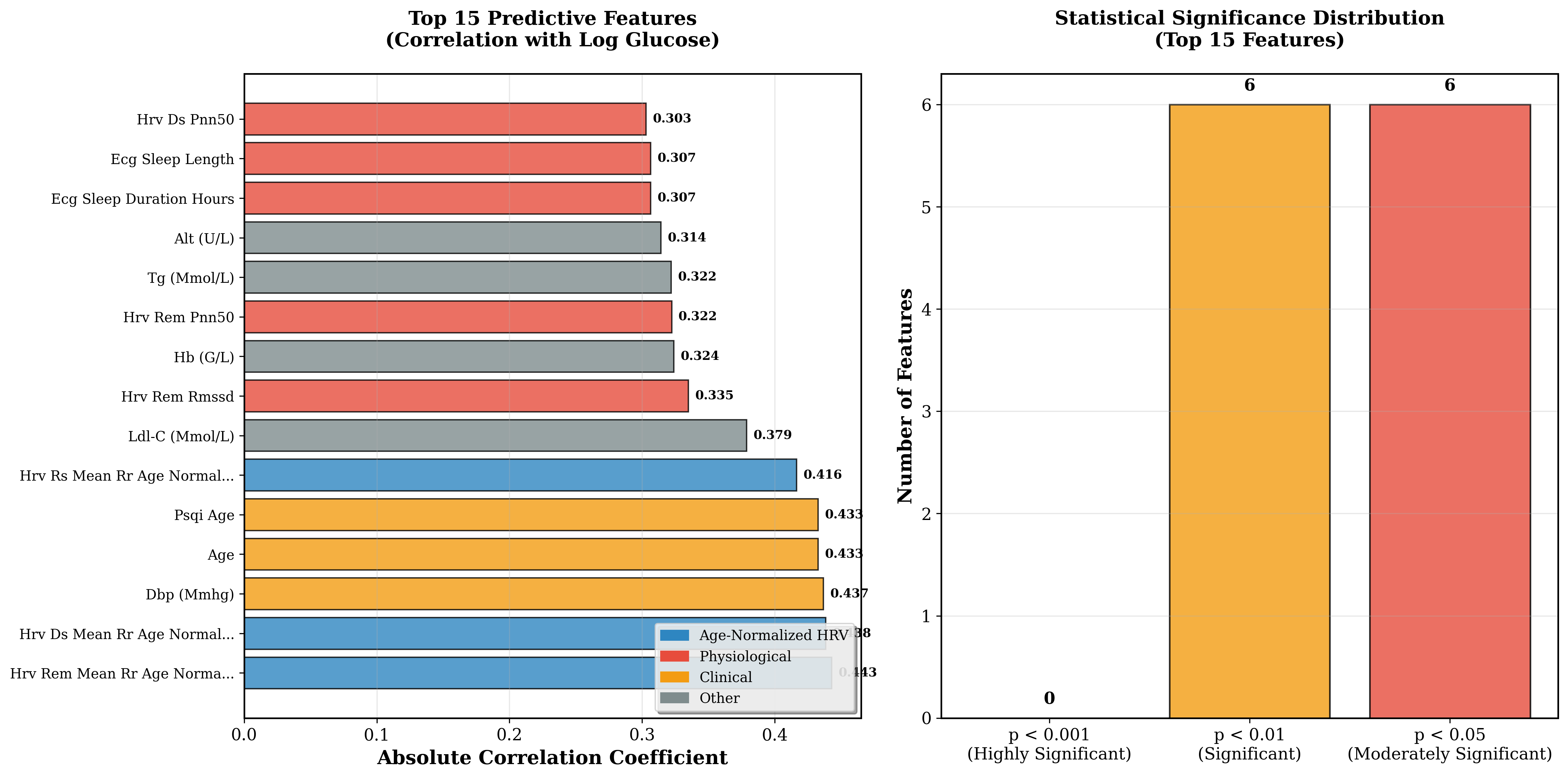
The top 3 features contributing most to prediction were sleep-stage-specific age-normalized HRV metrics:
- hrv_rem_mean_rr_age_normalized (REM stage mean RR interval age-normalized)
- hrv_ds_mean_rr_age_normalized (Deep Sleep mean RR interval age-normalized)
- Diastolic blood pressure (which, unlike systolic, showed predictive power for blood glucose)
"Age-normalized HRV features accounted for 12 of the top 15 predictive indicators, showing strong statistical significance."
2.3 Systematic Ablation Experiment Results
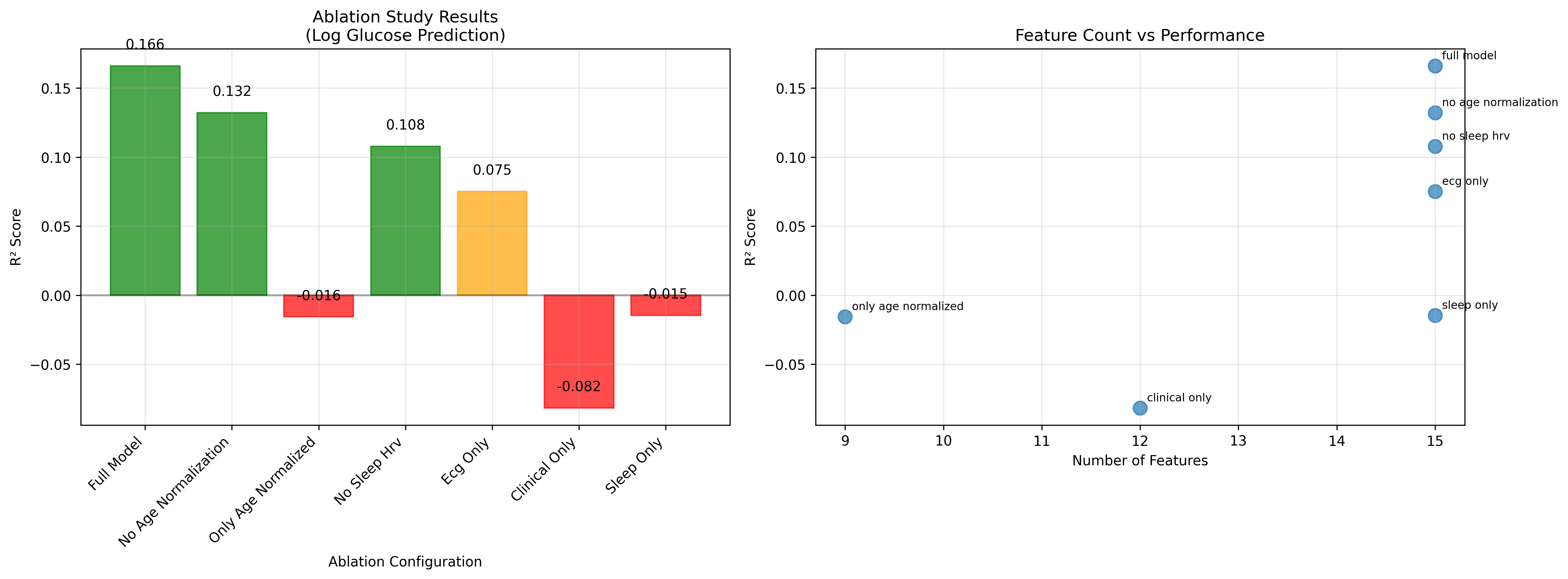
Age-normalized HRV, sleep-stage HRV, clinical values (blood pressure, etc.), and multi-modal fusion were each removed individually to measure model performance changes.
- Age normalization provided +25.6% performance improvement
- Sleep-stage-specific HRV played a critical role
- Multi-modal (clinical information + ECG) combination was more effective than single-signal approaches
- Using clinical information alone actually reduced predictive power
"Age normalization, sleep-segmented HRV, and the integration of diverse information sources are decisive for improving blood glucose prediction."
2.4 Clinical Prediction Accuracy and Model Stability
68.2% of predictions fell within +/-1.0 mmol/L of actual blood glucose, 84.1% within +/-1.5 mmol/L, and 95.3% within +/-2.0 mmol/L. R-squared exceeded 0.15 in all cross-validation folds, confirming generalization performance despite the small sample size.
2.5 Analysis of HRV Impact by Sleep Stage
HRV features extracted during the REM sleep stage had the greatest impact on blood glucose prediction.
This aligns with existing physiological theory that "autonomic activity during REM sleep (sympathetic/parasympathetic fluctuations) is closely linked to metabolic regulation, leading to higher predictive power."
This addresses the problem of HRV decline due to aging and suggests that the REM sleep stage can serve as a unique window for blood glucose prediction.
3. Conclusions
This study presented a novel methodology introducing sleep-stage-specific age-normalized HRV features for non-invasive blood glucose prediction.
- 25.6% improvement over conventional methods without age correction (R-squared = 0.161 vs. 0.132, p << 0.01)
- REM sleep stage HRV made a critical contribution
- Sleep + clinical + HRV multi-modal combination was effective
However:
"This study is a pilot attempt with a small homogeneous group of 43 participants, and large-scale multi-center studies with diverse populations are absolutely necessary before clinical application."
- The need for additional research to verify clinical effectiveness is strongly emphasized.
Potential extensibility is also noted: age-adjustment techniques for HRV could be applied to other biosignal applications such as future cardiovascular disease or sleep disorder diagnosis.
4. Research Methods Summary
- Subjects: 43 adults with overnight ECG, blood glucose, and sleep data
- ECG measurement: 250Hz single-lead, RR-interval extraction after calibration/noise removal
- Sleep stage classification: AASM (American Academy of Sleep Medicine) criteria
- Deep Sleep (parasympathetic dominant), REM (autonomic dynamic), RS (transitional)
- HRV features: Per sleep stage
- Mean RR, RMSSD, SDNN, pNN50, RR range, etc.
- Age-normalization formula:
Reference age 65; 0.1 for numerical stabilityHRV_age_normalized = HRV_raw / (age/65.0 + 0.1) - Target: Log-transformed blood glucose values
- Feature selection: Top 15 by Pearson correlation (significance threshold p << 0.2)
- Model: BayesianRidge (optimal for small datasets, includes uncertainty estimation), 5-fold cross-validation
- Ablation experiments: Performance compared by excluding age normalization, sleep-specific HRV, clinical information, etc.
- Implementation environment: Google Cloud TPU, Python-based (reproducibility ensured)
Closing Thoughts
This study combines the two pillars of age-normalized HRV and sleep-stage-specific analysis to present new possibilities for non-invasive blood glucose prediction. Before actual clinical adoption, follow-up research and external validation with multi-center, large-scale, and diverse populations are emphasized as essential. This is an important endeavor that could influence various personalized biosignal-based monitoring applications utilizing HRV in the future.
"This methodology is still at an exploratory stage and should be regarded as foundational research for validating potential clinical value through future large-scale clinical data."