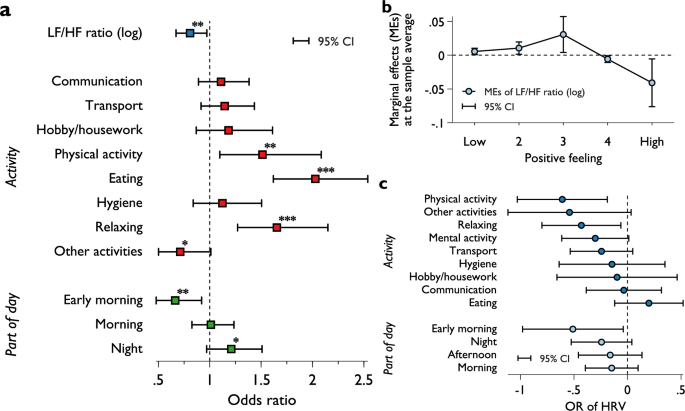
This study focuses on comparing subjective self-report data from surveys with objective biosignal data (heart rate variability, HRV) from wearable sensors to uncover the relationship between positive affect (mood) and psychological stress. In particular, it dynamically examines how daily activities affect our mood and biosignals, and how past activities or anticipation of future activities influence current positive affect. Through this analysis, the study confirms the reliability of subjective data and demonstrates the potential of real-time biometric data for policy decisions.
1. Introduction: Limitations of Subjective Reports and the Promise of New Measurement Technologies
The most common way we express our feelings is through self-reporting methods like surveys. In social sciences, analyzing such subjective judgments is a key strategy. However, there's a major problem: confounding factors like social desirability effects can introduce bias and produce skewed results. For example, as policymakers become increasingly interested in using subjective well-being as a policy tool, questions about the reliability of survey responses have been raised.
But recent technological advances have changed the landscape significantly. Thanks to non-invasive wearable sensors, we can now capture real-time information about how people behave and interact in their actual lives -- much like a 'social fMRI' that captures the dynamic digital traces of our society. In medical research, this real-time analysis is called 'adaptive or interactive monitoring.'
It's a natural step to investigate whether such technology relates to important social metrics like subjective well-being. This study sought to explore whether high-frequency data can complement survey data and whether this opens access to continuous behavioral data. If such complementarity is confirmed, it could help address the inherent problems of survey data, such as reporting biases and memory errors. While previous approaches like the 'Day Reconstruction Method (DRM)' attempted to overcome these biases, this research went further by exploring the use of real-time data.
2. Literature Review: Advantages of High-Frequency Data and the Importance of Daily Activities
High-frequency data enables more detailed exploration of environmental and situational factors. A major advantage of non-invasive devices is that people forget they're being measured, allowing them to wear devices throughout their daily lives. This provides valuable opportunities to better understand how daily activities affect our mood.
In this study, we tracked 300 participants over 24 hours, recording a total of 5,000 key daily activities and combining them with their heart rate variability (HRV) measurements and positive affect assessments. This method measures momentary emotions closer to activities or daily experiences than the retrospective DRM approach. It relies more on 'Ecological Momentary Assessment,' which reduces recall-related errors and biases such as recall bias and heuristic bias. However, since both measurement methods tend to capture hedonic happiness (momentary pleasure) rather than sustained happiness, we used the term 'positive affect' throughout the analysis.
Connecting daily activities with physiological and emotional responses provides more insights into 'experienced utility' than the 'decision utility' traditionally focused on by economists. Fields like clinical and health psychology have explored the bright and dark sides of human behavior, emotions, and experiences through daily life studies. For example, diaries have been used to examine how specific factors like food intake affect well-being.
Activities, routines, and rituals throughout the day can affect how we feel:
- Closeness with family or friends is associated with happiness (especially in children)
- Enjoyable daily activities can enhance happiness in older adults
- Predictability of family routines and daily activities improves children's and adolescents' happiness
- Personal choices like sleep patterns, diet, exercise, and social/mental balance can affect stress, health, and happiness
Daily activities such as commuting, work, mealtimes, religious activities, and exercise have also been shown to affect happiness. Research by Mowisch and colleagues demonstrated through surveys and DRM data that daily activities influence happiness. Our study went a step further by using objective heart rate monitoring data to understand how we feel.
While previous studies explored the influence of daily experience flow and situational context on emotions using only subjective survey data, our study is a first attempt to compare subjective survey data, DRM-like data, and objective heart rate monitoring data to understand the importance of daily activities (including activity sequences) in understanding happiness -- particularly how we feel during daily activities. Like happiness, affect is dynamic and relative in nature.
3. Materials and Methods
This study was conducted from January 9, 2006 to August 21, 2008. A total of 344 Austrian residents participated, primarily residing in Vienna. Participants were recruited through healthcare professionals and participated in a 24-hour heart rate variability monitoring program as part of a lifestyle assessment.
3.1. Activity Recording and Mood Assessment
Participants were asked to complete an activity protocol during the study. This protocol included reporting the type of current activity performed over 24 hours (e.g., communication, eating, traveling, sleeping) and current mood during each activity. Start and end times were also reported for alignment with heart rate monitor measurements.
Mood reporting involved selecting 3 levels of positive or negative emotion intensity from 'very bad' to 'excellent.' Since the distribution of self-reported mood measurements was strongly skewed toward the positive end, we combined the two lowest categories to create a positive affect scale.
This protocol minimized the time delay between activity and reporting, reducing information loss from recall bias and providing direct access to participants' self-reported well-being. Minimizing information collection also reduced participant burden and facilitated emotional recording.
3.2. Heart Rate Variability (HRV) Measurement
At the beginning of the observation period, each participant was fitted with a non-invasive pocket-sized heart rate monitor. This monitor recorded electrocardiograms (ECGs), enabling non-invasive exploration of the natural relationship between participants' physiological activity and psychological state. In particular, HRV analysis allowed identification and analysis of the autonomic nervous system's excitatory sympathetic (fight-or-flight) and parasympathetic (rest-and-digest) activities.
- Sympathetic Nervous System (SNS): Releases stimulatory hormones (e.g., epinephrine, norepinephrine) into the bloodstream, affecting heart rate; the effect is slower but longer-lasting.
- Parasympathetic Nervous System (PNS): Handles rest and relaxation, regulating heartbeat through the vagus nerve to decrease heart rate.
Heart rate variations can reveal the degree of sympathetic and parasympathetic activity. These variations occur at different speeds or frequencies: sympathetic activity produces longer oscillations (over 5 seconds, low-frequency changes), while parasympathetic activity produces shorter ones (under 5 seconds, high-frequency changes).
To analyze stress-related HRV changes, we calculated the ratio of low-frequency (LF) to high-frequency (HF) band activity (LF/HF ratio). This ratio is a more efficient and specific measure of autonomic regulation and a useful indicator of psychological stress. A higher LF/HF ratio indicates increased stress, related to increased sympathetic activity.
However, changes in the LF/HF ratio don't necessarily mean changes in overall HRV. Therefore, we employed two additional analytical approaches:
- Controlling for heart rate (HR) in regression analysis: Accounting for the potential influence of heart rate changes on HRV for more accurate interpretation of the LF/HF ratio.
- Exploring the relationship between LF/HF ratio, HR, and RMSSD (an HRV measure primarily influenced by parasympathetic activity): Additional analysis of HRV changes using RMSSD to support main findings.
- Systematic analysis of LF and HF contributions to the LF/HF ratio: Determining whether LF/HF ratio changes were due to increased sympathetic activity (increased LF power), decreased parasympathetic activity (decreased HF power), or both. Results confirmed that HF had a relatively larger influence on the LF/HF ratio than LF.
3.3. Ethics Declaration
This study was conducted in accordance with the 'National Statement on Ethical Conduct in Human Research' (QUT Institutional Review Board Project ID 5699). Participants were fully informed about the nature and purpose of the study and provided informed consent for voluntary participation.
3.4. Sample
Data collection occurred from January 9, 2006 to August 21, 2008. A total of 344 Austrian residents (mostly from Vienna) participated. Information from activity protocols was manually coded, and MATLAB scripts were used to extract HRV measurements and combine them with activity records and mood assessments. Data cleaning processes minimized errors, excluding noisy observations, observations with heart rates in the top/bottom 1%, and data from participants under 18 or over 80 (57 participants). The final analysis used mood assessment data from 321 participants across 5,575 activities. The mean age was 43.2 years (SD 12.3), and the female-to-male ratio was 1:1.49. All participant data was anonymized per ethical requirements.
4. Results
We used a fixed-effects ordered logit model to explore within-person covariance between psychological state (positive affect) and mental stress (log of LF/HF ratio).
4.1. Correlation Between Positive Affect and Mental Stress
The most important finding was a negative correlation between mental stress and psychological state.
- Higher LF/HF ratios were associated with participants reporting lower positive affect scores.
- For example, a 10% increase in LF/HF ratio was associated with a 1.92% decrease in the probability of reporting positive affect (category 1 or above) (p=0.024).
- Specifically, a 10% increase in LF/HF ratio increased the probability of reporting the lowest 3 affect categories by 0.056, 0.1, and 0.31 percentage points respectively, and decreased the probability of reporting the 4th and 5th positive affect categories by 0.058pp and 0.41pp respectively.
- This association was consistent even after controlling for activity type, time of day, activity duration, and other factors.
"A 10% increase in LF/HF ratio is associated with a 1.92% decrease in the probability of reporting positive affect (category 1 or above)."
This relationship was consistent across most activities (except eating) and throughout the entire day.
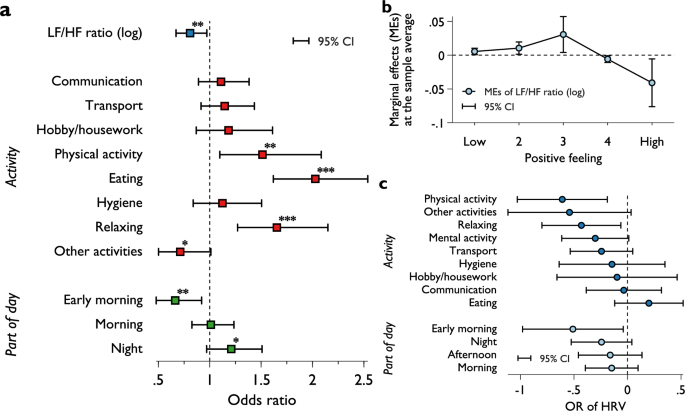
4.2. Effects by Activity Type and Time of Day
Effects by activity type:
- Participants reported the most positive emotions during exercise, eating, and rest (odds ratios approximately 50%, 100%, and 70% higher than mental activity/work).
- Other non-work activities tended to have positive effects, though not statistically significant.
- The finding that non-work activities overall had a positive effect was statistically significant, indicating lower self-reported positive affect during mental activities.
- In contrast, physiological stress (LF/HF ratio) was lowest during physical activity, followed by travel, hygiene, and hobbies/housework. Interestingly, eating and rest did not significantly lower the LF/HF ratio.
Effects by time of day:
- Participants reported increasingly positive emotions as the day progressed. They were more positive in late hours (5 PM to midnight) and more negative in early morning (midnight to 6 AM).
- However, the LF/HF ratio was lowest during early morning activities and highest in the afternoon. For most activities, the LF/HF ratio increased throughout the day, peaking in the afternoon.
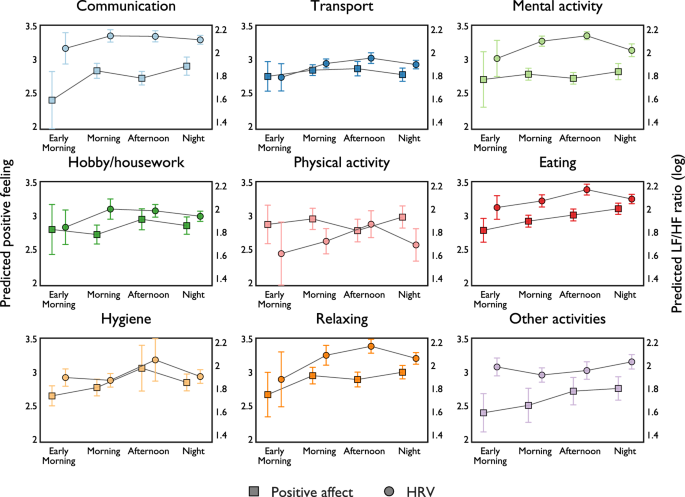
The figure above shows how positive affect (square markers) and physiological stress (circle markers) change according to activity type and time of day. While positive affect increases as the day progresses, physiological stress tends to peak in the afternoon.
4.3. Effects of Activity Duration
Activity duration also influenced our emotions and stress levels.
- For activities like eating, hygiene, communication, and hobbies/housework, longer durations were associated with higher positive affect.
- In contrast, mental activity and rest showed no change in positive affect with longer duration, and travel time showed decreased positive affect with longer duration. This is likely because people voluntarily extend enjoyable leisure activities but have less control over work or commute times.
- In fact, long commutes and hygiene activities were found to increase physiological stress (elevated LF/HF ratio).
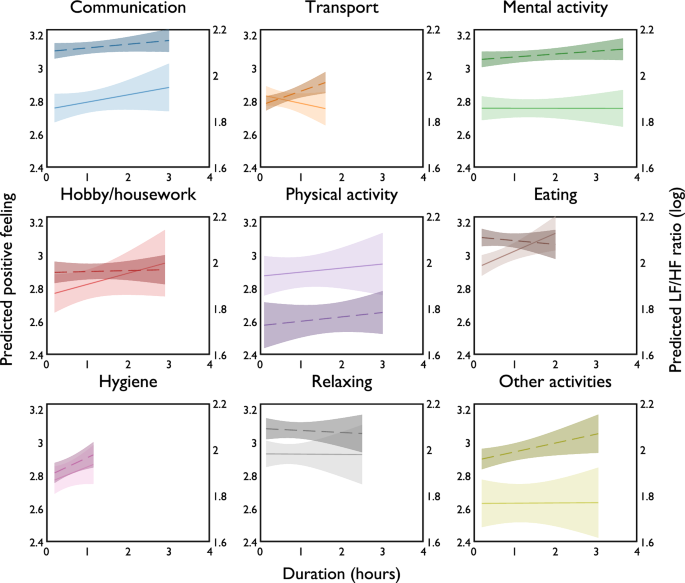
This graph shows changes in positive affect (solid lines) and physiological stress (dashed lines) by activity duration. The increase in physiological stress with longer commuting and hygiene activities is notable.
4.4. Effects of Past and Future Activities (Anticipation and Expectation)
A major advantage of our study was the ability to explore how previous activities affect the next, and how anticipation of future activities influences positive affect.
-
Effects of previous activities:
- Participants reported higher positive affect during activities following physical activity, eating, and rest (1.6x, 2.1x, and 1.7x higher than following mental activity, respectively).
- These effects were limited to the immediately preceding activity and did not extend to earlier activities.
-
Effects of next activities (anticipation):
- Self-reported positive affect was higher when the next activity was physical activity (1.34x higher).
- No significant changes in positive affect were observed before or after communication, travel, hobbies/housework, hygiene, or sleep.
Railton states: "The anticipating mind must simulate and 'see and feel' what the future will be like, thereby treating future possibilities as equivalent to what is actually seen and felt in the present."
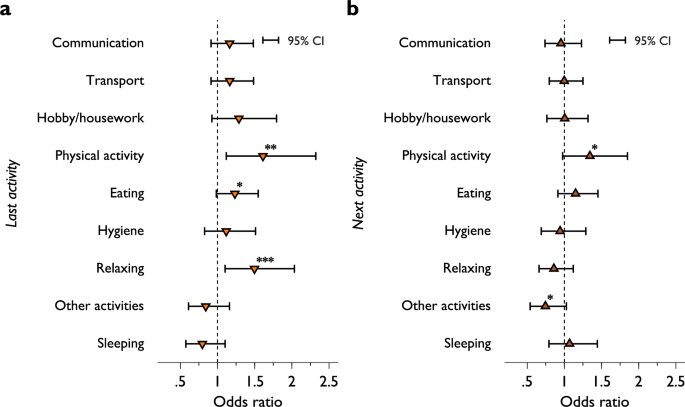
This figure shows the effects of previous activities (A) and next activities (B) on current positive affect. Higher positive affect following physical activity, eating, and rest is clearly visible.
Importance of activity sequences:
- During hobbies/housework, participants were more positive when the previous activity was travel, physical activity, or hygiene, and more negative after sleep.
- During physical activity, positive affect was enhanced when the previous activity was hobbies/housework.
- During eating, positive affect decreased when the previous activity was hygiene, but increased when it was communication or rest.
- Finally, during rest, self-reported positive affect improved when the previous activity was physical activity, eating, or hygiene.
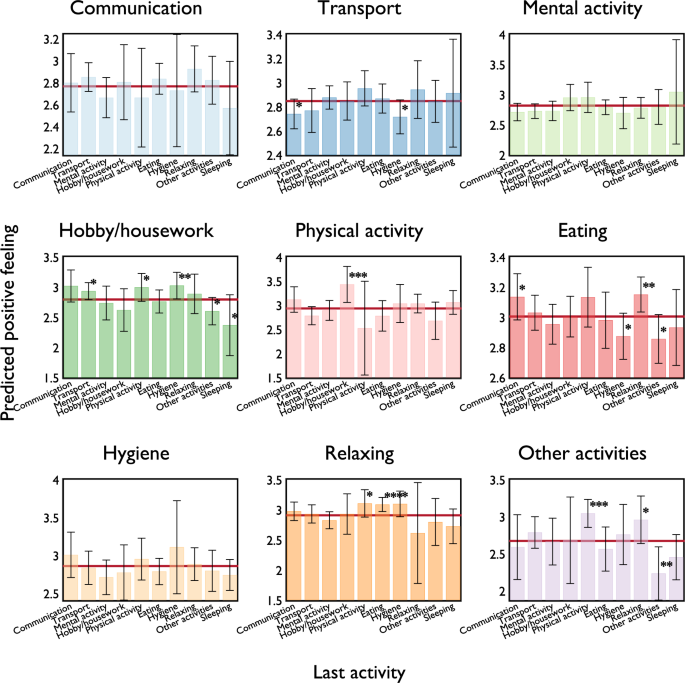
This graph shows the effect of previous activities on current positive affect for each activity combination, providing intuitive understanding of how specific activity sequences affect mood.
5. Discussion
The first objective of this study was to explore the association between subjective survey data and objective physiological measurements (HRV). Thanks to technological innovations like wearable biosensors, new measurement methods for tracking physiological states throughout the day have emerged. Through repeated observations across approximately 300 individuals over 24 hours covering 5,000 activities, we were able to perform within-person analyses while avoiding errors from individual heterogeneity.
In conclusion, we confirmed a strong positive association between self-reported psychological state and objective physiological state measured by HRV. This is good news, demonstrating that self-reported positive affect or hedonic well-being data is a reliable measure! Social sciences tend to rely on subjective data, and these findings support the reliability of such data.
Such self-report data is frequently used to evaluate the impact of health, psychological, and educational interventions on individual well-being or positive affect. Even more important for social scientists is the suggestion that not only GDP but also bottom-up measures of self-reported well-being should be reflected in public policy. Our findings suggest that attempts by the OECD and other countries to measure positive affect (particularly self-reported subjective well-being) as social progress indicators and policy decision tools are meaningful. At the same time, detailed high-frequency data from biosensors provides opportunities for continuous longitudinal measurement, suggesting more research is needed to complement survey results.
Regarding activities:
- Exercise, eating, and rest were associated with the strongest positive affect, and physical activity had the greatest effect in lowering physiological stress.
- Notably, a positive spillover effect was found where participants reported higher positive affect in subsequent activities after physical activity. The same was true after eating and rest.
- People's moods tended to become more positive as the day progressed, possibly related to a sense of accomplishment or biological changes like declining cortisol levels.
- However, the LF/HF ratio was lowest during early morning activities and peaked in the afternoon, increasing throughout the day for most activities.
- Activities like eating, hygiene, communication, and hobbies/housework showed higher positive affect with longer duration. But less controllable activities like commuting showed increased physiological stress with longer duration. This is consistent with existing well-being research showing commuting increases stress and decreases life satisfaction. Perhaps people don't properly recognize the costs of commuting?
These results are largely consistent with other well-being literature. For example, communication with others is positive and aids emotion regulation; long commute times increase stress and decrease positive affect. Mental activity results are consistent -- positive thinking improves mood while negative thinking increases stress, anxiety, and depression. Physical activity promotes growth and development and improves mood; even small amounts of housework or hobbies can help. Eating is associated with positive affect, and rest improves mood, though prolonged inactivity can trigger negative feelings. Hygiene activities like bathing can also enhance positive affect.
Conclusion
This study used heart rate variability (HRV) data to better understand how the duration of individual activities affects our mood. For example, long meetings or communication times increase stress, as does too much mental or physical activity. In contrast, extended eating or sufficient rest barely change stress levels (LF/HF ratio), likely because these activities are enjoyable and require little physical or mental effort. Ultimately, activity duration can affect our mood and HRV in different directions.
Additionally, our study provided insights into how prospection (anticipation of the future) influences positive affect. Emotions are not merely reactions to the past and present but are inherently related to the process of predicting the future. Activity protocols can offer methods to reduce conceptual and methodological errors when exploring the future by increasing control. Although we couldn't determine what participants were thinking during activities (such as how they were planning the future), we obtained several consistent findings. For example, higher positive affect was reported when the next activity was physical activity, and resting after exercise, bathing, or eating proved beneficial.
Recommendations
We demonstrated that real-time data collection is a reliable real-time method for measuring emotion (positive affect). While the expensive medical-grade heart rate monitors and medical protocols used in this project may not be available to all researchers, wearable devices like Apple Watch, Fitbit, and Garmin are now dynamically collecting diverse data including pulse, heart rate, HRV, and stress -- meaning a new frontier for research is accessible to everyone.
Using data from these affordable devices along with the data preparation and analysis methods presented in this paper, it will be possible to dynamically capture thought processes related to individual well-being and stress levels in even greater detail. Furthermore, the real-time time-series data these devices provide enables exploration of well-being questions that were previously difficult to access due to data scarcity or recall bias in surveys -- questions such as how anticipation and adaptation affect current mood, stress, or the impact of life events. Such research could provide deep insights into events occurring months or years before well-being surveys are completed.